Blog
AI Crawler Access Audit: How to Check Whether AI Assistants Can Read Your Site
Run an AI crawler access audit in five layers: robots.txt, CDN/WAF rules, rate limits, origin and rendering. Includes a per-bot policy table and owner model.
AEO agency pricing for B2B SaaS: retainer bands from $3K to $30K+ a month, break-even math for the CFO, a stage-gate plan and a kill criterion.
 Ishan ManchandaNov 8, 2026

Run an AI crawler access audit in five layers: robots.txt, CDN/WAF rules, rate limits, origin and rendering. Includes a per-bot policy table and owner model.

A vendor-neutral scorecard for choosing who can help you get cited in AI answers: metrics, attribution, kill criteria, contract terms and break-even math.
AI search visibility platforms cost $99 to $20,000 a month. See dated price bands by source and the break-even math: 0.4 to 1.6 deals at $30K ACV.
Request a quote and our experts will contact you within 24 hours with tailored solutions and pricing.
Last updated: Nov 8, 2026
By Ishan Manchanda, co-founder of GrowthSpree. Updated October 28, 2026. Disclosure: aeogeo.com is a GrowthSpree property, and GrowthSpree sells the managed service Salient. Figures for that service are labeled vendor-reported.
Answer engine optimization (AEO) agency pricing is the monthly retainer a firm charges to get a brand cited in AI answers, and published B2B SaaS bands run from $3K to $30K or more per month (Loudface, 2026). A six-month engagement at $1,500 to $6,000 a month commits $9,000 to $36,000 before the first leading indicator. For a CMO or founder, the sticker price is not the real question. The question is how many closed deals repay it, and what contract language stops the spend if nothing moves. This guide covers the price bands, the break-even arithmetic, the tools-versus-agency choice, a stage-gate plan for small teams and a kill criterion. For vendor selection, see how to choose an AEO or GEO agency.
Key Takeaways
- Published B2B SaaS AEO retainers run from $3K to $6K per month at entry level to $15K to $30K or more at enterprise level, and these are vendor-published bands, not market research.
- A six-month AEO or GEO retainer costs $9,000 to $36,000, which breaks even at 0.4 to 1.6 deals at $30,000 ACV and 75% gross margin.
- AEO tools cost $10 to $1,000 per month but only measure; agencies and in-house staff do the fixing.
- A company under 50 people with no marketing hire can stage-gate the spend: baseline first, a 90-day sprint second, renew or exit third.
- Every AEO or GEO contract should state a kill criterion, a 90-day exit and no auto-renewal before signing.
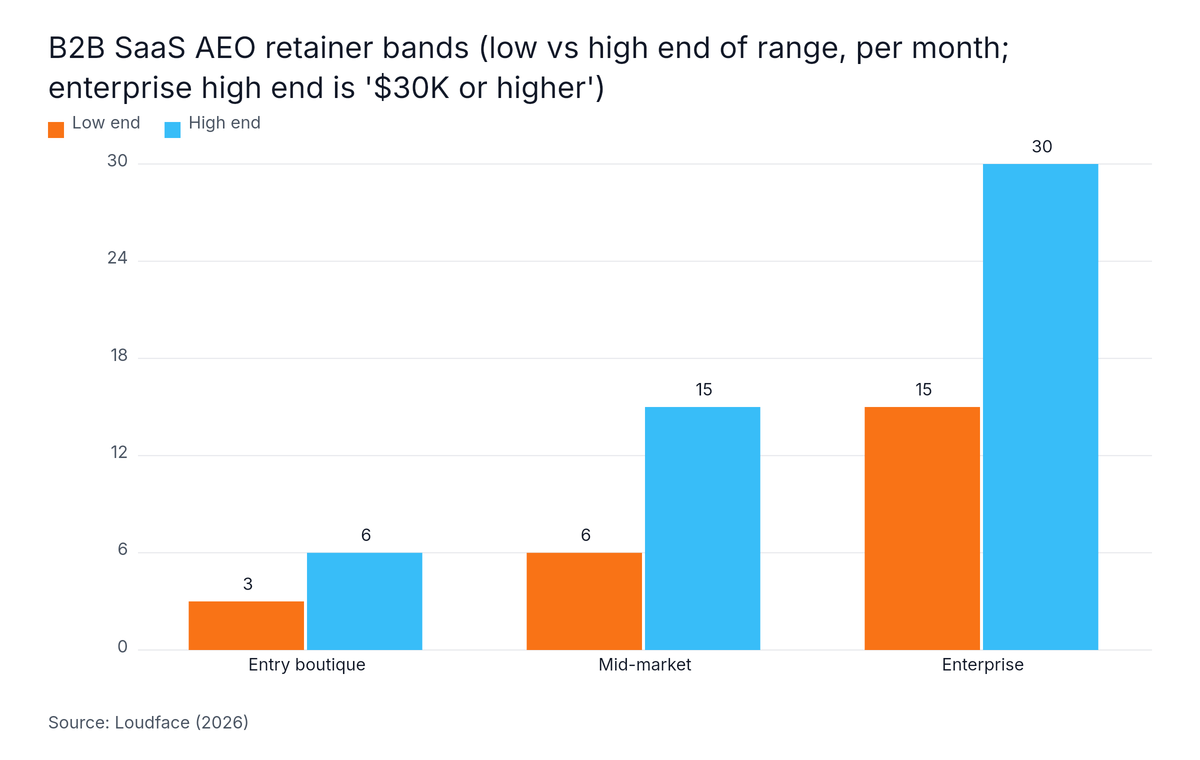
AEO agency pricing in 2026 is a monthly retainer, and published bands are wide: Loudface lists B2B SaaS entry retainers at $3K to $6K, mid-market at $6K to $15K and enterprise at $15K to $30K or more per month (Loudface, 2026). A six-month engagement should include a baseline, a fixed prompt set, monthly deliverables and reporting against agreed leading indicators.
Source: Loudface, 2026
The chart shows the low end of each Loudface band: $3K per month for entry boutique, $6K for mid-market and $15K for enterprise. The enterprise band tops out at $30K or higher.
A retainer is a fixed monthly fee for an agreed scope of work, usually on a minimum term. Four agency-side sources, all published in 2026, give overlapping but inconsistent ranges.
| Source | Published band (per month) | What it describes |
|---|---|---|
| Loudface (2026) | $3K to $6K entry; $6K to $15K mid-market; $15K to $30K+ enterprise | B2B SaaS retainers |
| Revv Growth (October 2026) | $3,000 to $12,000 ongoing; $15,000 to $50,000+ enterprise | Ongoing AEO services |
| WebFX, compiled by itgrows.ai (October 2026) | $1,500 to $5,000 small; $5,000 to $25,000+ mid-sized; $25,000 to $50,000+ enterprise | GEO retainers by business size |
| Teknicks (2026) | $1,500 to $50,000+ agency; $10 to $1,000 tools | Agency and managed GEO services |
Sources: Loudface (2026), Revv Growth (2026), itgrows.ai (2026), Teknicks (2026).
Treat the table as a vendor price survey: a set of ranges that sellers publish about their own services. The itgrows.ai compiler says plainly that there is no independent market study of GEO prices (itgrows.ai, 2026).
Higher tiers mostly add volume, channels and measurement. Loudface describes the entry boutique tier as one to three pieces, a single channel and no AI citation tracking. It describes mid-market as 5 to 10 pieces, multiple channels and measurement tooling (Loudface, 2026). Revv Growth prices its own packages from $3,000 per month for 10 articles to $8,000 per month for 40 articles (Revv Growth, 2026).
When a quote arrives, split it into four parts: tools, method, execution and outcomes. Ask which part you are paying most for. A quote that bundles a tool license into the retainer is not comparable to one that excludes it.
Three structures appear in the published sources. Pick the one that matches your capacity to act on the work.
| Structure | Published cost | Best for |
|---|---|---|
| Monthly retainer | $3K to $6K entry for B2B SaaS (Loudface, 2026) | Teams with no internal capacity |
| 90-day sprint | $5K to $10K per month (Organik PI, 2026) | High-competition categories needing speed |
| Tools only | $10 to $1,000 per month (Teknicks, 2026) | Teams with a practitioner to act on data |
Teknicks says most B2B SaaS engagements are retainer-based (Teknicks, 2026). For a defensible budget, aeogeo.com's working assumption is $1,000 to $3,000 per month or staff time only for small companies, and $1,500 to $6,000 per month for SMEs. These are aeogeo.com estimates, not market data.
For one reference point, Salient by GrowthSpree lists $999 and $1,500 per month on six-month terms, and reports 48,800 citations and $165,000+ pipeline across its clients (Salient pitch deck, 2026). These figures are vendor-reported, not independently verified, and not a recommendation.
A six-month AEO contract should read like a work plan with a gate in the middle. Check for these items:
For the technique side of the work, see what has evidence behind it.
A generative engine optimization (GEO) engagement breaks even when gross profit from won deals equals retainer spend. At $30,000 ACV and 75% gross margin, each deal yields $22,500, so six months at $1,500, $3,000 and $6,000 a month ($9,000, $18,000 and $36,000) needs 0.4, 0.8 and 1.6 deals.

Break-even deals is total spend divided by (ACV × gross margin). The arithmetic is short enough for a CFO to check line by line.
| Monthly retainer | Six-month spend | Break-even at $30K ACV, 75% margin | Break-even at $100K ACV, 75% margin |
|---|---|---|---|
| $1,500 | $9,000 | 0.4 deals | 0.12 deals |
| $3,000 | $18,000 | 0.8 deals | 0.24 deals |
| $6,000 | $36,000 | 1.6 deals | 0.48 deals |
Our data: At $30,000 ACV and 75% gross margin, break-even is 0.4 deals at $1,500/month, 0.8 at $3,000/month and 1.6 at $6,000/month. At $100,000 ACV the same spend breaks even at 0.12, 0.24 and 0.48 deals. These are illustrative models, not guarantees.
Cash out before the first leading indicator at day 90 is half the six-month total: $4,500 at $1,500 a month, $9,000 at $3,000 and $18,000 at $6,000. Put that number beside the break-even table. It is what you lose if the kill criterion fires at month three.
AI referral traffic is small. Conductor found it averaged 1.08% of total website traffic across 10 industries, in a dataset weighted toward enterprise customers (Conductor, 2025). Click behavior explains part of this. Pew Research found that "Those who did not encounter an AI summary clicked on a search result nearly twice as often (15 percent of visits)" (Pew Research Center, via The Register, 2025).
Fewer visits means the case must rest on how well those visits convert. The best-known upper bound is a single company. Ahrefs reported that 0.5% of its visitors drove 12.1% of signups (Ahrefs, 2025). In the words quoted by PPC Land, "AI search visitors convert at a 23x higher rate than traditional organic search visitors for Ahrefs" (Ahrefs, as quoted by PPC Land, 2025). This is one property's result, not a benchmark. Use it as a ceiling, not a planning input. A conservative case assumes no conversion premium and still shows the deal count.
Tools cost $10 to $1,000 per month while agency and managed GEO services span $1,500 to $50,000+ (Teknicks, 2026), so the hire-or-build choice turns on who does the work. Tools measure citations; agencies and in-house staff produce the fixes. One agency framework advises building in-house below about $50,000 of annual AEO budget (Organik PI, 2026).

| Option | Typical cost | What you get | Fits when |
|---|---|---|---|
| Tools only | $10 to $1,000 per month | Citation and prompt tracking | A practitioner on staff can act on the data |
| In-house | Staff time, no vendor fee | Full control and learning | Annual AEO budget is under about $50,000 |
| Agency sprint | $5K to $10K per month for 90 days | Execution and a fast baseline | Competition is high and speed matters |
| Agency retainer | $3K to $30K+ per month | Ongoing content, fixes and reporting | No internal capacity and a CFO-approved case |
Prices are from Teknicks (2026), Organik PI (2026) and Loudface (2026). Organik PI is an agency, so its build-in-house advice cuts against its own interest. For the full decision, read in-house AEO team vs agency retainer, and compare tooling in AI search visibility tools for B2B SaaS.
Google's May 2026 guide for site owners says, in its own words, "From Google Search's perspective, optimizing for generative AI search is optimizing for the search experience, and thus still SEO" (Google Search Central, via DemandSphere, 2026). So ask any agency which deliverables go beyond SEO fundamentals. If your team already does SEO well, the incremental work is narrower and cheaper. The AEO vs traditional SEO overlap is worth mapping before any quote.
A stage-gate AEO program releases money in steps: a baseline and crawler-access fix that costs staff hours, a 90-day sprint, then a renew-or-exit decision. For a 25-person company with no marketing hire, that limits cash out before the first verdict to $4,500 to $18,000 at $1,500 to $6,000 a month, instead of a six-month commitment.

A stage-gate is a funding method where each phase has a pass test, and money for the next phase is released only if the test is met.
| Gate | Timing | Cash | Pass test |
|---|---|---|---|
| 0. Baseline | Weeks 1 to 2 | Staff hours only | Crawlers can read public pages; prompt set written; "AI assistant" added to the lead form |
| 1. Sprint | Days 1 to 90 | $4,500 to $18,000 | Citation frequency on the fixed prompt set has moved, and AI-referred sessions or self-reported leads appear |
| 2. Renew or exit | Day 91 onward | Remaining months of the term | Gate 1 test met; otherwise exit |
An agency sprint of 90 days is the exception one agency framework names for high-competition categories, at $5K to $10K per month (Organik PI, 2026). Smaller scopes exist too, and published entry bands start near $1,500 per month (Teknicks, 2026). Choose by scope, not by headline price.
A kill criterion is a result agreed before signing that ends the engagement if it is missed. Write it into the contract in four lines:
Use repeated runs, never a single check, because AI answers can differ from one run to the next. Citations, not clicks, are the early signal, since clicks fall when an AI summary appears.
No neutral ranking of GEO agencies exists, and 41.5% of companies now report using GEO (Duke Fuqua Insights, 2026), so vetting matters. The compiler of October 2026 price roundups says there is no independent market study of GEO prices (itgrows.ai, 2026), and case studies are self-reported. Early-stage SaaS experience is something to verify with a named client at your stage, not assume.

The Duke survey was the 35th edition of The CMO Survey and the first to ask about GEO, which signals a mainstream budget category with few independent benchmarks. Use these six questions, in this order:
Treat vendor results as claims to verify, including the vendor-reported figures quoted earlier in this guide. Ask every shortlisted agency for the same evidence. A scorecard approach is covered in how to evaluate and shortlist an AEO or GEO agency.
An AEO and GEO pricing guide built on vendor-published bands has real limits. The price ranges come from agencies selling the service, the break-even model is illustrative and not financial advice, and Google's May 2026 guidance treats generative search optimization as still SEO. Three kinds of company should treat this guide with caution.
Use tools when you need measurement and have staff to act on the findings, and hire an agency when you lack the time or skills to produce the fixes. Tools cost $10 to $1,000 per month, while agency retainers start around $1,500 (Teknicks, 2026). Tools show where you are cited. They do not write or repair the pages.
Hiring an AEO agency costs between $1,500 and $50,000 or more per month depending on scope, according to published agency price lists (Teknicks, 2026). For B2B SaaS, entry retainers run $3K to $6K per month (Loudface, 2026). A six-month term at $1,500 to $6,000 a month totals $9,000 to $36,000.
A typical AEO agency retainer is $3,000 to $12,000 per month for ongoing services (Revv Growth, 2026), but no source publishes what contracts usually contain. A sound contract should specify a baseline phase, named leading indicators, a 90-day exit clause, no auto-renewal and ownership of your data.
Small businesses without a marketing team can start with a staged plan instead of a full retainer: fix crawler access, add an AI assistant option to the lead form, and run a 90-day sprint before committing to six months. One agency framework suggests building in-house below roughly $50,000 of annual budget (Organik PI, 2026).
Do it in house if you have a practitioner with spare hours and an annual AEO budget under about $50,000, and hire an agency when speed or missing skills matter more than cost (Organik PI, 2026). A hybrid works well: staff own the baseline and measurement, and an agency runs a time-boxed sprint with a kill criterion.
Six months of AEO or GEO work costs $9,000 to $36,000 at the retainers discussed here, and the decision gets easier once the arithmetic is on one page.
Get the weekly brief for dated platform changes and pricing updates, each tied to one action for your team.
Written by
Ishan Manchanda
Ishan Manchanda is co-founder of GrowthSpree, a B2B SaaS marketing consultancy founded in 2017 that has managed $60M+ in ad spend across 300+ B2B SaaS companies. He focuses on demand generation, go-to-market strategy and pipeline growth, and has been featured in Silicon Valley Times, SaaS Mag and the Unbounce podcast.