Blog
AI Crawler Access Audit: How to Check Whether AI Assistants Can Read Your Site
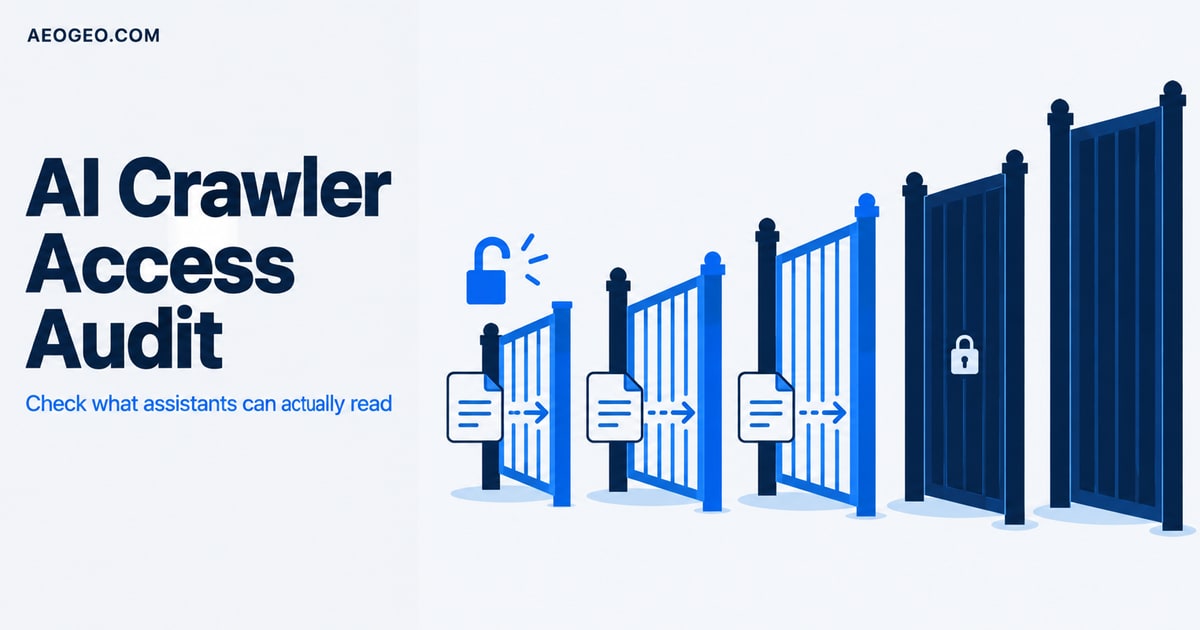
Run an AI crawler access audit in five layers: robots.txt, CDN/WAF rules, rate limits, origin and rendering. Includes a per-bot policy table and owner model.
AI citation tracking reports how often assistants cite your brand across repeated runs. Get the method, the competitor gap rule and CRM fields finance accepts.
 Ishan ManchandaNov 4, 2026

Run an AI crawler access audit in five layers: robots.txt, CDN/WAF rules, rate limits, origin and rendering. Includes a per-bot policy table and owner model.
A vendor-neutral scorecard for choosing who can help you get cited in AI answers: metrics, attribution, kill criteria, contract terms and break-even math.
AI search visibility platforms cost $99 to $20,000 a month. See dated price bands by source and the break-even math: 0.4 to 1.6 deals at $30K ACV.
Request a quote and our experts will contact you within 24 hours with tailored solutions and pricing.
aeogeo.app
Last updated: Nov 4, 2026
By Ishan Manchanda, co-founder of GrowthSpree. Last updated October 28, 2026. GrowthSpree is affiliated with this site.
AI citation tracking is the practice of repeatedly prompting AI assistants with a fixed set of buyer questions and recording how often, and from which sources, they cite or recommend your brand. A team that checks once and reports "zero citations" may simply be measuring wrong. This guide explains what AI citation tracking measures, why single checks fail, and how to connect the results to the CRM fields a CFO will accept. Teams comparing software can start with this guide to picking an AI visibility tool, but the method comes first.
Key Takeaways
- AI citation tracking reports citation frequency (cited in x of N runs), not a single point-in-time mention.
- A page cited in 14 of 50 runs has a 28% citation rate (our arithmetic), yet a single check can easily show "not cited".
- Ranking well in organic search does not predict AI citation: only about 11-12% of AI-cited URLs overlap with Google and Bing top 10 results (Ahrefs, 2025).
- Competitor citation gaps are read by prompt cluster, platform and cited source domain, and the fix is often a third-party source.
- Pipeline mapping needs an "AI assistant" lead-source value, self-reported attribution and first-party CRM data, not vendor benchmarks.
AI citation tracking measures how often AI assistants such as ChatGPT, Perplexity and Gemini cite or recommend a brand across repeated runs of a fixed prompt set. It matters for B2B pipeline because buyers see answers, not links: Pew found users clicked a result link in 8% of visits with a Google AI summary, against 15% without (Pew via Search Engine Roundtable, 2025).
A prompt set is a locked list of buyer questions, grouped by persona and buying stage, that is run the same way every cycle. Citation frequency is the share of repeated runs in which an assistant cites or recommends your brand. Together they turn a vague "are we visible?" into a number with a sample size.
Three things are worth separating:
Mixing these produces numbers nobody can defend. G2's March 2026 survey (n=1,076) found 51% of B2B software buyers start research with an AI chatbot, and 69% chose a different vendor than planned because of a chatbot recommendation. Forrester (2026) reports that 94% of business buyers use AI during buying, so the answer a buyer sees often shapes the shortlist before sales is involved.
A single AI citation check misleads because AI recommendations are non-deterministic. SparkToro and Gumshoe.ai analysed 2,961 runs and found fewer than 1 in 100 repeat runs returned the same brand list (SparkToro, 2026). A page cited in 14 of 50 runs, a 28% rate by simple division, can still look "not cited" in one check.

Fourteen citations in 50 runs is 28% (14 divided by 50, our own arithmetic, not a third-party figure). One run might catch the page and the next might miss it, so any single reading is a coin flip with a bias toward "not cited". Report "cited in 14 of 50 runs" with the run count. A confidence interval is a range that shows how far a measured rate could sit from the true rate, and it narrows as runs increase.
Academic work agrees. A 2026 paper titled "Don't Measure Once" (arXiv, 2026) argues for repeated sampling and uncertainty reporting. SparkToro's analysis used 60 to 100 runs per prompt in its design, a useful reference for how much sampling serious work involves.
| Design choice | Weak practice | Reportable practice |
|---|---|---|
| Runs per prompt | One check | Many repeated runs, count stated |
| Output | Yes or no | Frequency with a range |
| Prompt set | Edited ad hoc | Locked per quarter |
| Metrics | Mention count only | Mentions, citations and share of answers separated |
| Change log | None | Model and version changes recorded |
An AI visibility analysis tool should report citation frequency across repeated runs, per-competitor citation share, cited source domains, and the split between mentions and linked citations. This vendor-neutral checklist is not a ranking. For a wider view of the software category, see AI search visibility tools for B2B SaaS.
| Criterion | What to look for | Why it matters |
|---|---|---|
| Runs per prompt | Configurable, count shown | Frequency needs a stated sample size |
| Uncertainty | Confidence interval or range | Stops a single reading becoming "the number" |
| Platform coverage | ChatGPT, Perplexity, Gemini reported separately | Platforms cite different sources |
| Competitor share | Citation frequency per named competitor | Feeds the citation gap |
| Source drill-down | Cited domains and URLs per answer | Shows where the fix sits |
| Export | CSV or API to a BI tool or CRM | Lets finance audit and join the data |
Trackers probe synthetic prompts, not real buyer conversations, so treat every output as an estimate with a method attached. The criteria in this evaluation guide for marketing teams extend the list.
AI citation tracking matters for brands that already rank well because organic position does not predict citation. Ahrefs found that only about 11-12% of URLs cited by ChatGPT, Gemini, Copilot and Perplexity overlap with the top 10 results for the same query (Ahrefs, 2025). A brand can hold position one and still be absent from the answer.
The Ahrefs study ran 15,000 long-tail queries through Google and Bing, then put them to four assistants. The headline says 12% and the body says 11%, so "about 11-12%" is the safe wording. Platforms differ too. A separate Ahrefs finding states: "ChatGPT cites ranking domains ~3X more than ranking pages." (Ahrefs, 2025) The domain may be recognised even when the specific ranking page is not the one cited.
Clicks are thinning as well. Because only 8% of visits with a Google AI summary led to a traditional result click, against 15% without, position tracking misses both the answer a buyer sees and the click that no longer happens. Test it yourself: pick 10 queries where you rank in the top 3 and check whether you are cited.
Tracing competitor citations means recording, for each prompt cluster and platform, which domains the assistant cites and how often. The citation gap is the difference between a competitor's frequency and yours on the same prompts. McKinsey's State of the Consumer 2026 report found brand-owned sites supply about 1% of LLM-cited sources in consumer goods (McKinsey, 2026), so many fixes sit on third-party sources.

That figure comes from consumer goods, not B2B software, so treat it as a direction and test it in your own category. McKinsey's State of the Consumer 2026 report also warns that inconsistent third-party information lowers reliable inclusion of a brand.
Build a grid of prompt cluster by platform by cited source domain. Then rank gaps where a competitor's frequency is high and yours is low.
| Pattern in the grid | Likely cause | First fix |
|---|---|---|
| Competitor cited via its own pages, you are absent | Your pages do not answer the exact question | Rewrite or add an answer-first page |
| Competitor cited via review or list sites you are not on | Third-party corroboration gap | Earn or correct third-party listings |
| Neither of you cited, third-party source dominates | Open slot in the category | Publish a source worth citing and seek mentions |
| You are cited at low frequency (for example 14 of 50 runs) | Partial coverage | Strengthen the cited page and re-measure |
Check access before content. A page an AI crawler cannot fetch or parse cannot be cited, and Cloudflare began blocking AI crawlers by default in July 2025. For a wider comparison of tools that cover crawler diagnostics and citation tracking, see the AEO and GEO tools comparison.
Mapping citations to pipeline means adding an "AI assistant" lead-source value, capturing self-reported attribution, and reporting opportunity amount against it. Gartner's 2026 survey of 645 B2B buyers found 45% used generative AI in a recent purchase and 69% validate AI insights with sales reps (Gartner via BizTech Reports, a secondary report, 2026), so influence shows up at the sales touchpoint.

Self-reported attribution is a form or call field where buyers say how they first heard of you. Analytics sees only the last hop, so AI-driven visits often land as "direct". The fields below carry the evidence from citation to revenue.
| CRM or finance field | What to record | What a CFO will accept |
|---|---|---|
| Lead source (original source) | New picklist value: "AI assistant" | First-party CRM data only |
| Self-reported attribution | Free text plus "ChatGPT, Perplexity, Gemini" options | Counts alongside, not instead of, tracked sessions |
| GA4 channel group | AI referral domains grouped as one channel | Labelled as a floor, not total influence |
| Opportunity amount and stage | Win rate, ACV and cycle by source | Compared with other sources in the same CRM |
| Citation frequency | Range and run count per prompt cluster | A trend line, never a single reading |
Published AI conversion figures conflict. Ruler Analytics' 2026 benchmark (110M sessions, 13 industries) put AI referral at 5.8% conversion, the highest of any source, against 4.9% for organic search (Wolfstone Digital, 2026). That is a secondary re-report, and other 2026 vendor benchmarks show far lower AI conversion numbers.
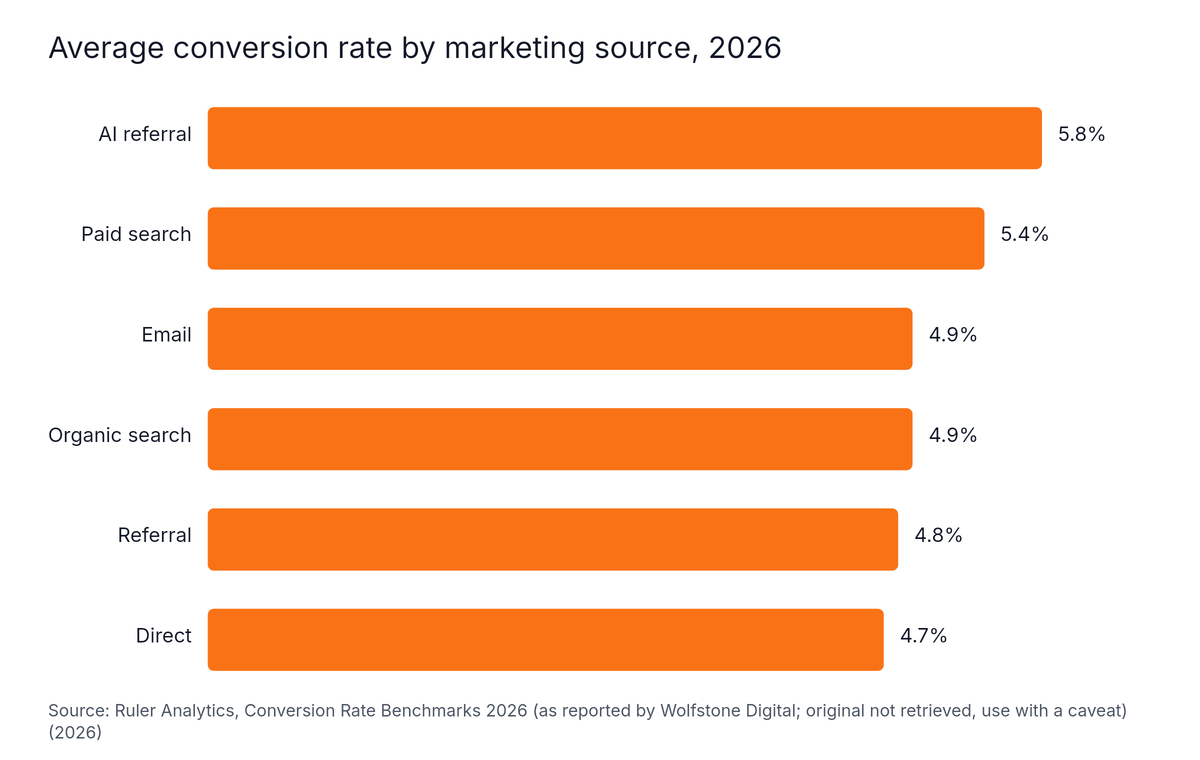
Source: Ruler Analytics, Conversion Rate Benchmarks 2026 (as reported by Wolfstone Digital; original not retrieved, use with a caveat), 2026
Invoca's July 2026 report, seen through a secondary analysis, found ChatGPT-referred calls qualified as leads 49% of the time against roughly 39% on average, but converted to a sale at 40% against 42% (Experience Karma, 2026). Report lead and sale stages separately, and use your own CRM numbers. The AEO ROI calculator guide shows how to turn them into break-even deals.
Our data: Salient by GrowthSpree, a managed AEO/GEO service affiliated with this site, reports 48,800 citations and $165,000+ pipeline across its clients (Salient pitch deck; Salient launched September 2026). This is vendor-reported and affiliated data, not independent research.
AI citation tracking is not for teams that want a single precise number, because trackers probe synthetic prompts rather than real buyer conversations. Pew's browsing study found only 1% of visits involved clicking a link inside an AI summary (Pew via Search Engine Roundtable, 2025), and Google disputed its methodology.
Who should skip it, or wait:
The honest limits:
An AI citation tracking tool handles non-determinism only if it runs each prompt many times and reports a frequency range, such as cited in 14 of 50 runs, rather than a single yes or no. Check for configurable runs per prompt, confidence intervals, and CSV or API export before trusting any dashboard figure.
A useful AI visibility tool for citation gaps reports citation frequency per named competitor, split by prompt cluster, platform and cited source domain. That grid shows where a competitor is cited often and you are cited rarely, which is where the content fix should start. Ask any vendor to show that drill-down on your own prompts.
Software is repeatable enough for a board pack when it locks the prompt set, states runs per prompt, reports ranges with confidence intervals, logs model changes, and exports raw data. Without those five features, quarter-on-quarter movement may be noise. Treat any single-run score as unsuitable for finance.
No tool is reliable by default; reliability comes from the sampling design. Finance should see citation frequency as a range with its run count, a locked prompt set, and raw exports it can audit. A tool that supports configurable repeated runs and shows uncertainty can meet that standard, while a one-pass score cannot.
A tool that tracks citations across ChatGPT, Perplexity and Gemini should run the same locked prompt set many times on each platform and log the share of runs that cite your brand, per platform. Report a range with its run count, and record model changes so trend breaks can be explained.
Most citation trackers stop at frequency, so the connection is usually built in the CRM. Add an "AI assistant" lead-source value, capture self-reported attribution, and report opportunity amount against it. Pick software that exports to a BI tool or CRM so citation trends can sit beside pipeline.
Run a fixed prompt set repeatedly on each assistant, then log date, platform, model version, whether the brand was named, which page was cited and which competitors appeared. Divide brand appearances by total runs to get a frequency, and report it as a range with the run count rather than a single reading.
Log the source domains and URLs cited in each answer where a competitor appears and you do not, grouped by prompt cluster and platform. The pattern shows whether the competitor wins through its own pages, review sites or third-party coverage, which decides whether the fix is a page or an outside mention.
AI citation tracking works when it reports ranges, not points, and when each range is tied to a CRM field. The key takeaways:
For choosing outside help, read how to choose an AEO or GEO agency. To keep up with platform changes and measurement methods, get the weekly brief.
Written by
Ishan Manchanda
Ishan Manchanda is co-founder of GrowthSpree, a B2B SaaS marketing consultancy founded in 2017 that has managed $60M+ in ad spend across 300+ B2B SaaS companies. He focuses on demand generation, go-to-market strategy and pipeline growth, and has been featured in Silicon Valley Times, SaaS Mag and the Unbounce podcast.