
Blog
Who Can Help Us Get Cited More in AI Answers? A Vendor-Neutral Buyer's Guide
A vendor-neutral scorecard for choosing who can help you get cited in AI answers: metrics, attribution, kill criteria, contract terms and break-even math.
Run an AI crawler access audit in five layers: robots.txt, CDN/WAF rules, rate limits, origin and rendering. Includes a per-bot policy table and owner model.
 Ishan ManchandaNov 7, 2026
A vendor-neutral scorecard for choosing who can help you get cited in AI answers: metrics, attribution, kill criteria, contract terms and break-even math.

AI search visibility platforms cost $99 to $20,000 a month. See dated price bands by source and the break-even math: 0.4 to 1.6 deals at $30K ACV.

No single platform proves AI search revenue. See what each measurement layer can and cannot prove, and how to report GEO results to a board as ranges.
Request a quote and our experts will contact you within 24 hours with tailored solutions and pricing.
aeogeo.app
Last updated: Nov 7, 2026
An AI crawler access audit is a layered test of whether bots such as GPTBot, OAI-SearchBot, ClaudeBot and PerplexityBot can fetch and read your pages, covering robots.txt, CDN and WAF rules, rate limits, origin responses and rendering. Most sites never made that decision on purpose: a 2026 census of 110,744 websites found only 21.3% block even one AI crawler (CipherCue, 2026). This guide gives revenue and engineering teams a pass or fail test per layer, a method for client-rendered docs, a per-bot policy table and an ownership model, so access is settled before any spend on AI search visibility tools.
Key Takeaways
- An AI crawler access audit tests five layers (robots.txt, CDN/WAF, rate limits, origin, rendering) and scores each one pass or fail per bot.
- Robots.txt can allow a bot while the CDN blocks it, so only live requests with each bot's user agent prove access.
- Client-rendered docs are probably unreadable to most AI crawlers, because those crawlers download JavaScript files but do not execute them.
- AI bots serve different purposes (training, search, user-triggered), so the right policy is per bot and per path, not allow-all or block-all.
- AI crawler access needs one named owner and a change-control habit, or marketing and security rules will override each other.
By Ishan Manchanda, co-founder of GrowthSpree, a B2B SaaS marketing consultancy founded in 2017. Updated October 28, 2026. Disclosure: aeogeo.com is a GrowthSpree property.
In this guide: what the audit is, how to run it before AEO spend, the robots.txt check, the CDN and WAF check, the client-rendered docs test, the per-bot policy, ownership, and limits.
An AI crawler access audit is a layered test of whether AI bots can fetch and read each class of page on a site. It checks five layers: robots.txt, CDN and WAF rules, rate limits, origin responses and rendering. Each layer gets a pass or fail per bot, because a page an AI crawler cannot fetch cannot be cited by an assistant.
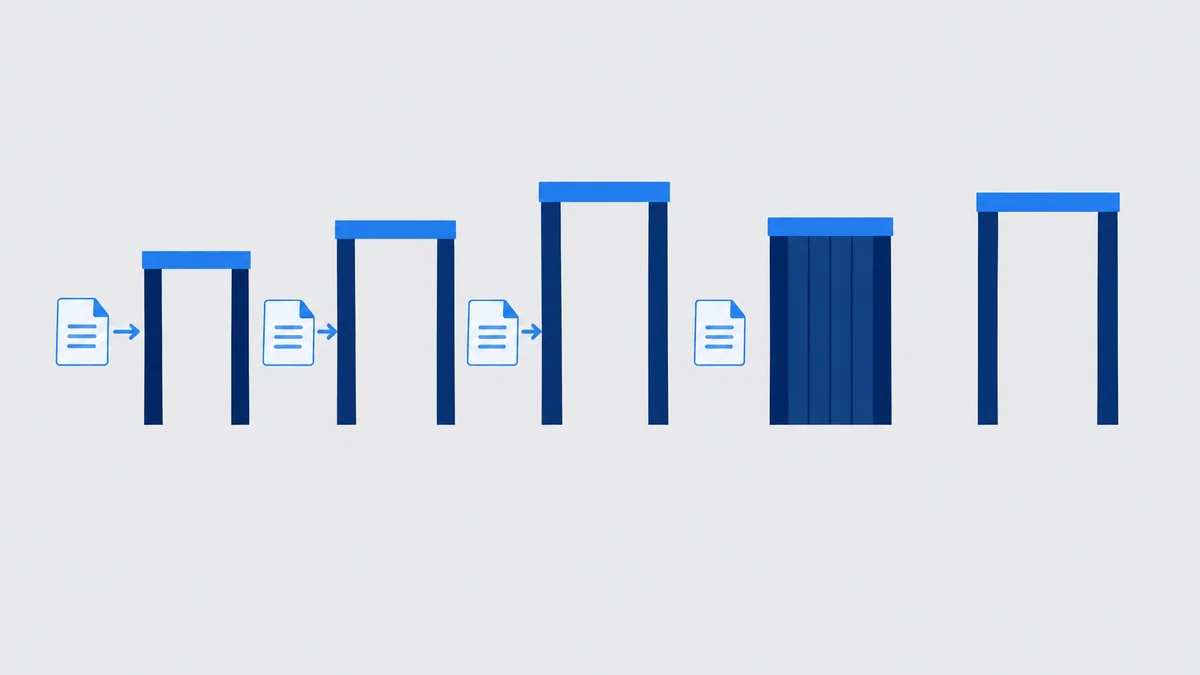
The audit exists because access is set in four places owned by four teams: robots.txt (marketing or SEO), CDN and WAF bot rules (infrastructure), rendering (front end) and logins or paywalls (product). Each team can switch AI visibility off without telling the others. Cloudflare Radar data showed bots at 57.5% of HTML requests in 2026 (nobori.ai, 2026), so these rules now govern most page fetches.
| Layer | What to test | Pass signal | Fail signal |
|---|---|---|---|
| robots.txt | Fetch the file on every hostname and read the group for each AI bot | Intended bots are allowed on public paths | Wildcard Disallow: / or a named block you did not intend |
| CDN and WAF | Request key pages with each bot's user agent from outside your network | HTTP 200 with the full page body | 403, challenge page or silent redirect |
| Rate limits | Repeat requests at a realistic crawl pace | No 429 responses | 429 or temporary bans |
| Origin | Compare edge logs with origin logs | Same page served at both layers | Edge says 200 but origin errors, or the reverse |
| Rendering | Diff raw HTML against the rendered page | Key text present in raw HTML | Text appears only after JavaScript runs |
A page needs a pass on all five layers for a given bot before it can be cited. One fail is enough to remove it.
Auditing whether AI crawlers can read a site before AEO investment takes five layered checks: robots.txt, CDN and WAF rules, rate limits, origin responses and rendering. The work costs hours, not a retainer. A census of 110,744 websites found only 21.3% block at least one AI crawler (CipherCue, 2026), so most sites have made no deliberate decision and defaults decide access.
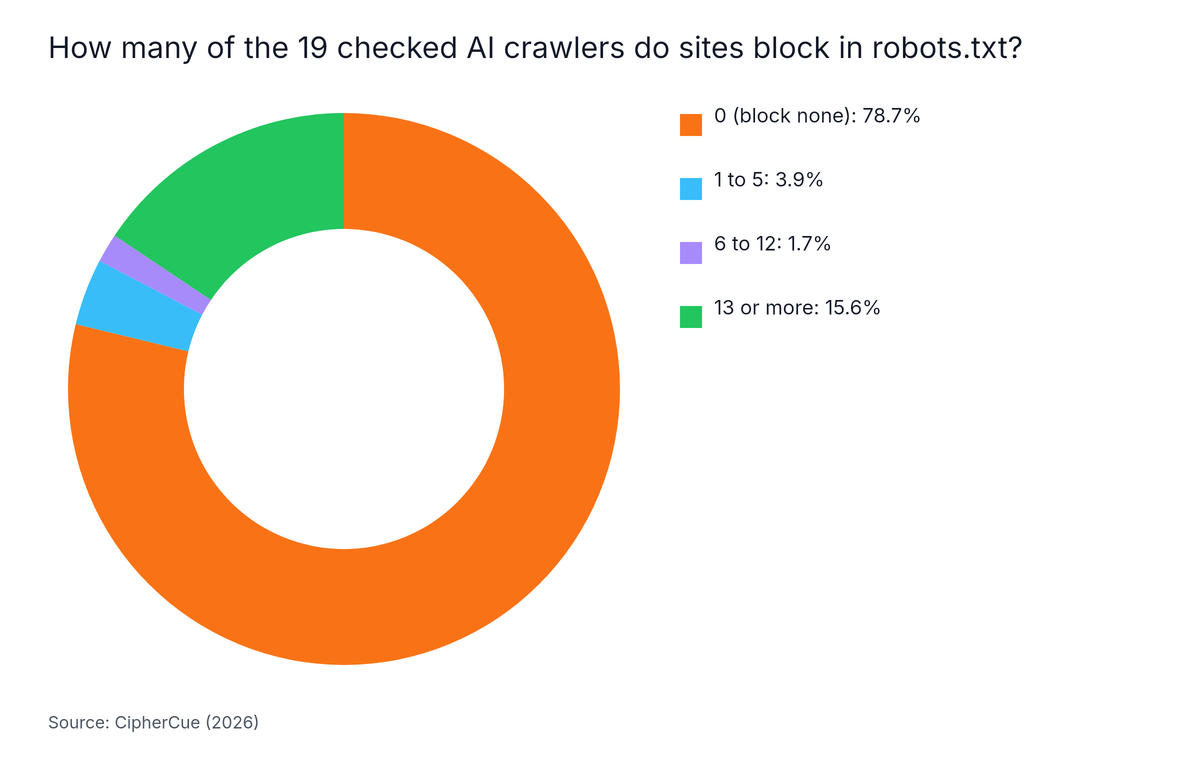
CipherCue checked those 110,744 sites against 19 AI crawlers in robots.txt (snapshot 8 October 2026, a vendor study with a stated method). Roughly four in five have added no AI-crawler rule at all. In the same data, 78.7% of sites block none of the 19 crawlers and 15.6% block 13 or more (CipherCue, 2026). Few sites make nuanced, per-bot choices.
Source: CipherCue, 2026
A second crawl points the same way. In a Q3 2026 robots.txt crawl of 1,744 sites, 84.2% had no AI crawler policy at all (AI Visibility UK, 2026, a small vendor sample, so directional). A CDN default, a security plugin or a migration can decide access for you.
Access does not mean traffic. In July 2026, chatgpt.com accounted for 0.913% of crawler referrals against 88.08% for Google (Cloudflare Radar, reported by ecorpit, 2026). Visibility can still matter, because assistants shape shortlists without sending a click. The audit costs hours, which is why it should be the first gate.
Our data: Salient by GrowthSpree, a sister service of aeogeo.com, reports 48,800 citations and $165,000+ pipeline across its clients (Salient pitch deck, company-reported, launched September 2026). Citations at that scale are only possible on pages crawlers can fetch.
A robots.txt audit for AI crawlers means fetching the file on every hostname, listing each AI user agent it names, and checking for wildcard rules that block everything. In a 2026 study of 4,962 robots.txt files from the top 10,000 sites, 177 files (3.6%) blocked every crawler with User-agent: * and Disallow: / (AICrawlerCheck, 2026).

robots.txt is a plain-text file at the root of a hostname that tells crawlers which paths they may fetch. It is advisory: well-behaved bots honor it, but it enforces nothing.
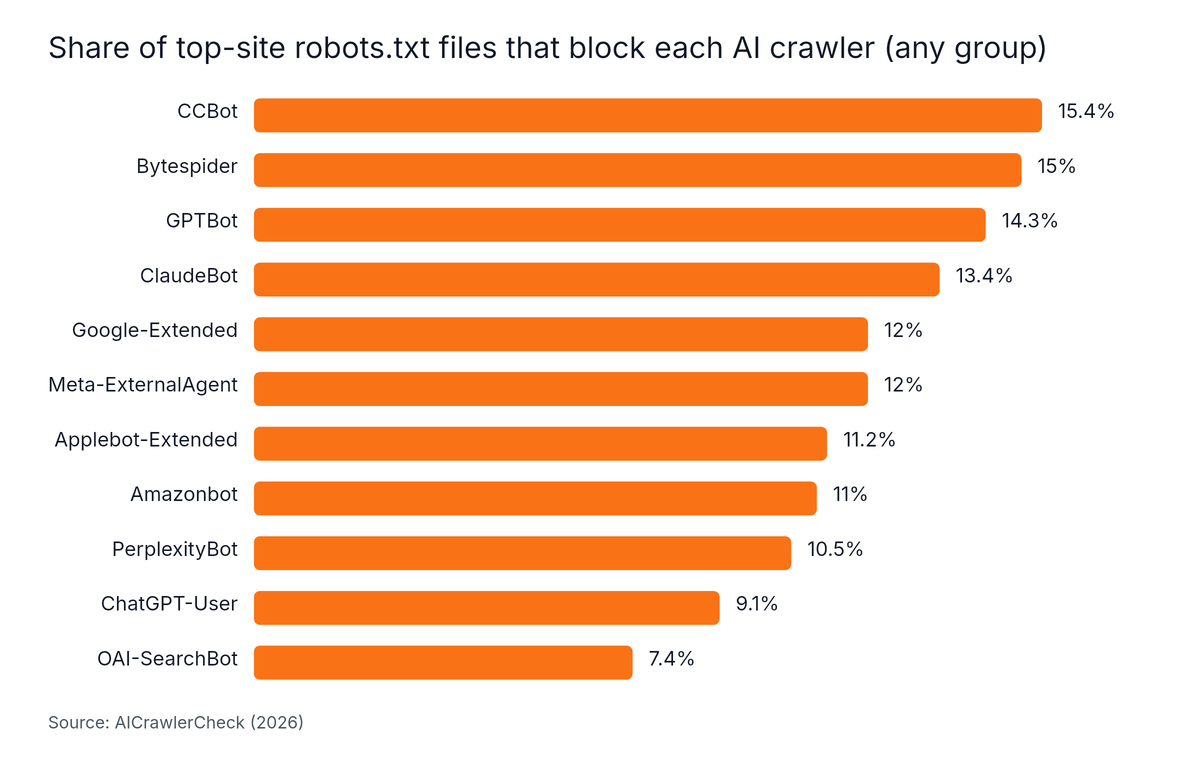
/robots.txt on every hostname you own: root domain, www, docs, blog, app and any regional site. Each hostname has its own file.User-agent: * groups with Disallow: /. These block AI bots that have no group of their own.Sites block training crawlers more often than search crawlers. AICrawlerCheck found that 19.2% block at least one AI training crawler and 10.8% block at least one AI search crawler (AICrawlerCheck, 2026). About half of GPTBot blockers still allow OAI-SearchBot. By named bot, CCBot (15.4%, AICrawlerCheck, 2026) and Bytespider (15%) are blocked most often, ahead of GPTBot at 14.3% (AICrawlerCheck, 2026).
| Bot | Primary purpose | Share of top-site robots.txt files blocking it (AICrawlerCheck, 2026) |
|---|---|---|
| CCBot | Training data crawl | 15.4% |
| Bytespider | Training | 15% |
| GPTBot | Training | 14.3% |
| ClaudeBot | Training | 13.4% |
| Google-Extended | Training control | 12% |
| PerplexityBot | Search | 10.5% |
| ChatGPT-User | User-triggered fetch | 9.1% |
| OAI-SearchBot | Search | 7.4% |
Source: AICrawlerCheck, 2026, vendor research on the top 10,000 sites, any group.
Source: AICrawlerCheck, 2026
Passing this layer proves only that the policy is not a block. The next layer decides whether the policy is honored at the edge.
Checking CDN and WAF bot policies means requesting key pages as each AI bot from outside your network and recording the status code, because robots.txt can say allow while the edge returns a 403, 429 or challenge. An AI crawler access checker automates that test. Cloudflare Radar data showed bots at 57.5% of HTML requests in 2026 (nobori.ai, 2026).
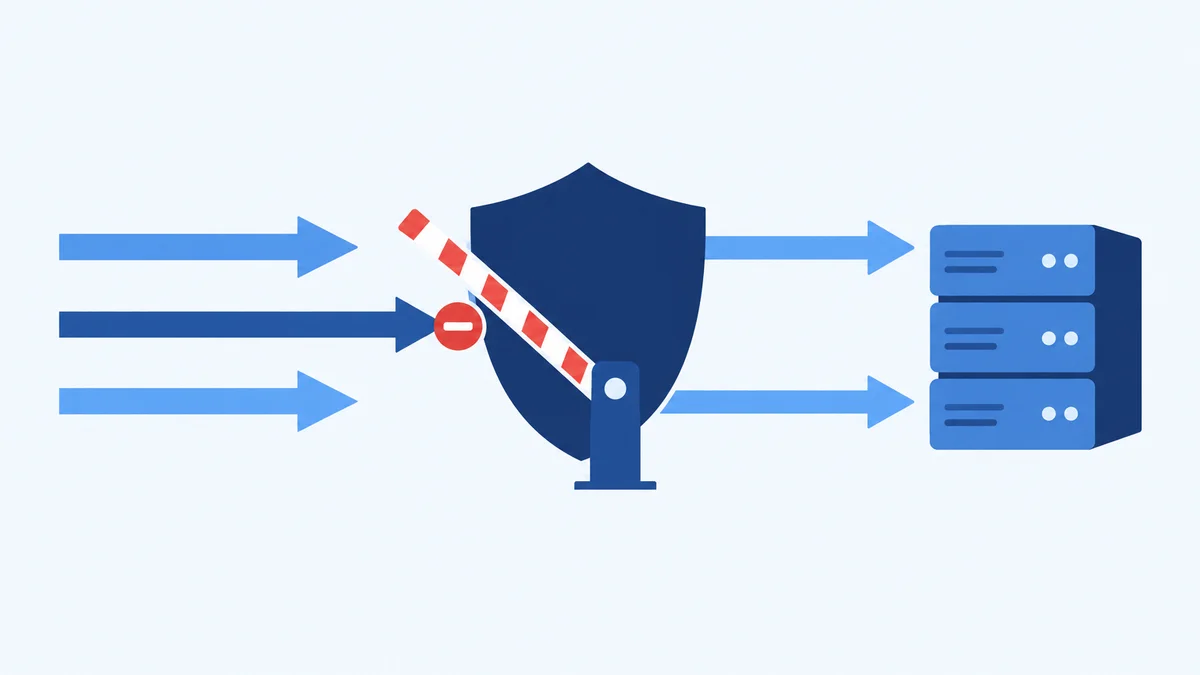
A web application firewall (WAF) is a rule engine at the network edge that allows, challenges or blocks requests before they reach your server. Its decisions are invisible in robots.txt. Cloudflare's CEO framed the stakes this way: "Now that the majority of traffic on the Internet is non-human, we must go further and act faster so that a sustainable ecosystem can emerge." (Matthew Prince, Cloudflare, via ValueAddVC Pulse, 2026).
On 1 July 2025 Cloudflare changed its default to block AI crawlers for new domains. Its announcement said: "non-verified bots are still default blocked, but we are no longer viewing Verified as “default allowed." (Cloudflare Blog, 2025). A bot being "verified" no longer means it is let through.
A second change is reported for 15 September 2026. Cloudflare's defaults block mixed-use AI crawlers on ad-carrying pages for new customers, new sites on existing accounts and free-plan sites (technology.org, 2026). Reports differ on scope by plan, so read Cloudflare's own post for your account type.
Two Cloudflare checkpoints are easy to miss. AI Crawl Control (formerly AI Audit) is on all plans, and blocking a crawler there creates a WAF custom rule. Bot Fight Mode is a Cloudflare setting that challenges suspected bots and cannot be bypassed with WAF Skip or Allow rules, per a practitioner write-up of Cloudflare documentation (dev.to, 2026). If your team added a skip rule and assumed the problem was solved, test it.
A scripted version of these steps works as a simple AI crawler access checker.
curl -s -A "OAI-SearchBot" -o /dev/null -w "%{http_code}\n" https://example.com/pricing
Use the full user-agent strings from each vendor's documentation, because a short token may not trigger the same rules.
Fill one row per bot and page class. The rows below are an example of how results read.
| Bot | robots.txt | Edge status | Raw HTML has key text | Verdict |
|---|---|---|---|---|
| OAI-SearchBot | Allowed | 200 | Yes | Pass |
| PerplexityBot | Allowed | 403 | n/a | Fail at CDN |
| GPTBot | Blocked on purpose | n/a | n/a | Intended block |
| ClaudeBot | Allowed | 429 | Yes | Fail at rate limit |
A robots.txt "allowed" cell next to a 403 is the failure most teams never see.
To check whether client-rendered docs are readable, fetch the raw HTML with curl using each bot's user agent, then compare it with the rendered page. Vercel and MERJ found that 11.50% of GPTBot requests and 23.84% of ClaudeBot requests were for JavaScript files that were never executed (2024), so text that appears only after rendering is invisible to those bots.
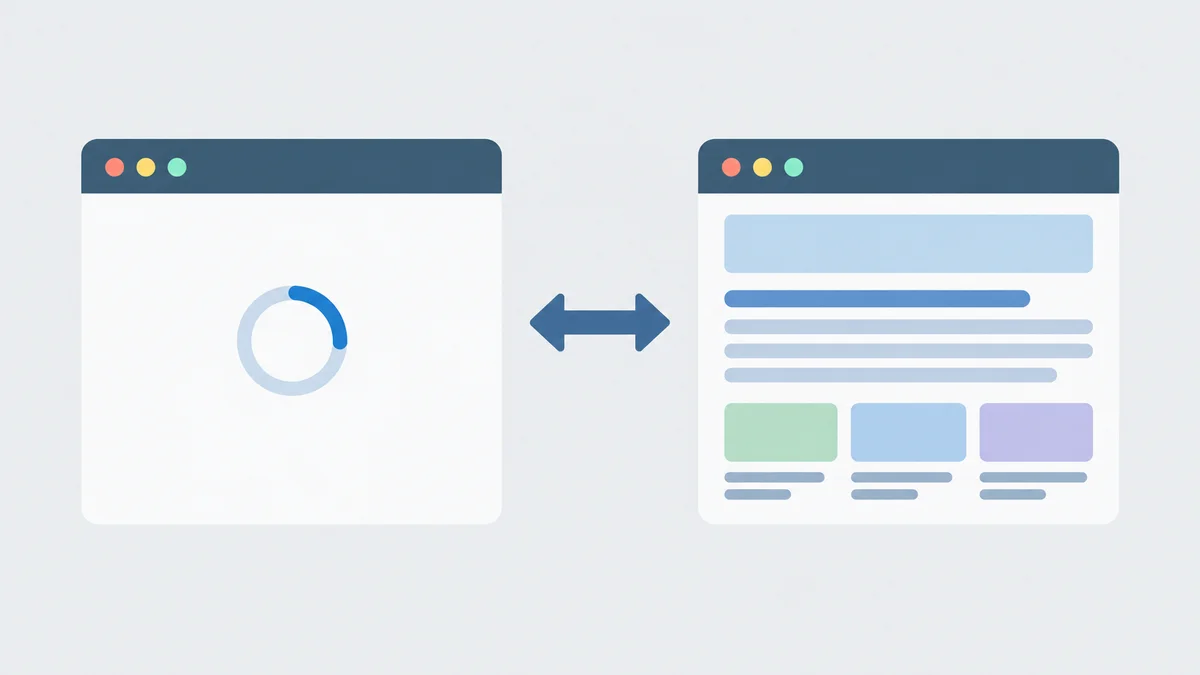
Client-side rendering is a pattern where the server sends a near-empty HTML shell and JavaScript builds the visible content in the browser. Crawlers that skip JavaScript see only the shell. The Vercel and MERJ authors put it plainly: "They can't read client-side rendered content." (Vercel and MERJ, 2024).
Vercel's network handled 569 million GPTBot requests and 370 million Claude requests in a month, about 20% of Googlebot's 4.5 billion (Vercel, 2024). That is a single-network sample and nearly two years old. A later measurement points the same way: across 32 AI crawlers and 1.3 billion requests, only Googlebot, Google-Extended and Applebot rendered JavaScript (searchVIU via nobori.ai, 2025). The same nobori.ai page notes a January 2026 EdgeComet log study found GPTBot script execution "extremely limited" rather than zero. Treat client-rendered content as unreliable, not impossible.
curl -s -A "GPTBot" https://docs.example.com/guide -o raw.html.raw.html for two or three distinctive sentences from the visible page. If they are missing, the bot probably cannot read them."Disable JavaScript in your browser" is a weaker test, because it does not replicate how a bot requests the page.
If text is missing, choose among three options. Server-side rendering (SSR) is a method where the server builds the full HTML for each request. Static site generation (SSG) builds pages ahead of time, which suits docs that change on release. Prerendering serves a rendered snapshot to bots. Pick the one your front-end team can maintain, and keep public docs server-rendered with a dated changelog.
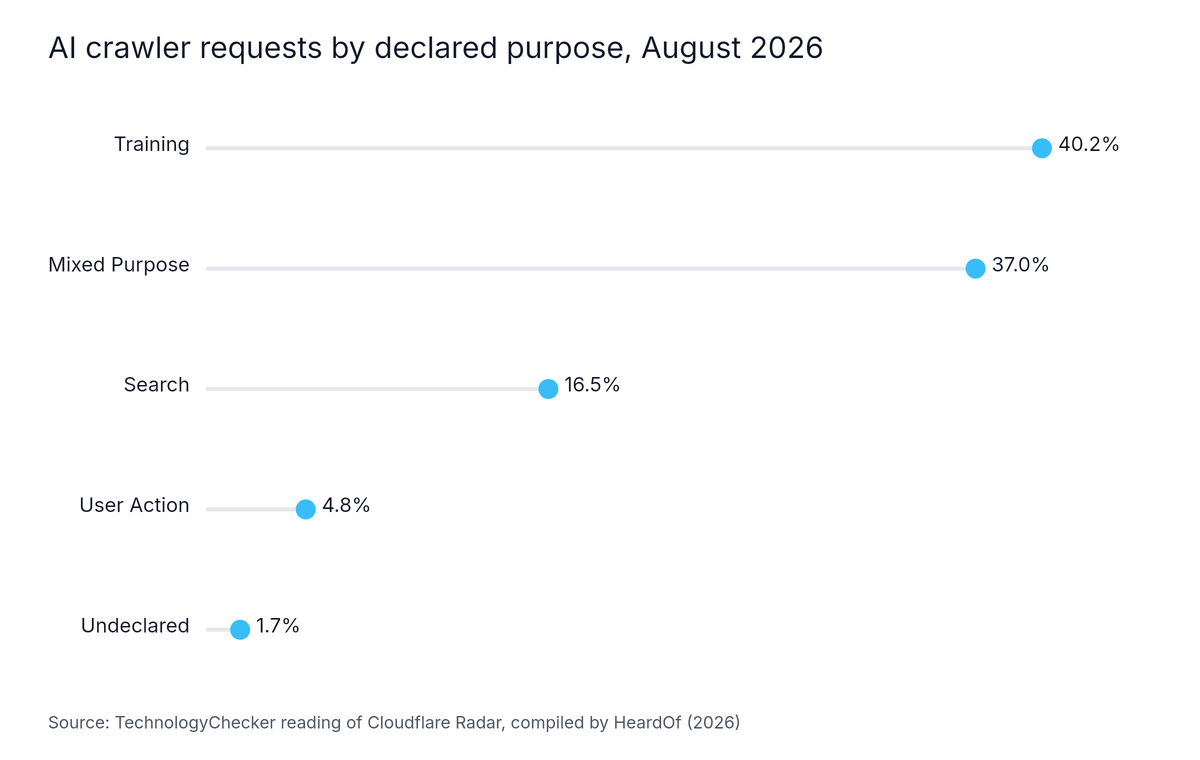
AI bots should be allowed, rate-limited or blocked by purpose and path, not with one global rule. Cloudflare Radar data for August 2026 shows training at 40.15% and search at 16.45% of declared AI crawler requests (HeardOf, 2026). A common starting point is to allow search and retrieval bots on public marketing and docs paths, and decide training bots separately.
A per-bot policy is a written decision, by path, for each named AI crawler: allow, rate-limit or block. It replaces a single allow-all or block-all rule. Bots fall into three groups:
The August 2026 split was training 40.15%, mixed purpose 36.96%, search 16.45%, user action 4.80% and undeclared 1.65% (HeardOf, 2026). Other months differ: nobori.ai (2026) reports search under 10% for May 2026.
Source: TechnologyChecker reading of Cloudflare Radar, compiled by HeardOf, 2026
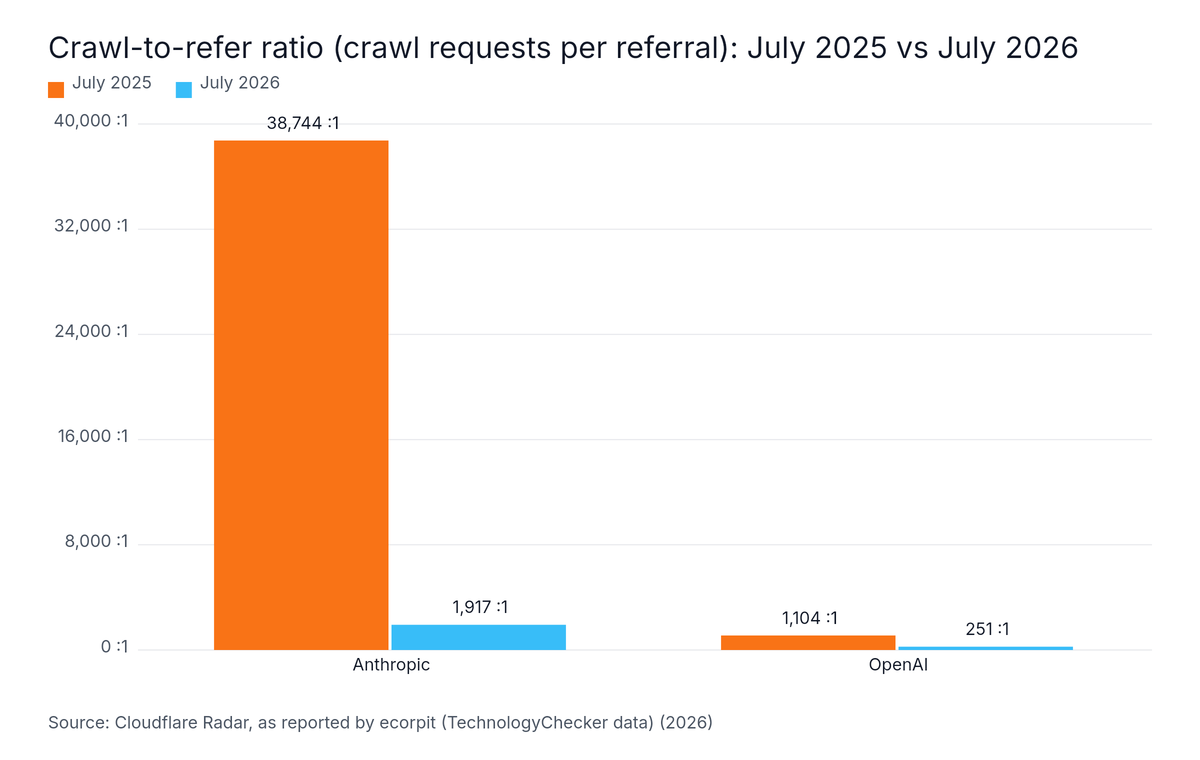
Both camps have evidence. Marketing's case: a blocked page cannot be cited, and assistants name only a few vendors. Engineering and finance's case is cost: a February 2026 Hacker News thread reported one site with ClaudeBot at 700,000 hits in a month, tripping a bandwidth limit. The crawl-to-refer data shows the imbalance: Anthropic stood at 1,917:1 and OpenAI at 251:1 in July 2026, down from 38,744:1 and 1,104:1 in July 2025 (Cloudflare Radar via ecorpit, 2026). Cloudflare itself says published ratios overstate the case, so treat them as magnitude.
Source: Cloudflare Radar, as reported by ecorpit (TechnologyChecker data), 2026
The crawl-to-refer ratio is the number of crawl requests a platform makes for each referral visit it sends back. A per-bot, per-path policy resolves the dispute: open the paths that earn citations, rate-limit and log the rest.
| Bot | Purpose | Public marketing and docs paths | Gated, pricing-sensitive or IP-sensitive paths |
|---|---|---|---|
| OAI-SearchBot | Search | Allow | Block |
| PerplexityBot | Search | Allow, rate-limit | Block |
| ChatGPT-User | User-triggered | Allow at the edge, since robots.txt may not apply | Block at the edge |
| GPTBot | Training | Decide by IP and content position | Block |
| ClaudeBot | Training | Decide by IP position, rate-limit and log | Block |
| Google-Extended | Training control | Decide by IP and content position | Block |
These are starting positions for review, not guarantees of citation. A robots.txt change takes effect on the next fetch but does not undo past collection, so decide training bots deliberately. For tools that track what happens after access opens, see the AEO and GEO tools comparison.
In-house ownership of AI crawler access works best with one named owner, typically in platform or web engineering, and marketing, security and product as consulted parties. A Q3 2026 crawl found 84.2% of 1,744 sites have no AI crawler policy at all (AI Visibility UK, 2026), which is what a missing owner looks like.
The right owner is rarely a single job title. The role needs five skills:
No single marketing or security role covers all five, which is why one owner plus consultation beats a committee.
AI visibility spans five functions: content in marketing, docs and pricing in product, crawl access in engineering, measurement in RevOps and claims accuracy in product marketing. No single budget owns it.
| Decision | Platform or web engineering | Marketing or SEO | Product or docs | RevOps | Security or finance |
|---|---|---|---|---|---|
| Per-bot, per-path policy | Accountable | Consulted | Consulted | Informed | Consulted |
| robots.txt edits | Responsible | Accountable for intent | Informed | Informed | Informed |
| CDN and WAF rules | Accountable | Informed | Informed | Informed | Consulted |
| Rendering of docs and pricing | Responsible | Informed | Accountable | Informed | Informed |
| Monthly bot-log report | Responsible | Consulted | Informed | Accountable for measurement | Informed |
This table is a recommended starting split, not a standard. Adjust it to your organization, but keep one "A" per row.
Re-run the audit on a trigger: a replatform, redesign, CDN or WAF change, or a bandwidth alert traced to bots. A short scripted status-code check against priority URLs works as a regression test in CI after any edge change. The owner should publish a one-page access spec once: which bots, which paths, how pages render and how it is monitored.
The AI crawler access audit is not for sites that gate content on purpose, and it cannot prove citations. Access is necessary, not sufficient. Referral volume is also small: chatgpt.com sent 0.913% of crawler referrals against Google's 88.08% in July 2026 (Cloudflare Radar via ecorpit, 2026), so a passing audit is a precondition, not a traffic forecast.
AI recommendation lists vary from run to run, so one passing check proves little. Several figures here come from vendor studies with stated methods, not neutral census data. The Vercel sample is a single network. The cited robots.txt studies measure policy, not whether a bot actually got through. Crawl-to-refer ratios carry Cloudflare's own caveat. Speculative tactics such as llms.txt are not proven to help, so they sit outside the pass or fail layers.
One named owner should hold AI crawler access decisions, usually in platform or web engineering, with marketing, security and product consulted. The role needs working knowledge of HTTP status codes, CDN and WAF configuration, robots.txt semantics, rendering and log analysis. A shared policy table and a re-test after every CDN change stop teams overriding each other.
Checking client-rendered docs means fetching each page with curl using the bot's user agent from outside your network, saving the raw HTML, and searching it for the page's key sentences. If the text is missing from the raw response, the bot probably cannot read it. Vercel and MERJ reported that AI crawlers download JavaScript files but do not execute them.
Allowing GPTBot in robots.txt does not guarantee access, because a CDN, WAF or rate limiter can still return a 403, 429 or challenge before the bot reaches the file's rules. OpenAI also says robots.txt rules may not apply to ChatGPT-User. Test each bot against live pages and record the status codes.
Cloudflare blocks AI crawlers by default for domains added since 1 July 2025, and from 15 September 2026 it reportedly also blocks mixed-use crawlers on ad-carrying pages for new and free-plan sites. Reports differ on scope by plan, so check your own account settings and test live responses with each bot's user agent.
Re-run the AI crawler access audit whenever a trigger occurs: a replatform, redesign, CDN or WAF change, or a bandwidth alert traced to bots. Between triggers, review bot logs monthly and run a short scripted status-code check against priority URLs. No universal interval is supported by the evidence, so tie the schedule to change events.
An AI crawler access audit turns a vague worry into five pass or fail checks per bot. Visibility is binary: a page that an AI crawler cannot fetch or parse cannot be cited, so this audit belongs ahead of any AEO program.
Once access passes, the next question is measurement, and the AEO and GEO tools comparison covers citation tracking and crawler diagnostics. For weekly updates on platform and CDN bot-policy changes, Get the weekly brief.
Written by
Ishan Manchanda
Ishan Manchanda is co-founder of GrowthSpree, a B2B SaaS marketing consultancy founded in 2017 that has managed $60M+ in ad spend across 300+ B2B SaaS companies. He focuses on demand generation, go-to-market strategy and pipeline growth, and has been featured in Silicon Valley Times, SaaS Mag and the Unbounce podcast.