AI Search Visibility Benchmarks 2026: What B2B SaaS Teams Can Defend
ai search visibility benchmarks 2026citation frequency benchmark B2B SaaSAI referral traffic share
AI Search Visibility Benchmarks 2026: What B2B SaaS Teams Can Defend
The defensible 2026 AI search benchmarks for B2B SaaS, each labeled primary-source or vendor-reported, with baseline reference points to set before any prompt runs.
Request a quote and our experts will contact you within 24 hours with tailored solutions and pricing.
AI Search Visibility Benchmarks 2026: What B2B SaaS Teams Can Defend
AI search visibility benchmarks for 2026 are reference points for how often AI assistants send traffic, shape buyer shortlists and cite brands, and for B2B SaaS only referral share, buyer adoption and click behavior have published figures.
A CMO asked for "the number" will find figures that differ by orders of magnitude: about 0.1% of referral traffic in one study (Ahrefs, 2025), 51% of buyers starting in a chatbot in another (G2, 2026). Both can be true. This post labels each data point as primary-source or vendor-reported, explains why they disagree, and sets reference points a team can use before running any prompt. For tooling choices, see this guide to boardroom-ready visibility tools.
Key Takeaways
In the sources reviewed for this post, no published citation-frequency benchmark for B2B SaaS was found, so a team's own frequency, cited in x of N runs, is the only usable citation number.
Ahrefs measured AI chatbots at 0.28% of web traffic in March 2026 (Ahrefs, 2026), a primary-source reading from the vendor's own tracker.
G2's March 2026 survey found 51% of B2B software buyers start research with an AI chatbot (G2, 2026), which is vendor-reported data.
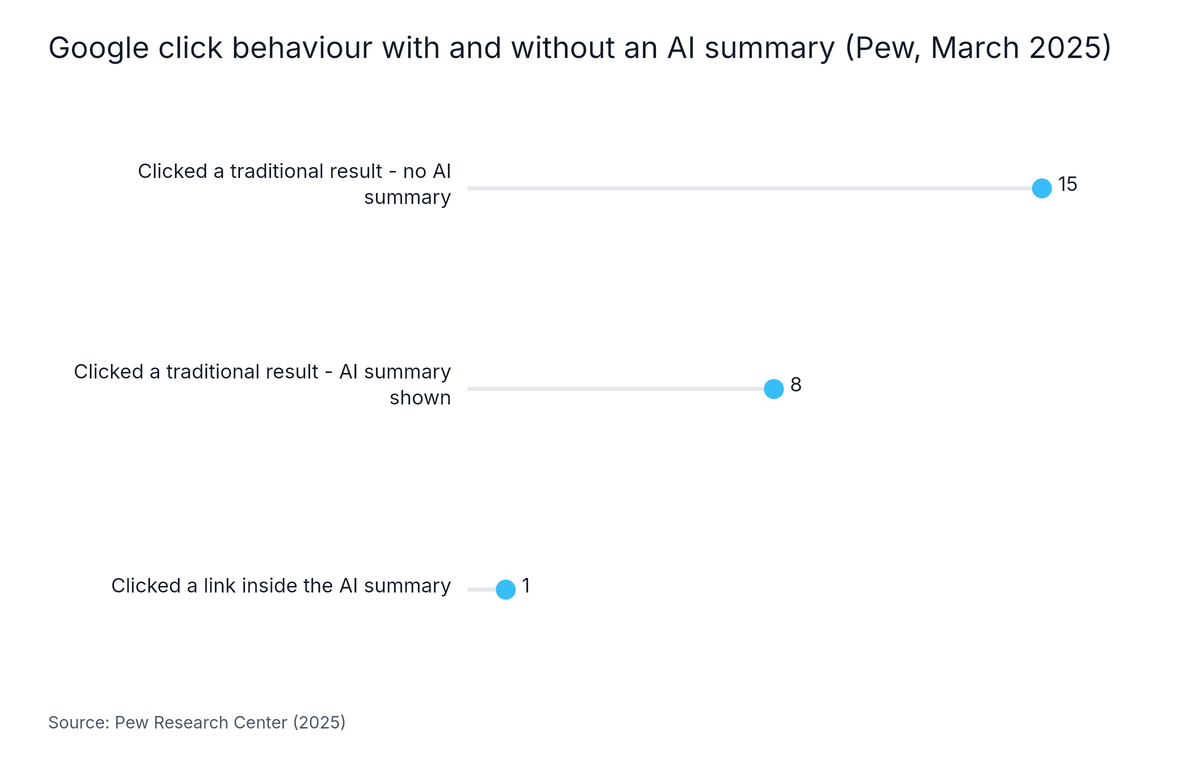
Pew Research Center found users clicked a traditional result in 8% of visits with a Google AI summary versus 15% without (Pew, 2025).
Board reporting should pair leading metrics (citation frequency) with lagging ones (AI-referred sessions, win rate), each shown as a range.
By Ishan Manchanda, co-founder of GrowthSpree, a B2B SaaS marketing consultancy founded in 2017. aeogeo.com is a GrowthSpree property, as is Salient by GrowthSpree.
What benchmarks exist for AI search visibility in B2B SaaS going into 2026?
AI search visibility benchmarks for B2B SaaS in 2026 come from three measurable layers: referral traffic, buyer adoption and click behavior. Ahrefs counted AI chatbots at 0.28% of web traffic in March 2026 (Ahrefs, 2026), while G2 found 51% of B2B software buyers start research with an AI chatbot (G2, 2026). No citation-frequency benchmark sits among them.
Flat-lay of a ruler, calipers and blank index cards arranged on a pale desk surface
The ledger below lists every data point this post relies on. Vendor-reported data is a figure published by a company that sells into the market it measures, so it may carry an incentive to stress urgency. Primary-source data means the publisher measured the behavior itself, though a vendor's own panel still reflects its own sample.
Salient by GrowthSpree reports client citation totals. AeoGeo and Salient are both GrowthSpree properties, so those totals would be vendor aggregates, not independent benchmarks. The total could not be verified for this post, so none is used here.
What is a good AI citation rate, and is there a published benchmark for B2B SaaS?
In the sources reviewed for this post, no published citation-frequency benchmark for B2B SaaS was found, so there is no sourced answer to what a good citation rate is. A May 2026 meta-analysis of 54 studies by Cyrus Shepard flagged viral statistics with no primary study (Digital Applied, 2026). Citation rates shift with the prompt set, engines and number of runs.
Stage-based citation ranges do circulate, but without disclosed datasets, shared definitions or stated prompt sets. Three terms get blurred together:
Citation rate is the share of tracked AI answers that cite a brand's pages.
Mention rate is the share of tracked AI answers that name a brand, with or without a link.
Share of voice, also called share of answers, is a brand's portion of all brand mentions across tracked answers in one category.
Why one check is not a number
AI answers vary from run to run. As an illustration, a page cited in 14 of 50 runs looks not cited in a single check. The honest unit is a frequency range: it reports how often a brand is cited as x of N runs on a fixed prompt set, stated with its sample size.
A tool that reports a single visibility number without its prompt set, engines and run count cannot be compared with any other tool's number.
Why do Ahrefs and other panels report different AI traffic percentages?
Ahrefs' two readings differ because each used a different panel, window and denominator: about 0.1% of referral traffic across roughly 35,000 sites in early 2025 (Ahrefs, 2025), then 0.28% of total web traffic across 74,752 sites in March 2026 (Ahrefs, 2026). Other panels differ further by sample and by which assistants they count, so the figures describe different populations.
Four stacks of wooden blocks of different heights on a light surface, each beside a small blank tag
Factor
Ahrefs, early 2025
Ahrefs, March 2026
Sample
About 35K sites
74,752 sites
What counts as AI
ChatGPT, Perplexity and Gemini referral clicks
All AI chatbots, human referral clicks only
Denominator
Total referral traffic
Total web traffic
Reading
0.1%
0.28%
Four things drive any gap between panels: broad versus narrow samples, different dates, which assistants count as AI, and whether the denominator is all traffic or referral traffic only. The two Ahrefs readings are not like-for-like, so the move from 0.1% to 0.28% shows direction, not an exact growth rate. Any baseline should carry its panel, date and denominator.
Does AI search visibility drive pipeline if AI referral traffic is under 1%?
AI search visibility can influence pipeline even when AI referral traffic is under 1%, because buyers research inside the answer and click little afterward. G2's March 2026 survey found 69% of buyers said a chatbot led them to choose a different vendor than expected (G2, 2026), and Pew found 8% of visits with an AI summary included a traditional click versus 15% without (Pew Research Center, 2025).
A magnifying glass resting on a blank survey form next to a sharpened pencil
Where buyers start
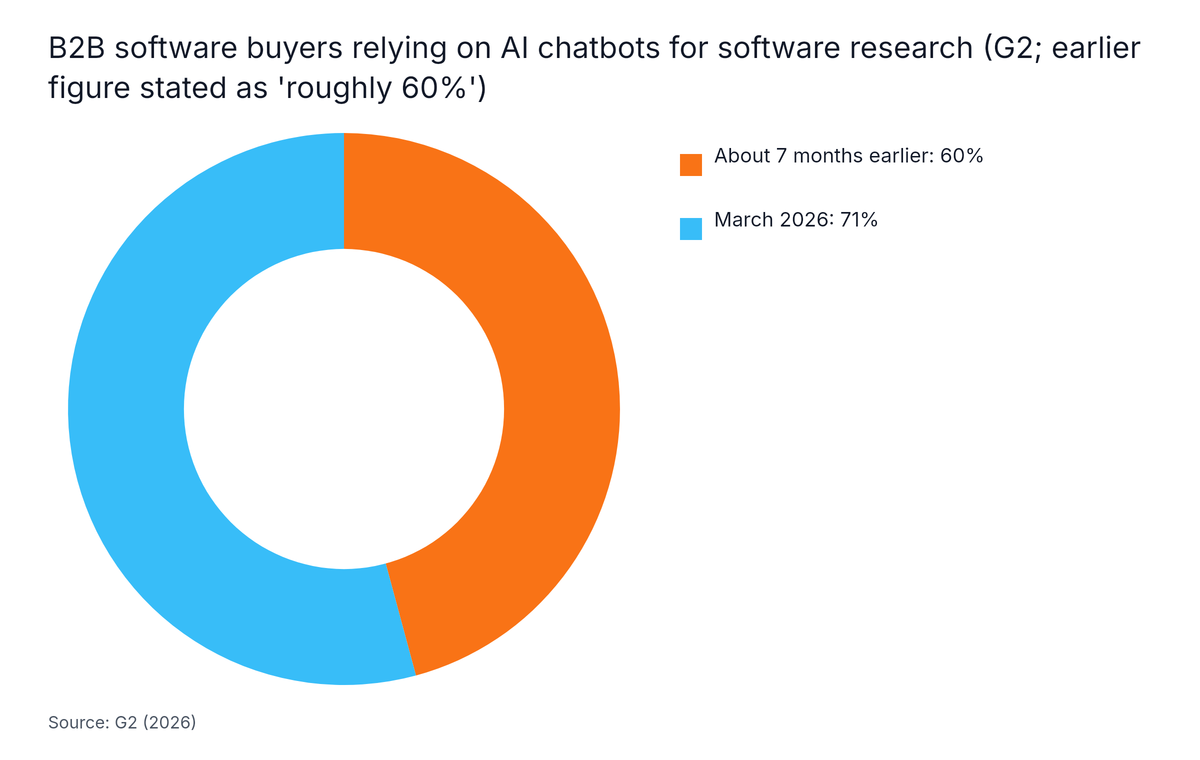
G2's two adoption figures measure different things. In the March 2026 survey of 1,076 buyers, 51% said they start research with an AI chatbot more often than Google, up from 36% about seven months earlier (G2, 2026). Separately, 71% said they rely on AI chatbots for software research, up from roughly 60% (G2, 2026). G2 sells to software vendors and the data is self-reported, so treat both as vendor-reported.
Donut chart: B2B software buyers relying on AI chatbots for software research (G2; earlier figure stated as 'roughly 60%'). Highest: March 2026 at 71%.
Forrester reports 94% of business buyers used AI in their buying process, up from 89% a year earlier (Forrester, 2026). G2's Buyer Behavior Report adds that "The discovery phase has compressed from hours of website browsing and report reviewing to a single prompt in an AI chatbot" (Tim Sanders, G2, 2026).
What happens to clicks
Pew's browsing study covered 900 U.S. adults in March 2025. Links inside the AI summary were clicked in about 1% of visits. As Pew put it, "For searches that resulted in an AI-generated summary, users very rarely clicked on the sources cited" (Pew Research Center, 2025).
Lollipop chart: Google click behaviour with and without an AI summary (Pew, March 2025). Highest: Clicked a traditional result - no AI summary at 15.
The wider zero-click picture agrees. SparkToro and Similarweb reported U.S. Google zero-click searches at 68.01% for January to April 2026 (SparkToro, 2026). Shortlists form inside answers while visible traffic stays small.
How do you set an AI visibility baseline, and how many prompts do you need?
A B2B SaaS team can set an AI visibility baseline before running a prompt by anchoring on published reference points: AI chatbots at 0.28% of web traffic (Ahrefs, 2026), 51% of buyers starting with a chatbot (G2, 2026) and an 8% click rate when an AI summary appears (Pew Research Center, 2025). A frozen set of 25 to 50 prompts, a suggestion rather than a sourced standard, then supplies the team's own citation frequency.
A row of numbered blank cards in sequence beside a stopwatch on a clean surface
The table turns the published data into starting reference points. They are not a citation benchmark and not a norm for B2B SaaS.
How much organic traffic erodes on exposed queries
Citation frequency
No published benchmark found
A five-step calibration method
The method below is a practical suggestion, including the prompt count, not a sourced standard.
Define the terms. Write down what counts as a citation, a mention and a share-of-answers reading.
Fix a prompt set. A panel of 25 to 50 buyer-intent prompts is a workable start. Keep it frozen between readings, because changing prompts changes the rate.
Repeat every prompt. Run each prompt several times per engine, because one answer is a sample of one.
Report a frequency range. State how often the brand was cited as x of N runs per engine, with the prompt count.
Cross-check. Compare against AI-referred sessions in GA4 and a self-reported "how did you hear about us" field.
How do you measure AI search visibility in GA4?
Measuring AI search visibility in GA4 means building a custom channel group that tags sessions from assistant domains such as chatgpt.com, perplexity.ai, gemini.google.com, copilot.microsoft.com and claude.ai as AI-referred sessions. Referral share understates influence: AI assistants produced about 12% of Ahrefs' own signups from only 0.5% of its traffic (Ahrefs, 2025), so pair GA4 with a self-reported field.
The setup takes four steps:
Create the channel group. Add a custom channel named AI assistants that matches the five source domains above.
Order it correctly. Place it above the default Referral channel so these sessions are not absorbed there.
Add a lead-form option. Include "AI assistant" in the self-reported attribution field and the CRM lead-source picklist.
Review monthly. Compare AI-referred sessions, self-reported AI-sourced leads and opportunity outcomes side by side.
The Ahrefs figure is a single-company result, so it should not be generalized to B2B SaaS as a whole. GA4 will miss visits that arrive without a referrer, which is why self-reported attribution matters.
How should a CMO report AI search visibility to the board?
A CMO should report AI search visibility to the board as a mix of leading metrics (citation frequency, mention rate) and lagging ones (AI-referred sessions, self-reported AI-sourced leads, win rate), each with its method and a range. Forrester found 94% of business buyers used AI in their buying process (Forrester, 2026), so influence outruns clicks.
A closed navy folder, a blank notepad and a pen on a pale desk, arranged for a briefing
Metric
Type
Definition
Main limit
Citation frequency
Leading
Cited in x of N runs on a fixed prompt set
No published benchmark; varies by prompt set
Mention rate
Leading
Share of answers naming the brand
Does not show whether a link was given
AI-referred sessions
Lagging
Visits from assistants such as chatgpt.com
GA4 can undercount; small share of traffic
Self-reported AI-sourced leads
Lagging
Leads naming an AI assistant on the form
Depends on form design and honesty
Win rate by source
Lagging
Closed-won share of AI-sourced opportunities
Needs CRM hygiene and time
G2's report puts the commercial point plainly: "Getting found matters, but the deal is won when buyers can evaluate you without finding new reasons to hesitate" (G2, 2026). Reporting both sides shows the board that visibility and revenue are linked.
Our data: In AeoGeo's illustrative model (October 2026), 300 opportunities a year at $40,000 ACV with a 2-point win-rate drop (22% to 20%) means 6 lost deals, or $240,000 ARR. This is a modeled example, not a measured result.
To build the business case around these metrics, use this AEO ROI model.
Who should not rely on these benchmarks?
AI search visibility benchmarks are not suited to teams that need a competitor-by-competitor citation number, sellers outside software, or anyone expecting a single figure for a board slide. G2's 51% comes from 1,076 software buyers in one March 2026 survey (G2, 2026), and GA4 can undercount AI referrals.
The main limits:
Segment fit: G2's survey covers software buyers. Enterprise or non-software sellers should check their own call recordings and self-reported attribution before assuming the same pattern.
Mixed definitions: the Ahrefs readings use different samples, assistants and denominators, so they are not like-for-like.
Single-company data: Ahrefs' own signups result (Ahrefs, 2025) describes one business.
Self-reported behavior: the G2 figures record what buyers say, not what was observed.
Moving targets: AI traffic readings changed between early 2025 and March 2026, so any baseline needs a date.
Teams choosing outside help should compare vendors on method and disclosure. This agency evaluation framework covers what to ask.
Frequently Asked Questions
Is there a published citation-frequency benchmark for B2B SaaS?
In the sources reviewed for this post, no published citation-frequency benchmark for B2B SaaS was found. Citation rates depend on the prompt set, engines and number of runs, and no shared definition exists. Teams should measure their own frequency, cited in x of N runs on a fixed prompt set, and compare it against their own trend.
How much website traffic should come from ChatGPT and other AI tools?
Ahrefs measured AI chatbots at 0.28% of total web traffic across 74,752 sites in March 2026 (Ahrefs, 2026), up from about 0.1% of referral traffic in early 2025 (Ahrefs, 2025). These are reference points, not a norm for B2B SaaS, so a site's own analytics should be compared with them.
Do Google AI Overviews reduce clicks to a website?
Yes, Pew Research Center found users clicked a traditional result in 8% of visits when a Google AI summary appeared, versus 15% without one (Pew Research Center, 2025). The study used March 2025 browsing data from 900 U.S. adults. Links inside the summary were clicked in about 1% of visits.
What share of B2B software buyers start research in an AI chatbot?
G2's March 2026 survey of 1,076 B2B software buyers found 51% start research with an AI chatbot more often than with Google, up from 36% about seven months earlier (G2, 2026). G2 sells to software vendors, so the figure is vendor-reported and should be read with that incentive in mind.
How many prompts are needed for a reliable AI visibility baseline?
No sourced standard exists for prompt count. A frozen set of 25 to 50 buyer-intent prompts, each repeated several times per engine, is a practical starting suggestion, not a benchmark. Report the result as a frequency range, cited in x of N runs, with the prompt count stated.
Conclusion
The measurable layers of AI search are small and well documented, while the citation layer has no shared benchmark in the sources reviewed.
Measure citation frequency on your own fixed prompt set, because no published B2B SaaS benchmark was found.
Treat AI traffic readings as dated reference points: 0.28% of web traffic in March 2026 (Ahrefs, 2026).
Weight buyer adoption heavily: 51% start in a chatbot (G2, 2026, vendor-reported) and 94% use AI in buying (Forrester, 2026).
Report influence as well as traffic, since clicks fall to 8% from 15% when an AI summary appears (Pew, 2025).
Label every figure primary-source or vendor-reported before it reaches a board slide.
Next step: Get the weekly brief for dated, sourced updates on AI search benchmarks. To compare measurement software, start with this overview of AEO and GEO tools.
Written by
Ishan Manchanda
Ishan Manchanda is co-founder of GrowthSpree, a B2B SaaS marketing consultancy founded in 2017 that has managed $60M+ in ad spend across 300+ B2B SaaS companies. He focuses on demand generation, go-to-market strategy and pipeline growth, and has been featured in Silicon Valley Times, SaaS Mag and the Unbounce podcast.
 Ishan ManchandaNov 8, 2026