How to Evaluate an AI Search Visibility Consultant Before You Sign
ai search visibility consultantAEO consultantGEO consultant
How to Evaluate an AI Search Visibility Consultant Before You Sign
Ten vendor-call questions, a six-criterion scorecard and a 90-day kill criterion to test an AI search visibility consultant before a six-month contract.
Request a quote and our experts will contact you within 24 hours with tailored solutions and pricing.
How to Evaluate an AI Search Visibility Consultant Before You Sign
Evaluating an AI search visibility consultant means testing how they measure citations over repeated runs, what baseline they set, what they refuse to guarantee, who owns the data, and whether you can exit at day 90. Disclosure: aeogeo.com is owned by GrowthSpree, which also sells Salient, a managed AEO (answer engine optimization) and GEO (generative engine optimization) service, so both are scored here by the same sheet as any other vendor. A six-month retainer at $3,000 to $6,000 a month commits $18,000 to $36,000 before most buyers see a verdict. This guide gives the questions, scorecard and exit clause to use first. For the tooling side, see how to evaluate AI search visibility tools.
Key Takeaways
"Best AEO agency" lists are often written by the agencies they rank, so a buyer needs a test they can run alone.
An AI search visibility consultant should be judged on citation frequency across repeated runs of a fixed prompt set, never on a single screenshot.
Ten vendor-call questions and a six-criterion scorecard apply equally to every consultant, agency and tool, including GrowthSpree and Salient.
A 90-day kill criterion belongs in the contract: a baseline, a prompt set, a threshold above noise and a penalty-free exit.
By Ishan Manchanda, co-founder of GrowthSpree, a B2B SaaS marketing consultancy founded in 2017 that has managed $60M+ in ad spend across 300+ B2B SaaS companies. Updated October 28, 2026.
Are 'best AEO agency' lists trustworthy when agencies write them?
Most 'best AEO agency' lists are not a neutral test, because in an October 2026 web snapshot the top results were agencies' own listicles, several ranking the publisher first. Agency-authored pricing pages quote $2,000 to $50,000 a month for identical scope (Digital Strategy Force, 2026). Treat such lists as marketing and verify every claim directly.
Marketing leader comparing two printed agency ranking lists at a conference table
An AI search visibility consultant is an outside practitioner who audits how often AI assistants cite or recommend a brand, then fixes access, content and corroboration so the brand appears more often. The category is young and has no standard scope, so each vendor defines its own deliverables and its own proof.
Google's own guidance gives a usable filter. Its June 2026 page on evaluating third-party SEO advice says "good advice either qualifies their claims as opinion based on data or experience" (Google Search Central, 2026). The same page says third-party tools lack access to Google's internal ranking data and cannot guarantee performance.
Use this order when you read any ranking, including this one:
Find who published it and whether the publisher sells the service.
Ask for the scoring method and whether the publisher scored itself.
Verify claims with reference customers and your own prompt run.
Apply one scorecard to every vendor so no name gets a pass.
What should an AI search visibility consultant actually be optimizing for?
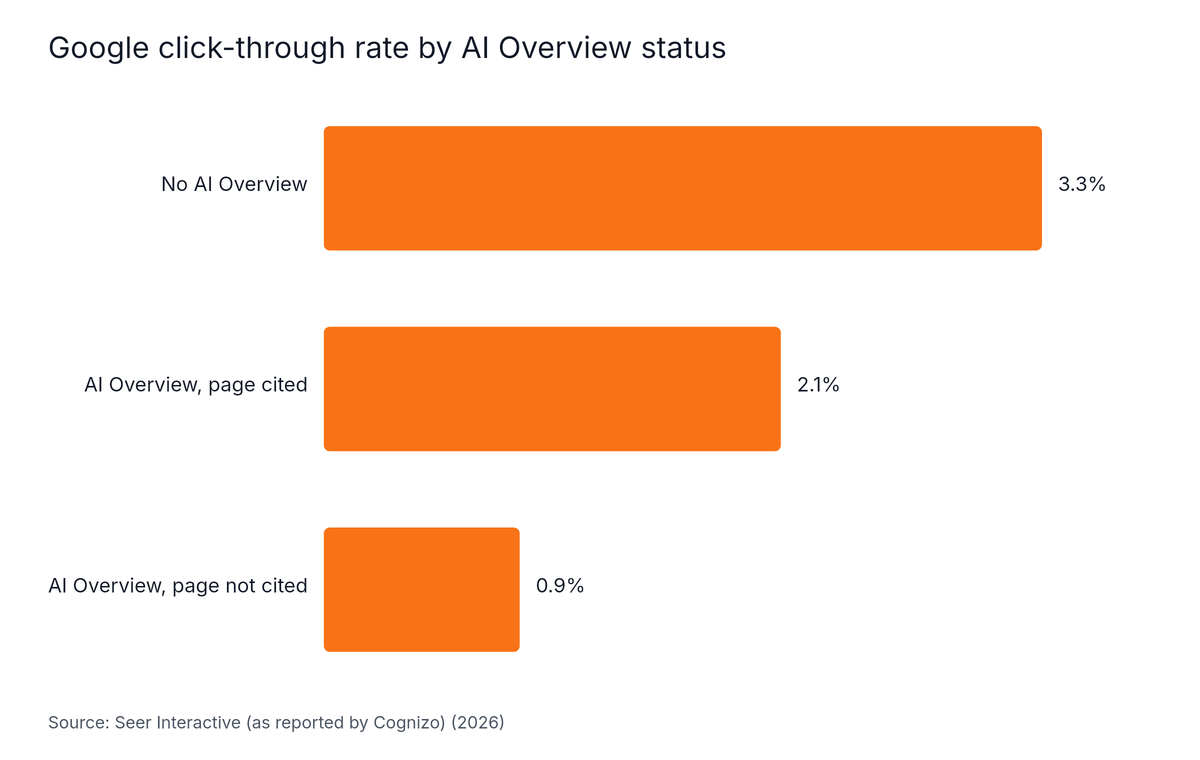
An AI search visibility consultant should be optimizing for being cited and recommended inside AI answers, then for the pipeline those citations influence, not for traffic alone. Seer Interactive's 2026 data, as reported by Cognizo, found a Google click-through rate of 2.1% when a page was cited in an AI Overview versus 0.9% when it was not.
Hands pointing at a printed table of click-through percentages during a planning meeting
Clicks fall when an answer appears. A Pew Research Center study of 900 U.S. adults in March 2025 found that "Users who encountered an AI summary clicked on a traditional search result link in 8% of all visits" (Pew Research Center, 2025). Visits without a summary produced clicks 15% of the time.
Citation is not the same as traffic. In the same study, links inside the AI summary were clicked in 1% of visits to pages with a summary (Pew Research Center, 2025). A consultant who reports only sessions will miss most of the effect.
Seer's figures show why being cited still matters:
Horizontal Bar chart: Google click-through rate by AI Overview status. Highest: No AI Overview at 3.3%.
Seer's Google click-through rate was 3.3% with no AI Overview, 2.1% with a cited page and 0.9% with an uncited page (Seer Interactive via Cognizo, 2026). Ask any consultant to show how their work moves a brand from the uncited bar to the cited one. Ask, too, how they would report influence when the click never happens. For a view of the measurement side, see how to pick a tool that gives boardroom-ready numbers.
What 10 questions should you ask an AI search visibility consultant before hiring?
Ten questions cover measurement, baseline, guarantees, tooling, data ownership and exit: which prompts will you track and how many runs, what baseline will you set, what do you refuse to guarantee, who owns the data, and what happens at day 90. A consultant who cannot answer all ten in writing has not earned a six-month commitment.
Buyer reading a ten-item question list during a video call with a vendor
The ten questions
A prompt set is a fixed list of the questions a buyer would ask an AI assistant, agreed in advance and re-run on a schedule to measure citation frequency. A baseline is the citation frequency, AI-referred sessions and self-reported attribution measured before any work starts, against which every later result is judged. Both appear below.
Which prompts will you track, who chooses them, and how many runs per prompt? Insist that you approve the prompt set before work starts.
What is my baseline today, and when will you measure it? No baseline means no way to judge day 90.
How will you report results? The right answer is a frequency range (cited in x of N runs), not a single screenshot.
What will you refuse to guarantee? Honest consultants name limits.
Which tactics are proven and which are speculative? Ask about llms.txt and schema markup specifically.
Which tools are in the retainer, what is the pass-through cost, and can I keep access if we part?
Who owns the accounts, prompt sets, raw data and content after termination?
How will you connect citations to pipeline? Look for AI-referred sessions, a self-reported attribution field and CRM reporting.
What do you need from my engineering, product and RevOps teams, and who decides crawler access?
What happens at day 90 if the agreed metric has not moved, and will that exit be in the contract?
Why a single screenshot is weak proof
A SparkToro and Gumshoe.ai study published in January 2026 found that AI tools almost never return the same brand list twice (SparkToro, 2026). As an illustration, a page cited in 14 of 50 runs would look "not cited" in many single checks. That is why questions 1 to 3 come first.
Guarantees and speculative tactics
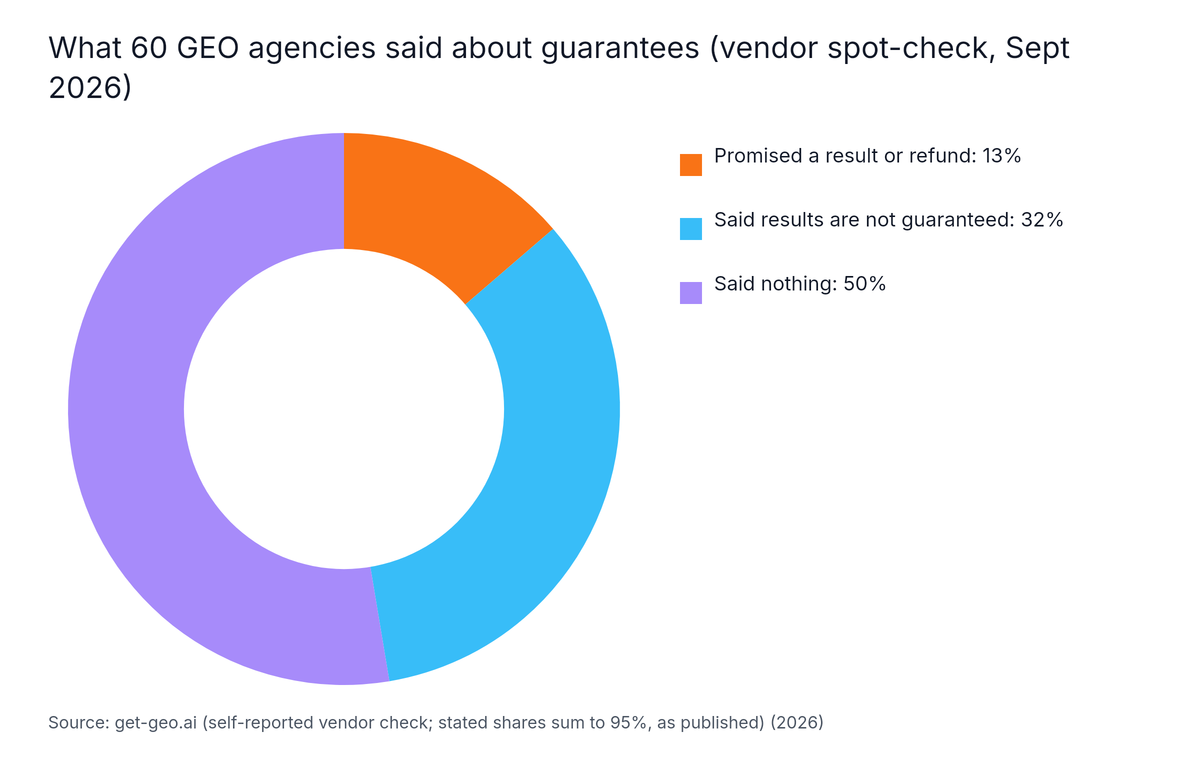
A September 2026 check of 60 GEO agencies by a GEO vendor found that 13% promised a result or refund, 32% said results are not guaranteed, and 50% said nothing about guarantees (get-geo.ai, 2026). It is vendor-reported with a small sample, so treat it as directional.
Donut chart: What 60 GEO agencies said about guarantees (vendor spot-check, Sept 2026). Highest: Said nothing at 50%.
On speculative tactics, Google's May 2026 guide says that adding an llms.txt file "will neither harm nor help your site's visibility or rankings in Google Search, as Google Search ignores them." (Google Search Central, 2026). A consultant selling it as the main lever has not read the guidance.
What scorecard criteria should you apply to every vendor?
Score every vendor, whether consultant, agency or tool, on the same six criteria: measurement method, baseline discipline, claim honesty, sector fit, contract and data terms, and proof of outcomes. Use a 0 to 2 scale per criterion and require written evidence for any 2. GrowthSpree and its Salient service are scored by this same sheet, with affiliation disclosed.
Finance and marketing leads reviewing a printed vendor scorecard together
Criterion
Score 2 needs this evidence
Red flag
Measurement method
Fixed prompt set, repeated runs, frequency range reported
One screenshot, "rank #3 in ChatGPT"
Baseline discipline
Baseline measured and signed before work starts
Baseline "to follow" after kickoff
Claim honesty
Limits stated, tactics labeled proven or speculative
Guarantees, refund promises, llms.txt as the lever
Sector fit
Targets benchmarked to your own sector
One headline lift promised to every client
Contract and data terms
Data ownership, tool access after exit, 90-day exit
Lock-in, tool only in their retainer
Proof of outcomes
Reference clients of similar ACV, method and dates shown
Aggregate totals with no method
Sector fit matters because AI's share of traffic varies. Conductor's 2026 benchmark report found IT had the highest share of traffic from AI referrals at 2.8%, and Consumer Staples followed at 1.9% (Conductor, 2025). A promised lift should be set against your own sector.
Our data: Salient by GrowthSpree reports 48,800 citations, $165,000+ pipeline and $70,000 media-equivalent across its clients (Salient pitch deck, 2026; the service launched in September 2026). These are vendor-reported, affiliated figures, not verified against the live page, and no method is published with them.
Apply the scorecard to those totals as you would to any vendor's: which prompts, how many runs, what baseline, what time window and which clients. Ask for reference clients with a similar ACV. Do the same for every other name on your shortlist, and ask each for the same written answers.
What 90-day kill criterion belongs in an AI search consultant contract?
A 90-day kill criterion is a written go or no-go test, agreed before signing, that lets the buyer exit if agreed leading indicators have not moved against a baseline. It should name a fixed prompt set, a minimum number of runs, a threshold larger than run-to-run noise, and an exit right without penalty.
Founder reading a contract page and circling an exit clause with a pen
What does the six-month commitment cost?
Break-even deals equal spend divided by (ACV × gross margin). The table uses aeogeo.com's illustrative model at 75% gross margin, so treat it as arithmetic, not advice. Practitioners in the Indie Hackers "Best GEO Agency 2026" thread (2026) quote $3,000 to $6,000 a month, which is anecdotal. Salient lists $999 and $1,500 a month, and GrowthSpree retainers start at $3,000.
Monthly fee
Cash out by day 90
Six-month total
Break-even deals at $30,000 ACV
Break-even deals at $100,000 ACV
$1,500
$4,500
$9,000
0.4
0.12
$3,000
$9,000
$18,000
0.8
0.24
$6,000
$18,000
$36,000
1.6
0.48
The 90-day column is the exposure the kill criterion caps. Without it, the commitment is the whole six-month figure. For the payback model behind the table, see this AEO ROI calculator guide.
Set the baseline before day one
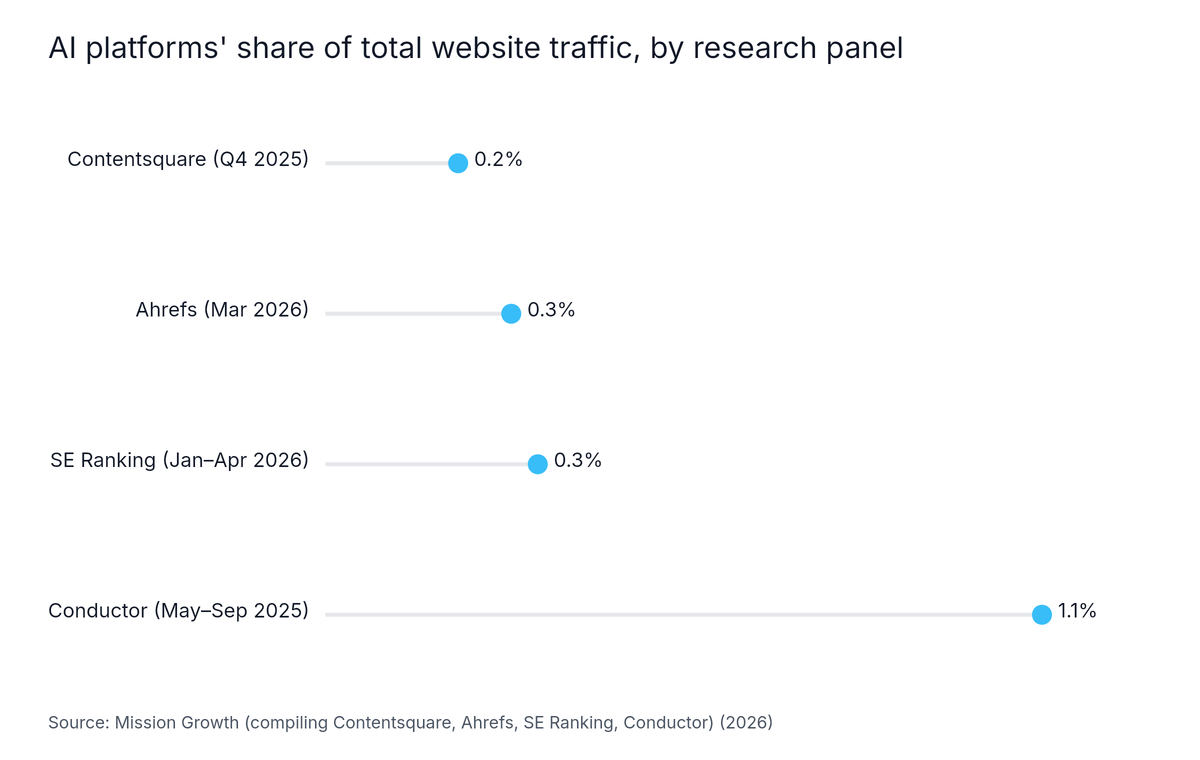
Baselines differ by who measures. Mission Growth's compilation of four panels puts AI's share of website traffic between 0.2% and 1.08% (Mission Growth, 2026). The panels read 0.2% (Contentsquare), 0.28% (Ahrefs), 0.32% (SE Ranking) and 1.08% (Conductor), per the same compilation (Mission Growth, 2026). The Conductor sample skews enterprise.
Lollipop chart: AI platforms' share of total website traffic, by research panel. Highest: Conductor (May–Sep 2025) at 1.1%.
Because panels disagree, a traffic number alone cannot be the kill metric. Record citation frequency on the prompt set, AI-referred sessions in GA4 and a self-reported "AI assistant" value on lead forms, all dated.
Control for platform noise
Platform swings can look like consultant results. Seer Interactive's data shows AI Overview click-through falling to 1.3% in December 2025 and recovering to 2.4% in February 2026, an 85% jump in two months (Cognizo reporting Seer Interactive, 2026).
A 90-day window can capture a swing of that size. Measure changes against the baseline and against control prompts you do not work on, not against the calendar.
Contract language to include
The baseline report, signed by both parties, as a schedule.
The prompt set, number of runs and a reporting cadence of every 2 to 4 weeks.
A day-90 threshold set above run-to-run noise, plus the review date.
A right to exit at day 90 without penalty if the threshold is missed.
Ownership of accounts, prompt sets, raw data and content, with tool access handover.
No guarantee language, and written labels for speculative tactics.
Who is a formal consultant evaluation not for?
A formal consultant evaluation is not for buyers who cannot yet afford a retainer, whose websites block AI crawlers, or who want a guaranteed ranking. A small team may do better with a minimum program that costs hours, not $9,000 to $36,000 over six months, until crawler access and a baseline are in place.
Know the limits of this guide:
Signal can be thin. Conductor's benchmark across 10 industries puts AI referrals near 1.08% of website traffic (Conductor, 2025), so a small site may see little measurable movement in 90 days.
Sources are thin in places. The Seer data comes via secondary roundups, and the agency guarantee check covers 60 agencies and is vendor-reported.
No neutral pricing benchmark exists. The figures here are quotes and arithmetic, not a market average.
The scorecard is a judgment, not a standard. Adjust the criteria to your buying committee.
Affiliation remains. aeogeo.com is owned by GrowthSpree. Verify every claim yourself.
Crawler access comes first. If the site blocks AI crawlers, no consultant can fix citations until that is resolved.
Frequently Asked Questions
How much does an AI search visibility consultant cost per month?
Practitioners in the Indie Hackers 'Best GEO Agency 2026' thread quote $3,000 to $6,000 per month, with 90 to 180 days to results, but that is anecdotal. Agency-authored pages report quotes from about $2,000 to $50,000 for identical scope, and no neutral benchmark exists. Salient by GrowthSpree lists $999 and $1,500 per month, and GrowthSpree retainers start at $3,000 (affiliated vendors, disclosed).
Can an AEO or GEO consultant guarantee that ChatGPT will cite my brand?
No AEO or GEO consultant can honestly guarantee citations, because AI answers vary from run to run and no consultant controls the platforms. Google Search Central says third-party tools lack access to Google's internal ranking data and cannot guarantee performance. Treat a guarantee or refund promise as a red flag and ask for a baseline and an exit clause instead.
Does llms.txt help an AI search visibility consultant get my brand cited?
Not in Google Search: Google's May 2026 AI optimization guide says llms.txt files neither harm nor help visibility or rankings in Google Search, as it ignores them. Benefits in other assistants remain unproven. A consultant who sells llms.txt as the main lever should be asked to label it as speculative.
How long does an AEO or GEO engagement take to show results?
Practitioners quote 90 to 180 days to results, which is anecdotal, so a 90-day review should test leading indicators such as citation frequency against a baseline, not revenue. Pipeline effects usually need longer. Platform swings can distort a 90-day window, so agree a threshold larger than normal run-to-run noise before signing.
Next steps before you sign
Run the test in this order. Treat self-published rankings as marketing, and put every shortlisted name through the same scorecard.
Ask the ten questions in writing and score the answers 0 to 2.
Agree a prompt set and baseline before the first invoice.
Reject guarantees, and label speculative tactics.
Write a day-90 kill criterion with a penalty-free exit into the contract.
Check the arithmetic: 0.4 to 1.6 deals at $30,000 ACV covers $9,000 to $36,000 over six months.
For tooling that supports the baseline, see AI search visibility tools for B2B SaaS. To start tracking citations on a fixed prompt set before you sign anything, get a demo of AI search visibility tracking.
Written by
Ishan Manchanda
Ishan Manchanda is co-founder of GrowthSpree, a B2B SaaS marketing consultancy founded in 2017 that has managed $60M+ in ad spend across 300+ B2B SaaS companies. He focuses on demand generation, go-to-market strategy and pipeline growth, and has been featured in Silicon Valley Times, SaaS Mag and the Unbounce podcast.
 Ishan ManchandaNov 5, 2026