Blog
AI Crawler Access Audit: How to Check Whether AI Assistants Can Read Your Site
Run an AI crawler access audit in five layers: robots.txt, CDN/WAF rules, rate limits, origin and rendering. Includes a per-bot policy table and owner model.
AI search visibility platforms cost $99 to $20,000 a month. See dated price bands by source and the break-even math: 0.4 to 1.6 deals at $30K ACV.
 Ishan ManchandaNov 7, 2026
Run an AI crawler access audit in five layers: robots.txt, CDN/WAF rules, rate limits, origin and rendering. Includes a per-bot policy table and owner model.
A vendor-neutral scorecard for choosing who can help you get cited in AI answers: metrics, attribution, kill criteria, contract terms and break-even math.

No single platform proves AI search revenue. See what each measurement layer can and cannot prove, and how to report GEO results to a board as ranges.
Request a quote and our experts will contact you within 24 hours with tailored solutions and pricing.
Last updated: Nov 7, 2026
AI search visibility platforms cost from about $99 per month for a self-serve software add-on (Exposure Ninja, 2026) to $3,000 to $20,000 per month for an agency retainer (Red Engage, 2026), and every published price comes from a seller. That is why the range looks arbitrary. This guide sets dated price bands against break-even arithmetic. At $30,000 ACV and 75% gross margin, a six-month engagement at $1,500 per month needs 0.4 deals, and at $6,000 per month it needs 1.6. It also covers the ROI counter-evidence and who should not buy. For the calculator version, see the AEO ROI calculator guide.
Key Takeaways
- AI search visibility software starts near $99 per month per domain, while GEO and AEO agency retainers run $3,000 to $20,000 per month in 2026 published pricing.
- Every public price for AI search visibility work comes from a seller, so each figure is a quote, not a market average.
- A six-month AEO or GEO engagement at $1,500 to $6,000 per month totals $9,000 to $36,000, or 0.4 to 1.6 deals at $30,000 ACV and 75% margin.
- Return evidence conflicts: Ruler Analytics (2026) measured AI referrals converting at 5.8%, yet Pipe Rocket (2026) found organic search produced 37x more leads, so fund the spend on break-even math.
AI search visibility platforms cost from about $99 per month per domain for a self-serve add-on such as the Semrush AI Visibility Toolkit (Exposure Ninja, 2026) up to $3,000 to $20,000 per month when an agency runs the work (Red Engage, 2026). AI search visibility platforms are software or services that track and improve how often a brand is cited in AI-generated answers.

Software and services sit in different price tiers because they do different jobs. Exposure Ninja's 2026 review lists Semrush Pro plans from $139.95 per month, with the AI Visibility Toolkit as a $99 per month per domain add-on. A tracking tool measures citations. It does not write content, run outreach or fix schema.
| Tier | Typical monthly price | What it usually covers | Source |
|---|---|---|---|
| Self-serve add-on | $99 per domain | Tracking and monitoring | Exposure Ninja (2026) |
| Monitoring retainer | $1,500 to $5,000 | Reporting, scaled by keywords and countries | Getspotted (2026) |
| Source-outreach retainer | $4,000 to $12,000 | Third-party source work plus monitoring | Getspotted (2026) |
| Agency retainer | $3,000 to $20,000 | Execution, across 20 agencies reviewed | Red Engage (2026) |
The gap between a $99 tool and a $3,000 retainer is where many CMOs shop. For a feature-level view of tools, see what AI search visibility tools track.
Software only covers measurement. Digiday reported in June 2026 that many tools give point-in-time results and that agency executives treat them as a benchmark rather than a source of truth (Digiday, 2026). Budget for the work that raises citations, not only the dashboard.
Answer engine optimization (AEO) is the work of getting a brand cited in AI-generated answers, and it costs about $600 to $3,000+ per month for monthly services and $1,800 to $6,000+ per month for full-scope campaigns, according to one agency's published price table (SEODIGIX, 2026). That table states no sample, so treat it as a seller's list, not a market average.

This guide focuses on a $999 to $6,000 monthly band, which spans the $999 tier of Salient by GrowthSpree and the upper end of the SEODIGIX (2026) campaign range. The lower rung covers narrow monthly work. The upper rung covers full campaigns. Sources conflict on whether $1,500 per month buys real work, so ask for the deliverable list, not the headline price.
Generative engine optimization (GEO) is the practice of earning citations and mentions inside answers written by generative AI systems. In pricing pages, GEO and AEO are used almost interchangeably, so compare scopes rather than labels. For how the disciplines differ from classic search work, read AEO versus traditional SEO.
A GEO or AEO agency typically costs $3,000 to $20,000 per month, and most mid-market B2B work lands at $5,000 to $10,000, based on a June 2026 analysis of 20 agencies (Red Engage, 2026). One-time audits run $1,500 to $5,000. Every figure is published by a seller, so treat each as a quote, not a market average.

A retainer is a fixed monthly fee for an agreed scope of ongoing work. Three 2026 sources price retainers differently.
| Source (2026) | Range | Type | Caveat |
|---|---|---|---|
| Red Engage | $3,000 to $20,000 per month | 20 agencies, published and quoted | Author is an agency |
| Getspotted | $1,500 to $5,000 monitoring; $4,000 to $12,000 outreach | Suggested US pricing | No sample, corroboration only |
| SEODIGIX | $600 to $3,000+ monthly; $1,800 to $6,000+ campaigns | Agency price table | No sample stated |
Getspotted's playbook says monitoring retainers scale with keyword count, country count and reporting frequency. Source-outreach work costs more because it involves third-party placements. When comparing quotes, ask which of those drivers each price assumes. The agency selection framework lists the proof to request.
Our data: Salient by GrowthSpree, a managed AEO/GEO service affiliated with this site, prices two tiers on a six-month engagement: $999 per month and $1,500 per month. GrowthSpree's own retainers start at $3,000 per month. Salient by GrowthSpree reports 48,800 citations, $165,000+ pipeline and $70,000 media-equivalent across its clients since launching in September 2026. These are the vendor's own reported figures, not independent research.
Break-even deals for an AEO or GEO engagement equal total spend divided by gross profit per deal (ACV x gross margin). At $30,000 ACV and 75% margin, one deal returns $22,500, so a six-month engagement at $1,500 per month needs 0.4 deals and at $6,000 per month needs 1.6. This is an illustrative model, not a forecast.

ACV is annual contract value, the yearly revenue a closed deal brings in. Gross margin is the share of that revenue left after delivery costs. Multiply them to get the gross profit one deal contributes to repaying the spend.
| Monthly fee | Six-month total | Break-even deals at $30,000 ACV, 75% margin | Break-even deals at $100,000 ACV, 75% margin |
|---|---|---|---|
| $1,500 | $9,000 | 0.4 | 0.12 |
| $3,000 | $18,000 | 0.8 | 0.24 |
| $6,000 | $36,000 | 1.6 | 0.48 |
Cash out before a 90-day checkpoint is $4,500 at $1,500 per month and $18,000 at $6,000 per month. Results often lag longer than a quarter. Set a kill criterion, which is a pre-agreed result that ends the engagement if missed, and ask for a 90-day exit clause. The in-house versus agency comparison covers what to fund first.
A CFO needs this arithmetic before any vendor call. G2's 2026 buyer report found nearly half of buyers had a CFO veto an already-approved software purchase in the last year (G2, 2026). Its summary line: "AI budgets have room to run, but the CFO wants proof." (G2, 2026)
Get the weekly brief for dated price changes and AI search platform news.
GEO cannot be shown to cost more than SEO from the 2026 sources reviewed, because none publishes a matched SEO retainer. GEO is priced as incremental scope: Getspotted's playbook puts monitoring retainers at $1,500 to $5,000 per month (Getspotted, 2026), while Red Engage's 20-agency review finds full retainers at $3,000 to $20,000 (Red Engage, 2026).
Crawlability, content quality and authority work serve both. The incremental parts are crawler access, answer fit, third-party corroboration and measurement. Ask a vendor which of those it adds beyond your current SEO retainer, and pay only for the increment. The overlap guide maps tasks by owner.
Evidence on AI search return is mixed. G2 found that 69% of software buyers picked a different vendor than planned after a chatbot recommendation (G2, 2026), while Pipe Rocket's data from 53 B2B SaaS brands shows organic search drove 91.3% of traffic and 37x more leads than all AI engines combined (Pipe Rocket, 2026). Both datasets can hold, so budget on break-even math.

Business buyers use AI heavily in purchasing. Forrester's 2026 Buyers' Journey Survey, as re-reported by a secondary page, found 94% of business buyers used AI during their most recent purchase (Forrester via machinerelations.ai, 2026). In G2's 2026 report, category-based prompts (33%) and competitor-based prompts (31%) were the most common first questions, followed by requirements-based (22%), ecosystem-based (9%) and budget-based (6%) (G2, 2026).
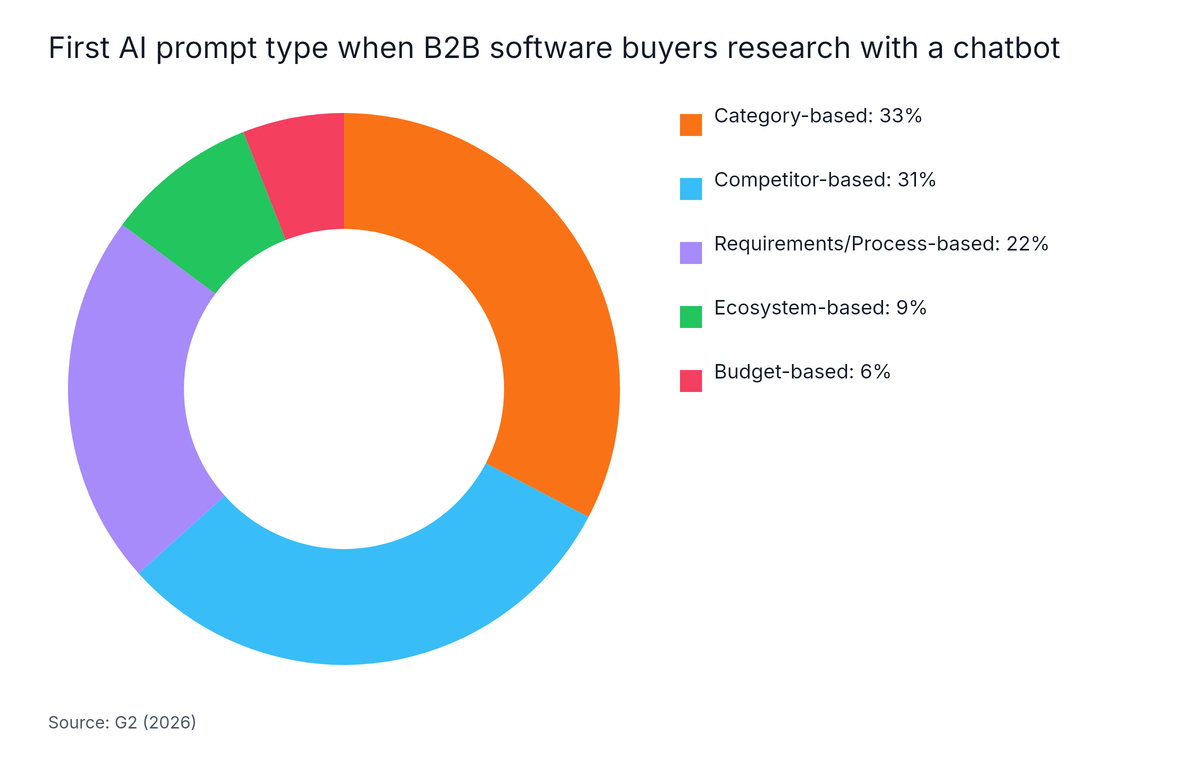
Source: G2, 2026
AI referrals convert slightly better than organic search in one large benchmark. Ruler Analytics, reported by Octo Agency, measured 5.8% for AI referrals, 5.4% for paid search and 4.9% for organic search across 110 million sessions in 13 industries (Octo Agency, 2026). That is far below the 5x lifts some pages claim. Ruler notes AI referral volumes remain small.
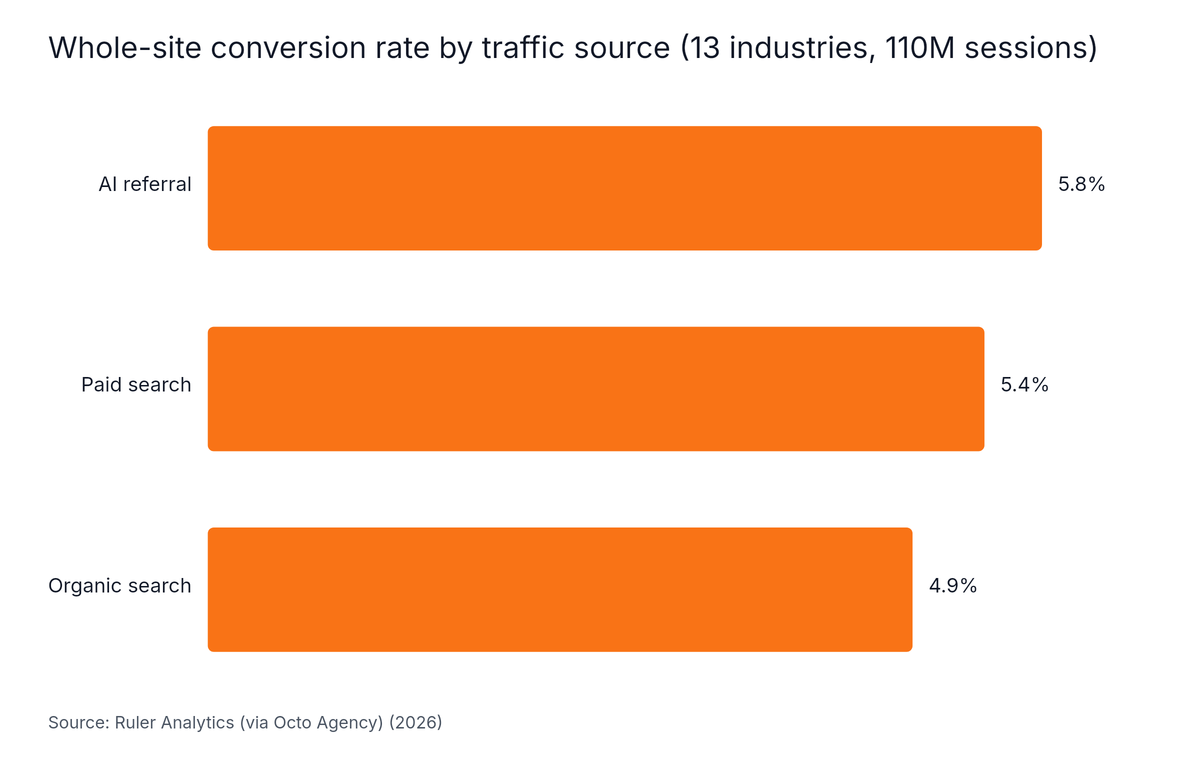
Source: Ruler Analytics (via Octo Agency), 2026
Pipe Rocket's counterpoint is volume. Across 53 B2B SaaS brands over eight months, organic search produced 37x more leads than all AI engines combined (Pipe Rocket, 2026). Pipe Rocket is a vendor, so read its data as directional.
AI search budgets mostly come from reallocation. Gartner's 2026 CMO Spend Survey, as re-reported by ThriveStack, found 56% of CMOs lack the budget for their strategy, with marketing budgets flat at 7.8% of revenue (ThriveStack, 2026). Fractl's survey, collected by Digiday in August 2026, puts the share of search and content budgets routed to AI visibility at 24% (Digiday roundup, 2026). Fractl's survey is a vendor survey, so treat the 24% as directional. Of the AI-visibility budget committed, the same roundup reports 32% sits with performance marketing, 31% with SEO, 21% with brand and 20% with content (Digiday roundup, 2026).
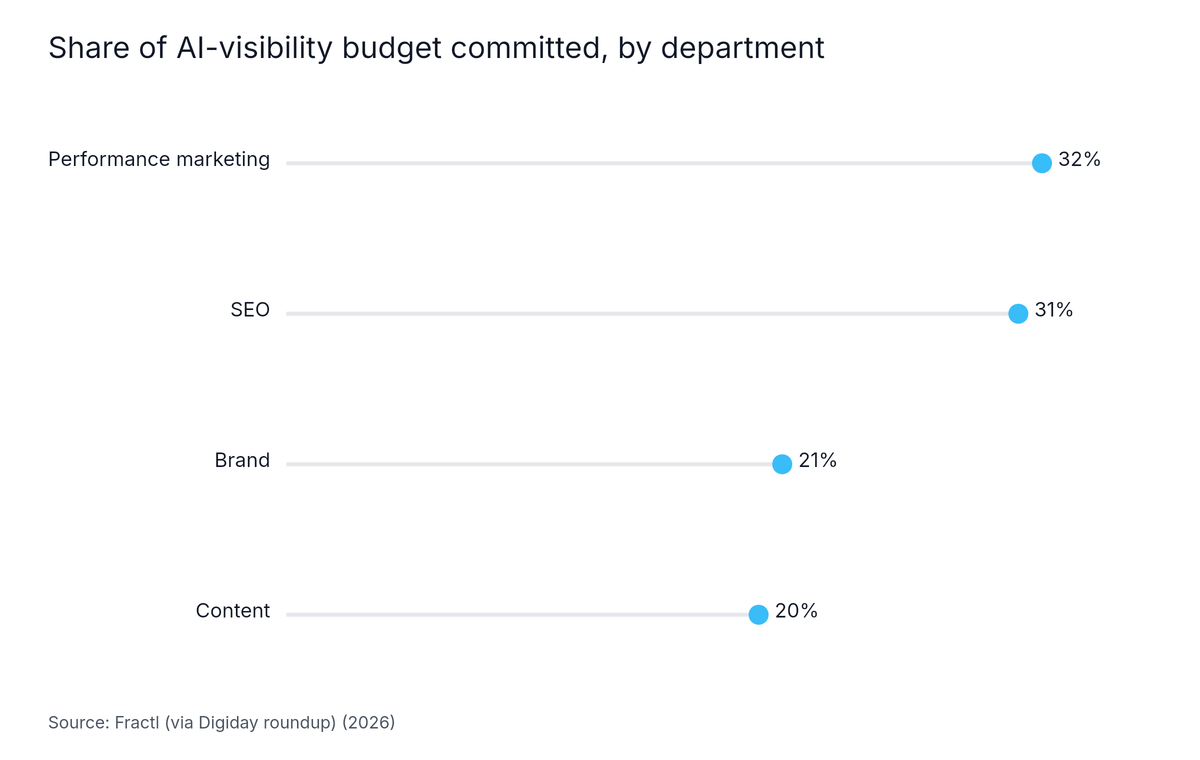
Source: Fractl (via Digiday roundup), 2026
Measurement is the other risk. In Digiday's 2026 reporting on marketer skepticism, Flex CEO Lauren Wang said "all of a sudden that information is opaque" (Digiday, 2026). Before paying, ask for raw responses, tracked prompt lists and citation tracking. See how to pick a tool with boardroom-ready numbers.
A six-month AEO or GEO engagement is the wrong purchase for a B2B company with a blocked or thin website, no way to tag AI-referred leads, or no budget line to reallocate. Agency retainers start around $3,000 per month (Red Engage, 2026), and 56% of CMOs say they lack budget for their 2026 strategy (ThriveStack, 2026).
Start with the minimum program, which costs hours rather than a retainer: fix crawler access, add an "AI assistant" option to the lead form and publish 10 answer pages. Gate any retainer on 90-day leading indicators. Six months of spend runs $9,000 to $36,000 across the $1,500 to $6,000 monthly band, so decide before signing.
A GEO agency typically charges $3,000 to $20,000 per month in retainers, and most mid-market B2B work lands at $5,000 to $10,000, according to a June 2026 analysis of 20 agencies by Red Engage (2026). One-time audits run $1,500 to $5,000. Red Engage is itself an agency, so treat the figures as seller-published.
A GEO or AEO agency costs roughly $1,500 to $12,000 per month depending on scope. Getspotted's 2026 playbook prices monitoring retainers at $1,500 to $5,000 and source-outreach retainers at $4,000 to $12,000. Scope drivers include keyword count, country count and reporting frequency. These are suggested US prices from a vendor, not a market sample.
An AEO agency costs about $600 to $3,000+ per month for monthly services and $1,800 to $6,000+ per month for full-scope campaigns, according to SEODIGIX's 2026 published price table. The table states no sample size. Buyers should ask which deliverables, such as content, citation tracking and reporting, sit inside each tier.
A GEO or AI visibility agency costs from about $1,500 per month for monitoring up to $20,000 per month for large retainers, based on 2026 figures from Getspotted and Red Engage. Self-serve software is far cheaper: the Semrush AI Visibility Toolkit starts at $99 per month per domain (Exposure Ninja, 2026), but it does not produce content or outreach.
Answer engine optimization costs from $99 per month for the Semrush AI Visibility Toolkit, a self-serve tracking add-on (Exposure Ninja, 2026), to $600 to $6,000+ per month for agency services (SEODIGIX, 2026). Over six months, $1,500 per month totals $9,000, which needs 0.4 deals at $30,000 ACV and 75% gross margin.
AI search visibility pricing has a clear shape once seller bias is stated. Software starts near $99 per month, agency retainers run $3,000 to $20,000, and this guide focuses on the $999 to $6,000 band.
Next step: plug your own ACV and margin into the AEO ROI calculator guide, then take the resulting deal count to your CFO before the first vendor call. For a vendor shortlist process, use the agency evaluation guide.
Written by
Ishan Manchanda
Ishan Manchanda is co-founder of GrowthSpree, a B2B SaaS marketing consultancy founded in 2017 that has managed $60M+ in ad spend across 300+ B2B SaaS companies. He focuses on demand generation, go-to-market strategy and pipeline growth, and has been featured in Silicon Valley Times, SaaS Mag and the Unbounce podcast.