Blog
AI Crawler Access Audit: How to Check Whether AI Assistants Can Read Your Site
Run an AI crawler access audit in five layers: robots.txt, CDN/WAF rules, rate limits, origin and rendering. Includes a per-bot policy table and owner model.
What an answer engine optimization agency does for B2B teams, how it is billed ($9K to $36K over six months), and three questions to ask before you sign.
 Ishan ManchandaNov 5, 2026
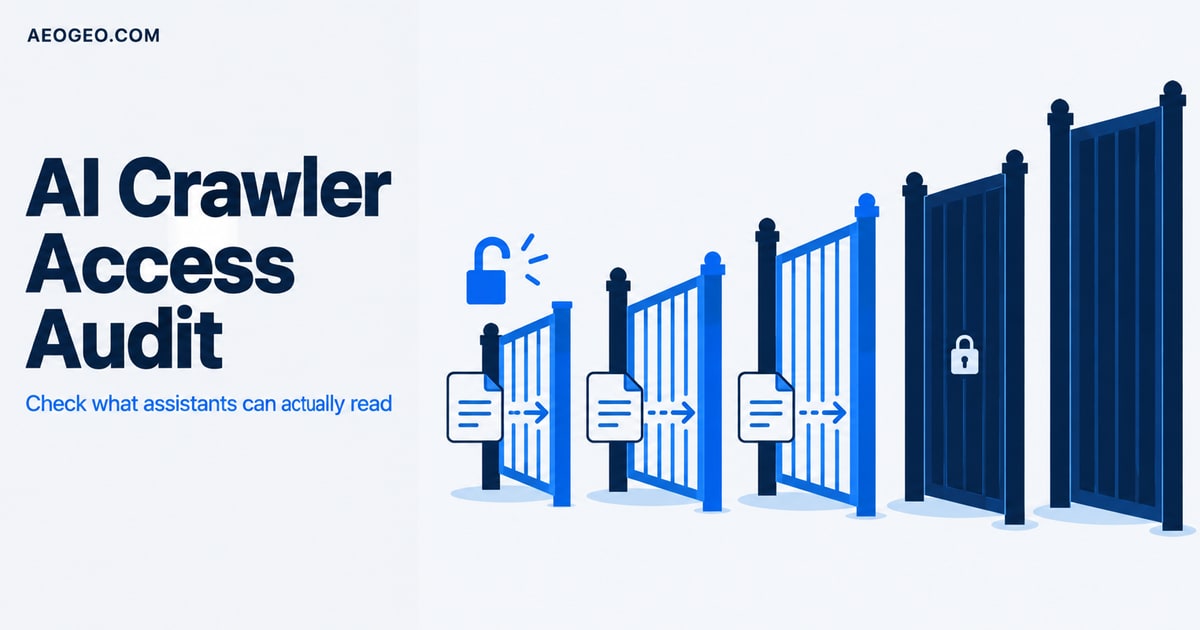
Run an AI crawler access audit in five layers: robots.txt, CDN/WAF rules, rate limits, origin and rendering. Includes a per-bot policy table and owner model.
A vendor-neutral scorecard for choosing who can help you get cited in AI answers: metrics, attribution, kill criteria, contract terms and break-even math.
AI search visibility platforms cost $99 to $20,000 a month. See dated price bands by source and the break-even math: 0.4 to 1.6 deals at $30K ACV.
Request a quote and our experts will contact you within 24 hours with tailored solutions and pricing.
aeogeo.app
Last updated: Nov 5, 2026
By Ishan Manchanda, co-founder of GrowthSpree.
An answer engine optimization agency is a firm that makes a B2B company's pages readable, citable and measurable inside AI answers from ChatGPT, Gemini, Claude and Perplexity, and it usually bills a six-month retainer. The stakes are concrete: 69% of software buyers chose a different vendor than planned because of chatbot guidance (G2, March 2026 survey). Yet six-month engagements run $9K to $36K with no agreed success metric, and most "best agency" lists are written by agencies. This guide gives the scope checklist, the billing models and three screening questions. A structured agency comparison framework covers shortlisting in more depth. Disclosure: aeogeo.com is a GrowthSpree property, and Salient by GrowthSpree is scored here by the same scorecard as every other vendor.
Key Takeaways
- An answer engine optimization agency should deliver four things: a crawler access audit, answer-ready pages, third-party corroboration and citation tracking tied to pipeline.
- Six months of retainer at $1,500, $3,000 and $6,000 a month costs $9,000, $18,000 and $36,000, which is 0.4 to 1.6 break-even deals at a $30,000 contract value and 75% gross margin.
- Three questions screen out most weak vendors: is a crawler access audit included, how is citation tracking done, and what is the pipeline attribution deliverable?
- Visibility tracking cannot prove revenue by itself, so a defensible engagement states its attribution method and a 90-day kill criterion up front.
An answer engine optimization agency audits whether AI crawlers can read a B2B company's site, restructures pages so assistants can extract answers, builds third-party corroboration, and tracks citations against a fixed prompt set. The work matters because 69% of software buyers chose a different vendor than planned after chatbot guidance (G2, March 2026 survey).

Answer engine optimization (AEO) is the practice of structuring a site so AI assistants can fetch, extract and cite its answers. Generative engine optimization (GEO) is the same discipline aimed at the responses generative AI engines compose. Agencies use the two terms interchangeably, and so does this guide.
G2's 2026 Buyer Behavior Report found that more than 80% of buyers have sourced software recommendations from an AI chatbot (G2, mid-2026). Its conclusion: "Winning means getting on the list before buyers start looking, and increasingly, that means showing up in AI answers." (G2, 2026)
A generative engine optimization agency covers what an SEO agency or content team usually does not: crawler policy by bot, extraction-ready answers, third-party corroboration and citation measurement. Overlap is real in crawlability, content quality and authority. The overlap between AEO and traditional SEO is mapped separately.
The break is measurement. AI answers are synthesized and vary by run, so success is citation frequency, not rank. A simple test: pick 10 queries where the company ranks in the top three and check whether it is cited. An agency that cannot explain a gap between the two lists is selling SEO under a new name.
Answer engine optimization services can come from four sources: an AEO-native agency, your current SEO agency with a written AEO scope, an in-house practitioner, or an independent consultant. Choose by who can own crawler access, measurement and content together, because more than 80% of buyers have sourced software recommendations from an AI chatbot (G2, mid-2026).
| Option | Fits when | Main risk |
|---|---|---|
| AEO-native agency | No internal owner and a need for audit, content and tracking together | Relabeled SEO work with no citation method |
| Current SEO agency | Overlap is high and the budget is tight | AEO added as a paragraph, not a deliverable |
| In-house practitioner | Engineering and RevOps already cooperate | One person asked for results with no tooling |
| Independent consultant | A scoped audit or a 90-day pilot is enough | No capacity for ongoing execution |
Hiring is only half of the question, because ownership spans five functions: content, product docs, engineering crawl access, RevOps measurement and product marketing. Name one accountable owner before signing anything. The in-house versus agency decision covers what to fund first.
An answer engine optimization agency is billed through one of five models: a one-off audit, a monthly retainer, a fixed project, a hybrid SEO add-on, or an outcome-tied fee. Retainers dominate, usually over six months, which is $9,000, $18,000 or $36,000 at $1,500, $3,000 or $6,000 a month. Buyers are already using chatbots for software research (G2, mid-2026).

| Billing model | What the buyer pays for | Best when | Watch for |
|---|---|---|---|
| One-off audit | Crawler access findings and a prioritized fix list | Access is unknown and the owner is unclear | No implementation or tracking after delivery |
| Monthly retainer | Ongoing content, corroboration and tracking | A fixed program is already scoped | Six-month lock-in with no exit or success metric |
| Fixed project | A defined deliverable, such as an answer-page set | A single launch or replatform | Scope ends before results can appear |
| Hybrid SEO add-on | AEO tasks folded into an SEO retainer | Overlap is high and budget is tight | Relabeled SEO work with no citation method |
| Outcome-tied fee | Payment linked to an agreed metric | Both sides accept a measurable metric | Metrics defined as "visibility" units |
Break-even deals is spend divided by (average contract value multiplied by gross margin). The figures below are illustrative and assume 75% gross margin.
Price points vary. GrowthSpree states that its own retainers start at $3,000 a month (company pricing, as of October 2026). Salient by GrowthSpree lists $999 and $1,500 a month on a six-month term (company pricing, launched September 2026).
| Monthly spend | Six-month commitment | Break-even deals at $30,000 ACV | Break-even deals at $100,000 ACV |
|---|---|---|---|
| $1,500 | $9,000 | 0.4 | 0.12 |
| $3,000 | $18,000 | 0.8 | 0.24 |
| $6,000 | $36,000 | 1.6 | 0.48 |
Cash out before the first 90-day signal runs from $4,500 to $18,000. Contracts should carry a 90-day exit tied to leading indicators. A deeper AEO return model can replace these placeholders.
Generative engine optimization services should include four layers beyond content writing: a crawler access audit, answer-ready page structure, third-party corroboration such as review-site presence, and per-engine citation measurement. Access comes first because a page an AI crawler cannot fetch cannot be cited, and 14.3% of the top 10,000 sites block GPTBot (AI Crawler Check, October 2026).
Source: AI Crawler Check (Horatos), 2026
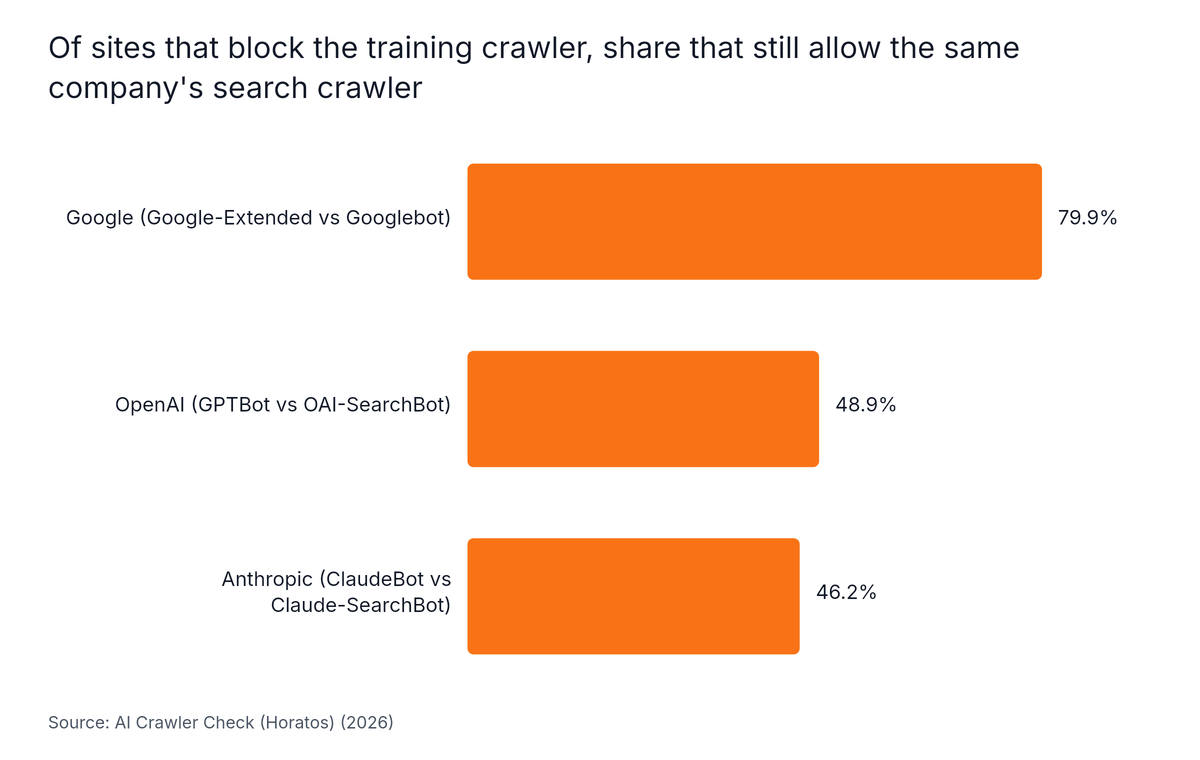
A crawler access audit checks, bot by bot and path by path, whether AI crawlers can fetch and render a company's public pages. Configuration is often inconsistent. Of the 710 sites blocking GPTBot, 347 (48.9%) still allow OAI-SearchBot (AI Crawler Check, October 2026). A second sample found 41 of 76 GPTBot blockers never mention OAI-SearchBot. It also found that 24.0% (120 of 500) fully block at least one AI crawler (Forage AI, 2026).
The chart shows the same split across vendors. Among sites that block Google-Extended, 79.9% still allow Googlebot. Among sites that block GPTBot, 48.9% still allow OAI-SearchBot. Among sites that block ClaudeBot, 46.2% still allow Claude-SearchBot (AI Crawler Check, October 2026). Per-bot policy, not one allow-or-block rule, is the deliverable.
A real scope lists these items in writing:
Answer engine optimization consulting should specify a frozen prompt set, repeated runs, per-engine reporting and a layered attribution method. Reporting should show how often a brand is cited, not a single screenshot, because 85% of software buyers think more highly of a vendor an AI chatbot cites (G2, March 2026 survey), while clicks on cited links stay rare.
Source: Pew Research Center, 2025
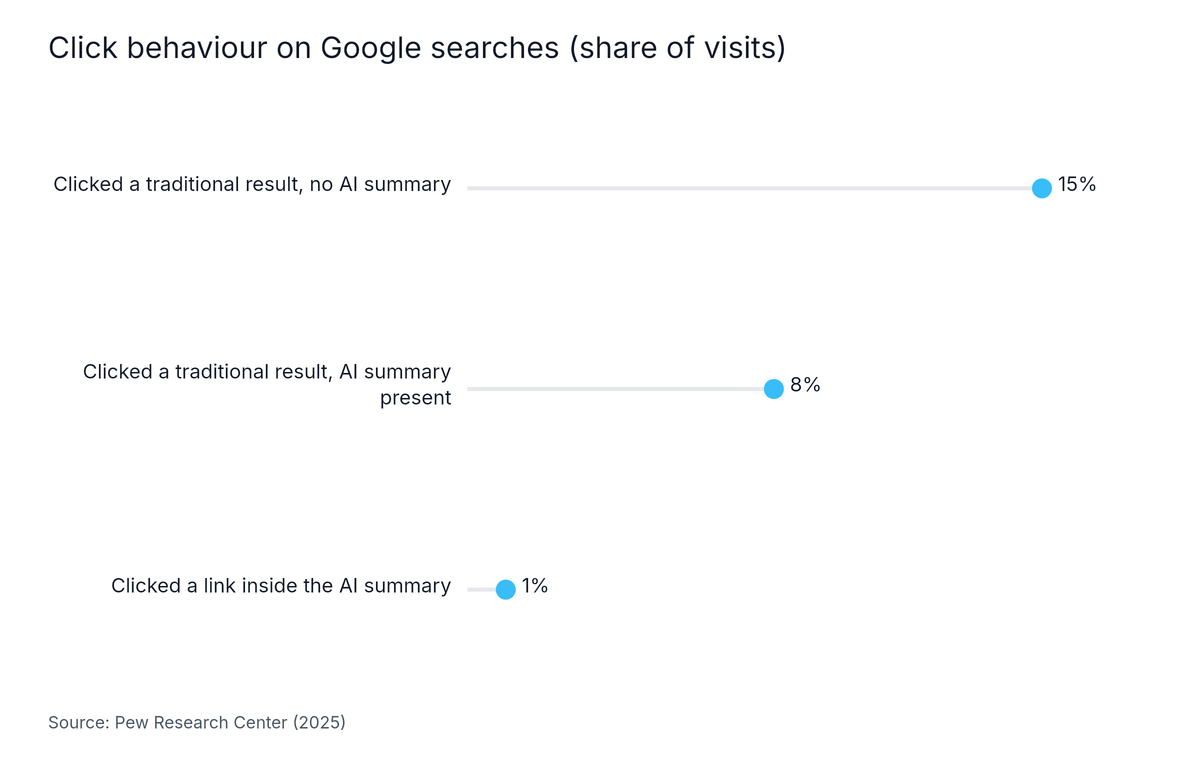
Click behavior explains why attribution is hard. Pew Research Center found that users clicked a traditional result in 8% of visits with an AI summary versus 15% without. They clicked a link inside the summary in about 1% of visits (Pew Research Center, July 2025). In Pew's words: "Users who encountered an AI summary clicked on a traditional search result link in 8 percent of all visits," (The Register, 2025). Google replied: "This study uses a flawed methodology and skewed queryset that is not representative of Search traffic." (PPC Land, 2025). Treat the figures as directional.
Citation tracking is the repeated measurement of how often a brand is cited in AI answers to a fixed set of prompts. A contract should name:
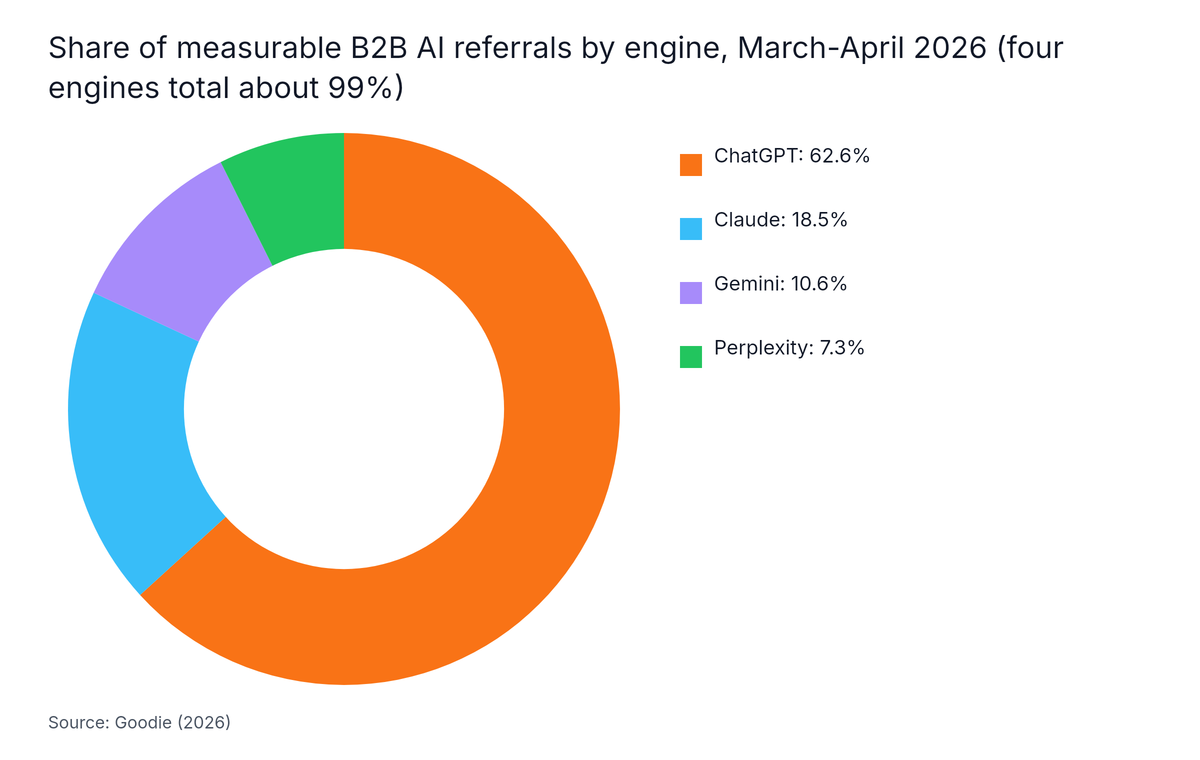
Engine share is itself contested. One vendor panel put ChatGPT at 62.6% of measurable B2B AI referrals in March to April 2026, down from 89.1% in May to August 2025, with Claude at 18.5% (Goodie, 2026). A secondary report of Previsible's data cites 92.4% for ChatGPT on trackable standalone LLM referrals (PropSaaS Growth, 2026). The original was not verified, so read it as proof that estimates conflict by method. Agencies should say which dataset they use.
Source: Goodie, 2026
Pipeline attribution here means tying AI-sourced visits and leads to opportunities, with the method and its limits stated. A defensible deliverable layers four things:
It must also say that visibility tracking cannot prove revenue by itself.
A B2B buyer should score an answer engine optimization agency on one scorecard with Pass, Unverified or Fail verdicts: crawler access audit, citation tracking method, pipeline attribution deliverable, exit terms and verifiable proof. Salient by GrowthSpree, an affiliate of aeogeo.com, is scored the same way below. The stakes are real: 33% of software buyers bought from a vendor they had never heard of (G2, March 2026 survey).

Three questions screen out most weak vendors:
| Criterion | Pass | Unverified | Fail |
|---|---|---|---|
| Crawler access audit | Per-bot policy by path, delivered before content work | Listed, but no sample output shown | Not offered, or a bullet point with no output |
| Citation tracking | Frozen prompt set, repeated runs, ranges reported | Listed, but method not stated | One-run dashboards or "visibility" units |
| Pipeline attribution | GA4, CRM and self-reported layers named | Listed, but format not shown | Promise of revenue proof from citations alone |
| Contract terms | 90-day exit tied to leading indicators | Exit terms not stated | Six months locked with no success metric |
| Proof | Named, checkable results with method | Company-reported only | Guaranteed rankings or unverifiable case studies |
Disclosure: Salient by GrowthSpree is affiliated with aeogeo.com. The scoring below uses only the Salient pitch deck and the pricing listing supplied for this guide, so each Unverified verdict means "not shown in those materials," not "absent."
| Criterion | Evidence in the materials reviewed | Verdict |
|---|---|---|
| Crawler access audit | No audit scope or sample output stated | Unverified |
| Citation tracking | Listed as part of the service; method not stated | Unverified |
| Pipeline attribution | Listed as part of the service; deliverable format not stated | Unverified |
| Contract terms | Six-month engagement at $999 or $1,500 a month; no exit clause stated | Unverified |
| Proof | Company-reported results, launched September 2026 | Unverified |
Our data: Salient by GrowthSpree reports 48,800 citations, $165,000+ pipeline and $70,000 media-equivalent across its clients (Salient pitch deck, launched September 2026). These are company-reported figures, not independent research.
To compare any vendor, give each 20 to 30 real commercial prompts. Ask for a mini audit showing where the company appears and who is named instead. For more context, see how an AEO agency fits B2B SaaS.
The answer engine optimization agency buyer's guide on aeogeo.com is not for companies that cannot yet be crawled, teams that need guaranteed rankings, or very small teams that cannot fund a retainer. The evidence base is thin: a July 2026 critical survey of 45 GEO studies found no technique with a stable, longitudinal, cross-platform causal effect (arXiv, July 2026).

Three caveats apply. First, no agency can guarantee citations, and any that does is a red flag. Second, the break-even figures in this guide are illustrative, not predictions, and Google disputed Pew's click data.
Third, a 25-person company may not need a retainer at all. A minimum program costs hours, not $9,000: fix crawler access, add "AI assistant" to the lead form, and publish 10 answer pages. Judge it at 90 days on leading indicators before committing to six months.
A real generative engine optimization service includes a crawler access audit, per-bot robots.txt and CDN policy, answer-ready page structure, third-party corroboration, and citation tracking on a frozen prompt set. Content writing is one input. Without access and measurement, new pages cannot be fetched or proven, so the first deliverable should be the access audit, not articles.
No list can be trusted on its own, so test each generative AI search engine optimization agency against three requirements: a crawler access audit in scope, a written citation tracking method, and a pipeline attribution deliverable. Agencies that cannot show all three are usually SEO retainers with a new label. Ask for a mini audit on 20 to 30 of your real prompts.
A generative engine optimization agency covers crawler policy by bot, extraction-ready answers, third-party corroboration and citation measurement, which SEO agencies and content teams rarely own. Overlap exists in crawlability, content quality and authority. The break is measurement: AI answers are synthesized and vary by run, so success is citation frequency, not rankings.
Answer engine optimization for B2B is run by a specialist agency, an in-house team, or a split of the two, but ownership spans five functions: content, product docs, engineering crawl access, RevOps measurement and product marketing. Name one accountable owner first. Then run a Day-One Shortlist Test: type 20 buyer prompts into AI assistants and record which vendors are named instead of you.
Answer engine optimization consulting should scope a crawler access audit, a frozen prompt set run repeatedly across engines, a frequency range for citations, GA4 and CRM tagging for AI-referred and self-reported leads, and a 90-day kill criterion. It should also state plainly that visibility tracking cannot prove revenue on its own.
Hiring an answer engine optimization agency is a scoping decision before it is a vendor decision. Require a crawler access audit, a written citation tracking method and a pipeline attribution deliverable, then check the math: six months at $3,000 a month is $18,000. Buyers are moving fast, since more than 80% have sourced software recommendations from a chatbot (G2, mid-2026).
Get the weekly brief for dated platform changes and what each means for a B2B revenue team.
Written by
Ishan Manchanda
Ishan Manchanda is co-founder of GrowthSpree, a B2B SaaS marketing consultancy founded in 2017 that has managed $60M+ in ad spend across 300+ B2B SaaS companies. He focuses on demand generation, go-to-market strategy and pipeline growth, and has been featured in Silicon Valley Times, SaaS Mag and the Unbounce podcast.
© 2026 aeogeo.app All rights reserved.