Blog
AI Crawler Access Audit: How to Check Whether AI Assistants Can Read Your Site
Run an AI crawler access audit in five layers: robots.txt, CDN/WAF rules, rate limits, origin and rendering. Includes a per-bot policy table and owner model.
GEO agency vs SEO agency: see which deliverables overlap, which are GEO-specific, and whether to expand an SEO retainer or hire separately, with cited data.
 Ishan ManchandaNov 9, 2026
Run an AI crawler access audit in five layers: robots.txt, CDN/WAF rules, rate limits, origin and rendering. Includes a per-bot policy table and owner model.
A vendor-neutral scorecard for choosing who can help you get cited in AI answers: metrics, attribution, kill criteria, contract terms and break-even math.
AI search visibility platforms cost $99 to $20,000 a month. See dated price bands by source and the break-even math: 0.4 to 1.6 deals at $30K ACV.
Request a quote and our experts will contact you within 24 hours with tailored solutions and pricing.
Last updated: Nov 9, 2026
By Ishan Manchanda, co-founder of GrowthSpree (the group behind aeogeo.com and its sister service Salient). Last updated October 28, 2026.
A GEO agency is a firm that gets a brand cited and recommended inside AI-generated answers, whereas an SEO agency ranks pages in search results; both share crawlability, content and authority work.
In a geo agency vs seo agency decision, the risk is paying for a retainer that reports rankings while buyers take answers from AI assistants. Ahrefs estimated that an AI Overview cut position-1 click-through rate by 34.5% (Ahrefs, 2025). This guide maps which deliverables a competent SEO retainer already covers, which work is GEO-specific, and when to expand a retainer versus hire separately. It also shows how answer engine optimization differs from traditional SEO, how per-bot crawler policy works and how to measure answers that change every run. Nothing here argues for cancelling SEO. The scope is additive.
Key Takeaways
- A GEO agency adds citation tracking, answer-fit testing, per-bot crawler policy and repeated-run measurement to the crawlability, content and authority work an SEO agency already does.
- Google says optimizing for generative AI search is "still SEO" for its own surfaces, so SEO work remains the base for AI Overviews and AI Mode.
- Only 38% of AI Overview citations came from top-10 pages in 2026, down from 76% in July 2025 (Ahrefs, 2026), so ranking well no longer guarantees being cited.
- AI brand lists almost never repeat across runs (SparkToro, 2026), so a credible GEO report shows visibility rate over many runs, not a single rank.
In this guide: the core difference, the overlap, why it matters now, GEO-specific work, measurement, how to choose, how to evaluate, and limits.
A GEO agency differs from an SEO agency mainly in what it measures and what it adds. An SEO agency covers crawlability, content quality and authority to earn rankings. A GEO agency adds citation tracking, answer-fit testing, per-bot crawler policy and repeated-run measurement to earn mentions inside AI answers, and it treats SEO work as the shared base.

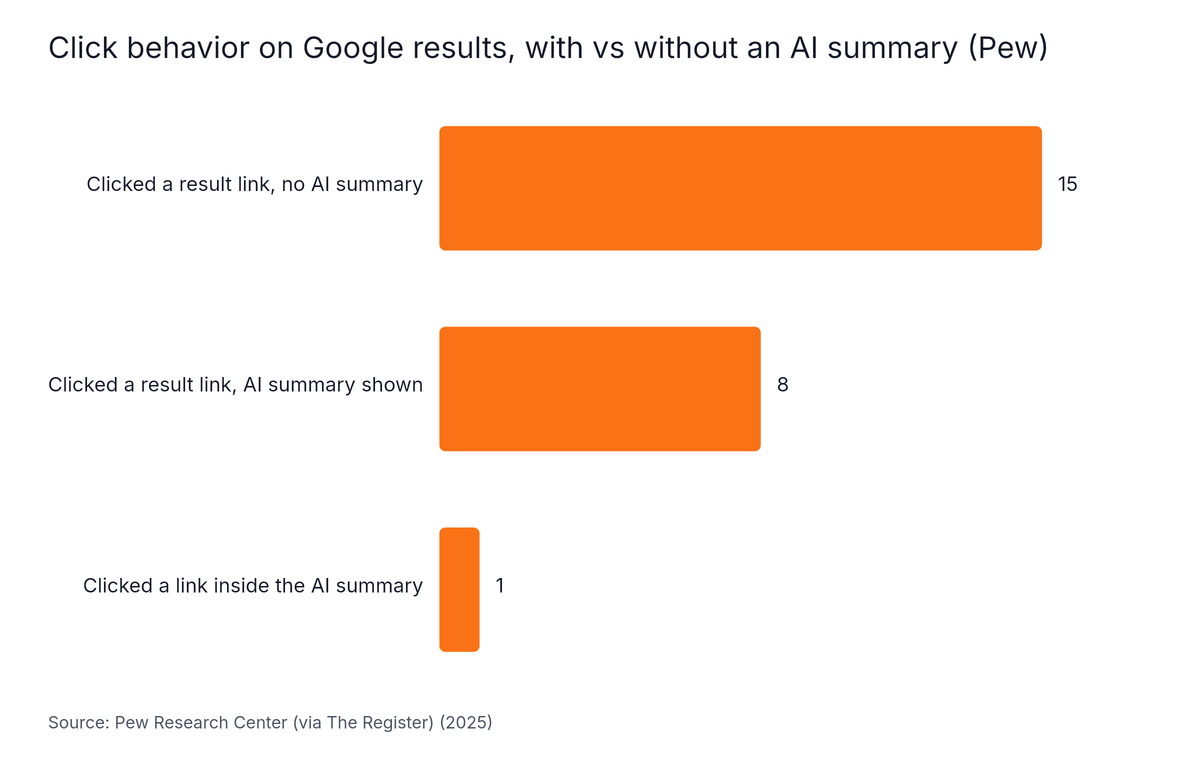
The reason this matters is click behavior. Pew found users clicked a result link in 8% of visits with an AI summary versus 15% without (Pew Research Center, 2025).
SEO (search engine optimization) is the practice of earning visibility and clicks from ranked search results. GEO (generative engine optimization) is the practice of making a brand's content easy for AI assistants to retrieve, cite and recommend inside generated answers. AEO (answer engine optimization) is a closely related term for the same goal, and this article uses GEO for both.
The table below is a scoping synthesis, not a measured benchmark. It shows where a standard SEO retainer usually ends and where GEO-specific work begins.
| Deliverable | Usually inside an SEO retainer | GEO-specific addition |
|---|---|---|
| Crawlability and indexation | Yes: robots.txt, sitemaps, rendering, indexation | Separate rules for AI training, search and user-triggered bots |
| Content quality | Yes: intent match, depth, originality | Answer-fit testing: does the page state the exact answer in an extractable form |
| Authority and links | Yes: backlinks, brand signals | Third-party mentions that AI assistants draw on when naming vendors |
| Reporting | Rankings, clicks, organic sessions | Citation, mention and recommendation tracking over repeated runs |
| Platforms | Google and Bing results | ChatGPT, Perplexity, Claude, Gemini and Google AI surfaces |
Read the table row by row. The first three rows are shared ground. The last two are where most retainers have no existing line item.
GEO is not simply SEO renamed, but the two overlap heavily. Google says optimizing for generative AI search is still SEO for its own surfaces, yet only 38% of AI Overview citations came from top-10 pages in 2026, down from 76% in July 2025 (Ahrefs, 2026). Non-Google assistants such as ChatGPT and Perplexity add crawler, citation and measurement work that a standard SEO retainer rarely includes.

Google's May 2026 documentation states plainly: "From Google Search's perspective, optimizing for generative AI search is optimizing for the search experience, and thus still SEO." (Google for Developers, 2026). It adds that "our generative AI features on Google Search are rooted in our core Search ranking and quality systems" (Google for Developers, 2026).
That guidance covers AI Overviews and AI Mode only. It says nothing about ChatGPT, Perplexity or Claude. A buyer who scopes work for Google surfaces and a buyer who scopes work for non-Google assistants are therefore asking different questions.
The overlap is real but shrinking, and it depends on method. Ahrefs attributes the drop to fan-out sub-queries that pull citations from deeper in the index. A different dataset put the overlap at 52% of organic-ranked citations (Originality.ai, 2025).
| Study | Finding | Method |
|---|---|---|
| Ahrefs (2026) | Top-10 share of AI Overview citations fell from the July 2025 level to 38% | 863,000 keyword SERPs and about 4 million AI Overview URLs |
| Originality.ai (2025, publication month estimated as November) | 52% of organic-ranked citations appear in the top 10; about 9 in 10 come from the top 30 | Only citations overlapping the top-100 results; 48% of all citations overlapped the top 100 |
Both are vendor studies. The practical reading is simple: test your own queries rather than trusting any single overlap number.
The SEO versus GEO question matters now because AI summaries reduce clicks even when a page ranks first. Ahrefs estimated that an AI Overview cut position-1 click-through rate by 34.5% in 2025 (Ahrefs, 2025) and later reported 58% on December 2025 data (MediaNama, 2026). Pew found only 1% of visits with an AI summary led to a click inside the summary (The Register, 2025).
An AI Overview is a generated summary that Google Search shows above the traditional results for some queries. Pew's analyst summarized the click gap this way: "Users who encountered an AI summary clicked on a traditional search result link in 8 percent of all visits." (The Register, 2025). The comparison group, visits without an AI summary, clicked in 15% of visits (Pew Research Center, 2025).
Source: Pew Research Center (via The Register), 2025
Two points follow for agency scope. First, a lower click rate means rankings alone misstate impact, so a citation or mention KPI needs its own line in the retainer. Second, a citation does not guarantee a visit, as the 1% in-summary click rate shows. Reporting must say what a citation is worth before it promises revenue.
A GEO agency adds four kinds of work to a standard SEO scope: citation tracking across AI assistants, answer-fit testing of individual pages, per-bot crawler policy, and measurement built for non-deterministic answers. In a 2026 study of 4,962 robots.txt files, 14.3% of top sites blocked GPTBot, yet about half of those blockers still allowed OAI-SearchBot (AICrawlerCheck, 2026).

Citation tracking is logging which brands and URLs an AI assistant names across a fixed set of prompts. A useful log separates three outcomes: a citation (a linked source), a mention (the brand named in text) and a recommendation (the brand proposed as an option). An SEO rank tracker records none of these.
Answer-fit testing is checking whether a page states the exact answer to a target question in a form an AI assistant can extract. Google's guidance supports the content standard behind it: "Don't just recycle what others on the internet have already said, or could easily be produced by a generative AI model." (Google for Developers, 2026). A practical test takes ten queries where a page already ranks in the top three and checks whether it is cited.
Per-bot policy is setting separate crawler rules for each AI bot by purpose and by site path. The AICrawlerCheck figures come from 4,962 domains in the Tranco top 10,000 that returned a real robots.txt file: 347 of the 710 GPTBot blockers still allowed OAI-SearchBot. It is a vendor study with a stated denominator.
| Bot | Purpose | Policy question |
|---|---|---|
| GPTBot | Training data collection | Allow or block, decided on intellectual-property position |
| OAI-SearchBot | Supports ChatGPT search results | Blocking it can remove a site from ChatGPT search |
| ChatGPT-User | User-triggered fetches | robots.txt may not apply to user-triggered fetchers |
| ClaudeBot, Google-Extended | Training use | Decide separately from search bots |
| PerplexityBot | Search and retrieval | Usually allowed on public marketing and docs paths |
OAI-SearchBot is the OpenAI crawler that supports ChatGPT search results. Blocking GPTBot does not remove a site from ChatGPT search, but blocking OAI-SearchBot does. A single allow-or-block rule is therefore the wrong design. Most SEO retainers cover robots.txt hygiene, but few set policy by bot purpose and path.
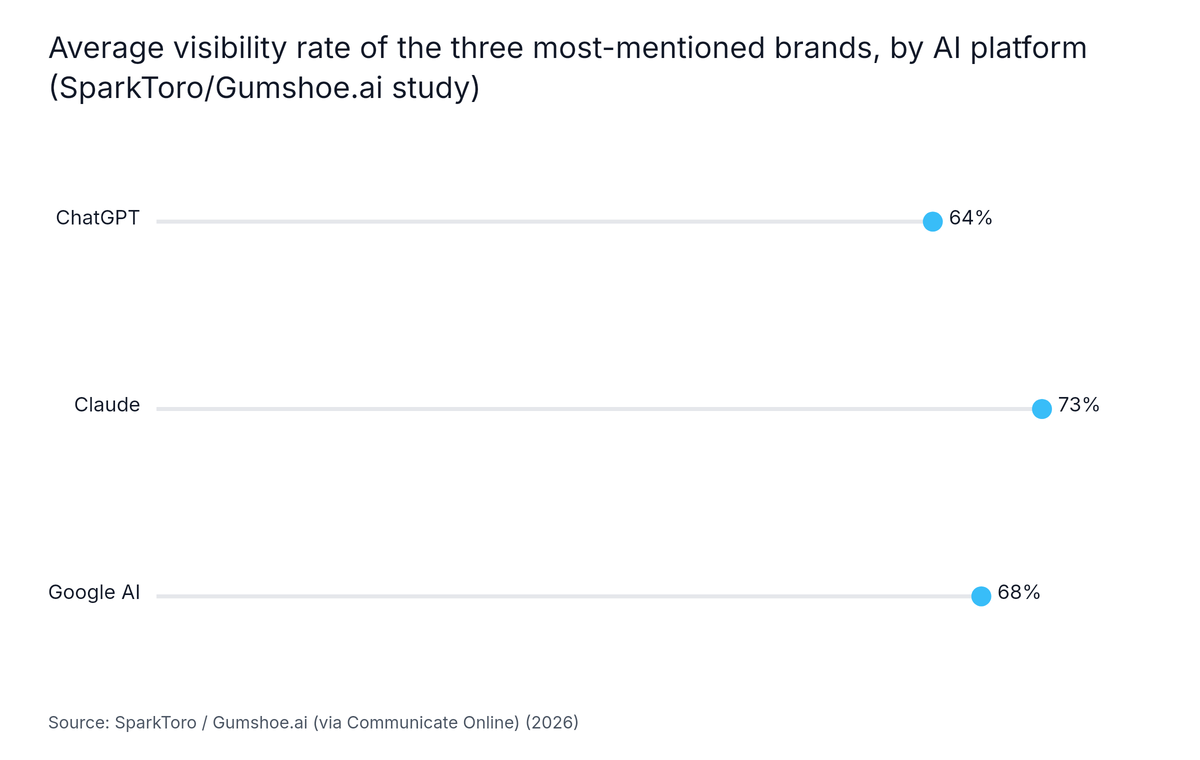
GEO agencies measure results by running a fixed prompt set many times and reporting visibility rate as a range, not a rank. SparkToro and Gumshoe.ai found the three most-mentioned brands averaged 64% visibility on ChatGPT, 73% on Claude and 68% on Google AI (Communicate Online, 2026), far steadier than the order of any brand list.

Visibility rate is the share of AI responses to a prompt set that mention a brand. The underlying study had 600 volunteers run 12 prompts 2,961 times on ChatGPT, Claude and Google AI in November and December 2025. It found less than a 1-in-100 chance of the same list of brands and roughly 1-in-1,000 of the same order (PPC Land, 2026; primary write-up by SparkToro, 2026). The study has not been peer-reviewed, and its partner sells visibility tracking, so the numbers show direction, not precision.
Source: SparkToro / Gumshoe.ai (via Communicate Online), 2026
Rand Fishkin, SparkToro co-founder and study co-author, drew the measurement conclusion directly: "any tool that gives a 'ranking position in AI' is full of baloney" (PPC Land, 2026). That is why a single rank check cannot anchor a retainer.
For a view of what tracking software does and where it falls short, see the guide to AI search visibility tools for B2B SaaS.
Choosing a GEO agency starts with one test: expand the existing SEO retainer if the agency can show prompt-panel measurement, per-bot policy and answer-fit testing, and hire a separate GEO agency if it cannot. The scope is additive: Pew found only 1% of visits with an AI summary led to a click inside it (The Register, 2025), so citation work needs its own line.
| Situation | Expand the SEO retainer | Hire a separate GEO agency |
|---|---|---|
| Agency can show prompt-panel size and run counts | Fits | Not needed |
| Agency reports only rankings and sessions | Weak fit | Fits |
| Need covers Google AI Overviews and AI Mode only | Often fits, since the work is core SEO | Optional |
| Need covers ChatGPT, Perplexity and Claude | Fits only with added crawler and tracking work | Fits |
| Engineering must set per-bot policy by path | Needs a named owner either way | Needs a named owner either way |
Take a hypothetical B2B software company whose SEO agency already handles crawlability, content and links. The company now wants to appear in ChatGPT and Perplexity answers. It asks the agency for three things within an agreed window: a prompt panel with run counts, a per-bot robots.txt proposal and an answer-fit test on its ten most important pages. If the agency delivers, the retainer expands. If it returns rankings and sessions only, the company adds a GEO specialist and keeps the SEO agency on technical and content foundations.
A hybrid is common. The decision rule is evidence, not labels. Ask what each party will deliver first and how it will be measured. A structured way to compare vendors is the framework for choosing an AEO or GEO agency.
Our data: Salient by GrowthSpree, the managed GEO service from the group behind aeogeo.com (affiliation disclosed), reports 48,800 citations, $165,000+ pipeline and $70,000 media-equivalent across its clients (Salient pitch deck, service launched September 2026). These are the service's own reported figures from its pitch deck, not independent research, and they have not been re-checked against a live page.
An SEO agency that only rebranded as a GEO agency typically reports rankings and traffic but cannot show prompt-panel size, repeated run counts or per-bot crawler decisions. Ask for those three items first. Per-bot policy is already common practice: 14.3% of 4,962 top-site robots.txt files block GPTBot, yet 347 of 710 blockers still allow OAI-SearchBot (AICrawlerCheck, 2026).

The measurement standard is equally clear. Rand Fishkin put it this way: "visibility % across dozens to hundreds of prompts run multiple times is a reasonable metric" (PPC Land, 2026). An agency that cannot describe its panel and run counts is not following it.
Agencies that answer with rankings, keyword counts or a single proprietary score are describing an SEO scope under a new name.
The GEO agency vs SEO agency comparison in this guide does not apply to buyers who need local map-pack work or guaranteed citations. The evidence is also thin in places: the SparkToro study (2026) is not peer-reviewed, and overlap figures range from 38% (Ahrefs, 2026) to 52% (Originality.ai, 2025) by method. No source here gives reliable pricing or timelines.
Blocking GPTBot does not remove a site from ChatGPT search, but blocking OAI-SearchBot does. GPTBot is OpenAI's training crawler, while OAI-SearchBot supports search results. In a 2026 study of 4,962 robots.txt files from top sites, 14.3% blocked GPTBot, and 347 of the 710 blockers still allowed OAI-SearchBot (AICrawlerCheck, 2026).
A top-10 ranking is not required to be cited in Google AI Overviews, but it still helps. Ahrefs found 38% of AI Overview citations came from top-10 pages in 2026, down from 76% in July 2025 (Ahrefs, 2026). Originality.ai reported 52% among organic-ranked citations (Originality.ai, 2025). Results depend on method, so test your own queries.
Google says optimizing for generative AI search is still SEO and that no special tactics are required. Its May 2026 documentation states that llms.txt, content chunking, AI-specific rewriting and special schema are not needed for Google's AI features (Google for Developers, 2026). The guidance covers AI Overviews and AI Mode only, not ChatGPT, Perplexity or Claude.
GPTBot, OAI-SearchBot and ChatGPT-User are three separate OpenAI agents with different purposes. GPTBot collects training data, OAI-SearchBot supports search results, and ChatGPT-User is a user-triggered fetcher. Practitioner guides in 2026 treat each as its own robots.txt decision and note that robots.txt may not apply to user-triggered fetchers (AICrawlerCheck, 2026).
Google states that llms.txt, content chunking, AI-specific rewriting and special schema are not needed for its AI features on Google Search (Google for Developers, 2026). The documentation does not cover ChatGPT, Perplexity or Claude, so benefits there are unproven. Treat these tactics as speculative until a test on your own prompt set shows a change in citations.
A GEO agency and an SEO agency share a foundation, and the useful question is which extra deliverables a retainer needs. The main points:
Continue learning: the guide to evaluating and shortlisting an AEO or GEO agency adds reference checks and red flags.
Next step: Get the weekly brief for dated, sourced updates on AI search platform changes and what they mean for agency scope.
Written by
Ishan Manchanda
Ishan Manchanda is co-founder of GrowthSpree, a B2B SaaS marketing consultancy founded in 2017 that has managed $60M+ in ad spend across 300+ B2B SaaS companies. He focuses on demand generation, go-to-market strategy and pipeline growth, and has been featured in Silicon Valley Times, SaaS Mag and the Unbounce podcast.