Request a quote and our experts will contact you within 24 hours with tailored solutions and pricing.
How to Get Cited in AI Answers: Access, Answer Fit and Trust
By Ishan Manchanda, co-founder of GrowthSpree, a B2B SaaS marketing consultancy founded in 2017 that has managed $60M+ in ad spend across 300+ B2B SaaS companies. Last updated: October 28, 2026.
Getting cited in AI answers means making your pages fetchable by AI crawlers, shaped to answer the exact question, and corroborated by third-party sources, because ranking position alone does not decide which brands ChatGPT names. A B2B software team can hold three top-three rankings and still watch an assistant recommend three competitors. That gap has causes, and each one can be diagnosed. This guide shows how to get cited in AI answers by testing three layers in order: access, answer fit and trust. It also covers a measurement method finance will accept, and how to judge tools without taking a vendor's word for it. For tested tactics, see GEO and AEO techniques with evidence behind them.
Key Takeaways
AI citation needs three conditions at once: crawler access, an extractable answer to the exact question, and third-party corroboration. Publishing more fixes none of them.
Rank and citation are different things: 28.3% of ChatGPT's most-cited pages have zero organic visibility in Google (The Digital Bloom, 2026, reporting Ahrefs).
Paid and advertorial content is only 0.3% of AI citations (Muck Rack, 2026), so buying placement will not close a citation gap.
A single prompt check is noise. Citation frequency, meaning cited in x of N runs, should be reported as a range with the method stated.
The best AI answer visibility tool is the one that passes transparent criteria on prompts, run counts, parsing and exports, not the one with the best dashboard.
How do I get my brand cited in AI answers?
To get your brand cited in AI answers, pass three tests in order: AI crawlers can fetch the page, the page answers the exact question in extractable form, and independent third parties corroborate the brand. Muck Rack's 2026 analysis of 207 million citations found paid content is only 0.3% of AI citations, so earned corroboration carries the weight.
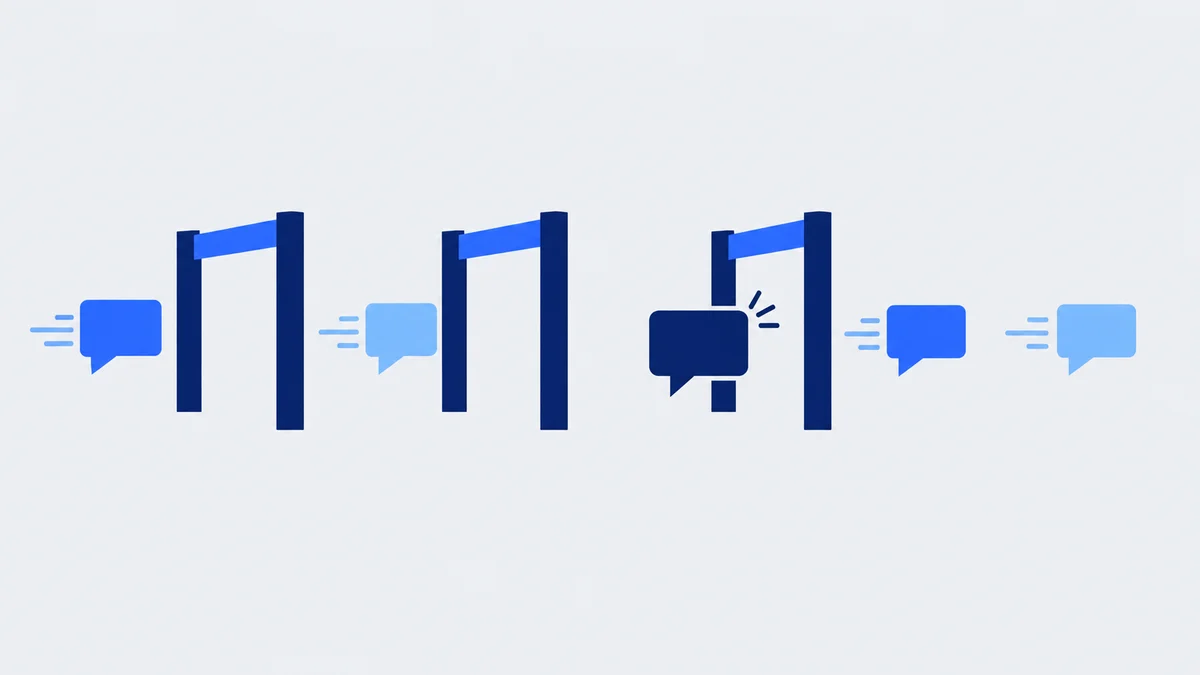
Flat illustration of a speech bubble passing through three numbered gates
A citation is a link or named source an AI engine shows as support for its answer. The 0.3% figure comes from Muck Rack's dataset of more than 40 million AI responses and 207 million citations, where about 99% of cited links come from non-paid sources (Muck Rack, 2026; vendor-published).
The Failure-Point Test is a three-part diagnostic: can the machine read the page, does the page answer the exact question, and is the source trusted. The table shows how each failure looks and what to fix first.
Failure point
Symptom in your words
How to detect it
First fix
1. Access
"We rank, but the assistant never names us"
Server logs show no AI bot hits, or robots.txt and CDN rules block them
Allow search and retrieval bots on public paths
2. Answer fit
"Bots visit, but we are never the cited page"
The page buries the answer or does not match the buyer's question
Add an answer-first paragraph under each question heading
3. Trust
"Competitors appear across many sources, we appear on our own site"
Few independent mentions in trade press, directories and video
Earn independent coverage and accurate third-party profiles
Why does ChatGPT name competitors when you rank in the top three?
ChatGPT draws on sources that only partly overlap with Google's results. A secondary agency report citing Ahrefs analyses found only 6.82% of ChatGPT results overlap with Google's top 10, and that 28.3% of ChatGPT's most-cited pages have zero organic visibility in Google (The Digital Bloom, 2026).
Overlap figures vary widely by method and dataset, so treat any single number as indicative and verify it against the originals. Rank still helps. It is one input, not the verdict.
How to get cited in AI answers: where does citation break down?
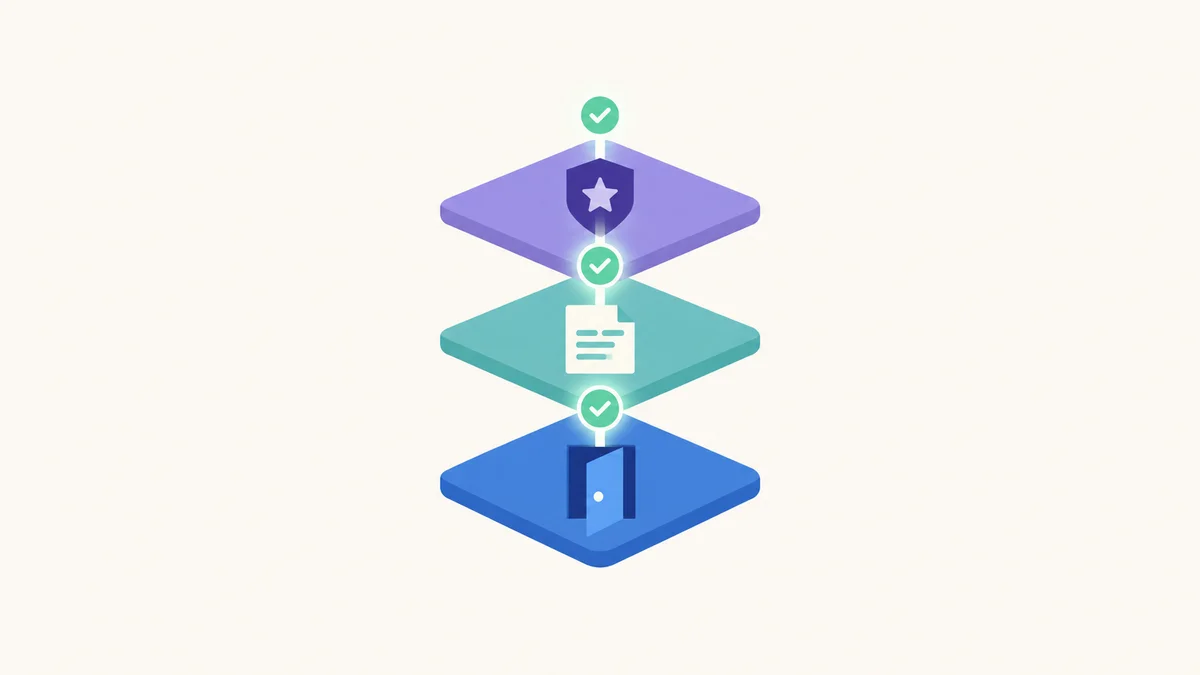
To get cited in AI answers, find which of three layers fails: access (crawlers cannot fetch or parse the page), answer fit (the page does not answer the exact question in extractable form), or trust (independent sources do not corroborate the brand). Diagnose in that order, because a page an AI crawler cannot fetch cannot be cited, however good it is.
Flat illustration of three stacked layers marked by a door, a document and a badge
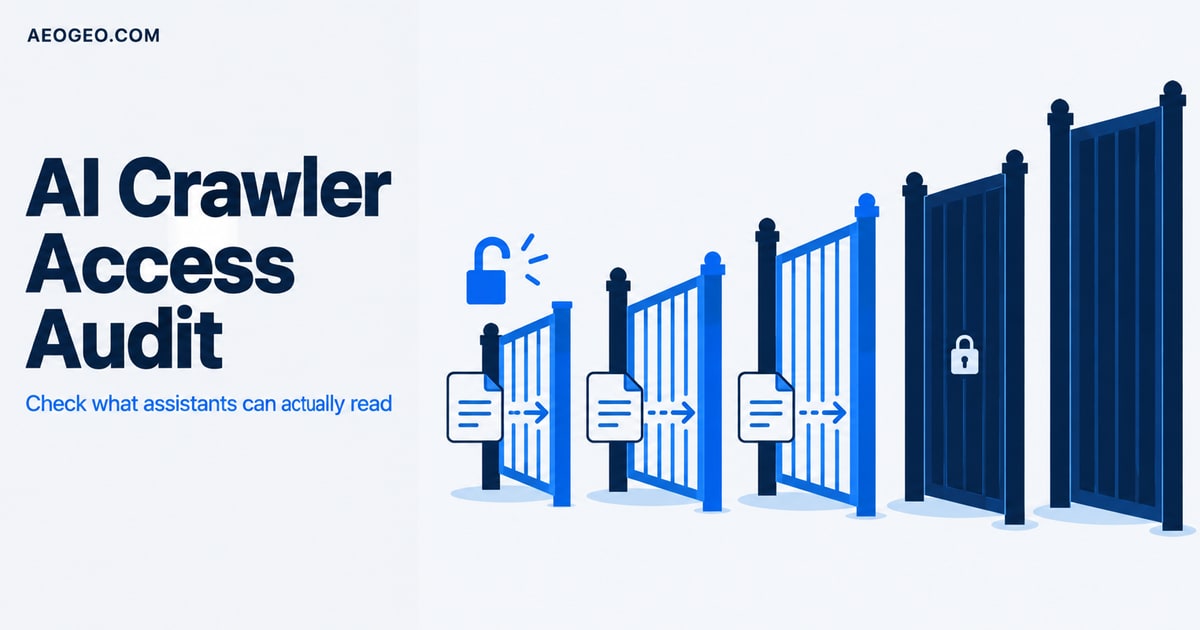
Failure point 1: Can AI crawlers read your site?
OAI-SearchBot is OpenAI's crawler for ChatGPT search. OpenAI's documentation is blunt: "Sites that are opted out of OAI-SearchBot will not be shown in ChatGPT search answers" (OpenAI Developers, 2026). OpenAI treats search (OAI-SearchBot), training (GPTBot) and user-initiated fetches (ChatGPT-User) as separate settings, so one allow-or-block rule is wrong.
Access is set in four layers, often owned by four teams: robots.txt, CDN and WAF bot rules, page rendering, and logins or paywalls. A CDN or WAF rule can block AI crawlers without anyone in marketing deciding it should.
To check and fix access:
List who owns robots.txt, CDN and WAF rules, rendering and gated content.
Set a per-bot policy by path. Allow search and retrieval bots on public marketing and docs paths, and decide training bots separately.
Serve key pages as server-rendered HTML, so crawlers that do not run scripts can still read them.
Read server logs to confirm AI bots reach the pages.
Retest after about 24 hours, the lag practitioners report for robots.txt changes to reach search results (Momentic Marketing, 2026).
Failure point 2: Does each page answer the exact question?
Answer fit is how well a page answers the exact buyer question in a form an AI engine can lift out. Pages fail here when the answer sits in paragraph six, the heading names a topic instead of the question, or a comparison hides inside prose.
Fix it page by page:
Use the buyer's phrasing as the heading, such as "What is the best tool for X?"
Put a 40 to 80 word answer directly under it that names the subject in full.
Put options, steps and criteria in lists or tables.
Date time-bound facts and link the source.
Do not chase markup as a silver bullet. Google's May 2026 guide says SEO fundamentals remain foundational and that llms.txt and special AI markup are not needed (Google Search Central, 2026).
Failure point 3: Is your brand corroborated by third parties?
Third-party corroboration means independent sources mention your brand in ways an AI engine can cross-check. Journalism's share of AI citations fell from 27% to 22% in Muck Rack's fourth edition, while owned, government and encyclopedic sources gained ground (Muck Rack, 2026). The mix shifts, so a single outlet is a weak bet.
Video matters as well. YouTube brand mentions showed a Spearman correlation of about 0.737 with AI visibility, and branded web mentions correlated between 0.66 and 0.71 (The Next Web, 2025, reporting an Ahrefs study). That is correlation, not causation, and Ahrefs is a tool vendor.
Google also lists seeking artificial brand mentions as something to avoid. The fix is slow and honest: accurate directory profiles, analyst and trade coverage, customer reviews, and video that explains the product.
Our data: Salient by GrowthSpree (aeogeo.com is a GrowthSpree property) reports 48,800 citations, $165,000+ pipeline and $70,000 media-equivalent across its clients. The figures come from the Salient pitch deck (Salient launched September 2026) and have not been verified by an independent party.
How do I measure AI answer visibility in a way that finance will accept as a real number?
Finance accepts AI answer visibility as citation frequency: the share of N repeated runs of a fixed prompt set in which your brand is cited, reported as a range with the method stated. One check misleads. In a 2026 EWR Digital study of 12,778 AI answers, asking ChatGPT the same question twice returned the identical set of cited sources 0.06% of the time (EWR Digital, 2026).
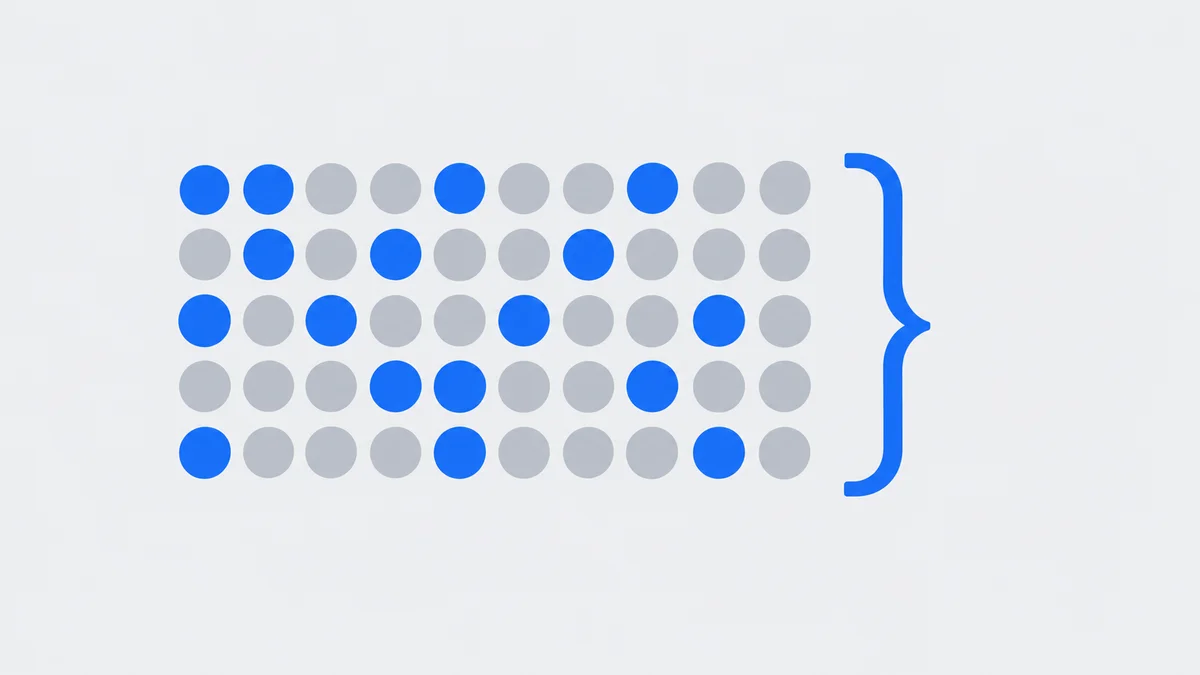
Flat illustration of fifty small dots, some highlighted in blue, beside a bracket range
Citation frequency is the count of runs in which a brand is cited divided by the total runs. The EWR Digital study covered five engines and 118,050 citations over 164 days, and no engine exceeded 2.5% identical source sets (EWR Digital, 2026; agency research, single source). The authors of one arXiv preprint put it plainly: "AI-powered answer engines are inherently non-deterministic: identical queries submitted at different times can produce different responses and cite different sources." (arXiv, 2026)
Suppose a page is cited in 14 of 50 runs. That is 28% (an illustrative example, not measured data), yet it looks "not cited" in a single check. A January 2026 study by SparkToro and Gumshoe.ai covered 2,961 runs. It found AI brand lists almost never repeat, while the share of responses in which a brand appears is more stable (Communicate Online, reporting the study, 2026).
What denominator will finance accept?
Include every run in the denominator, with and without citations. In one configuration of a GEO literature survey, 57.8% of ChatGPT repetitions did not activate web search (arXiv survey, 2026; preprint, not a universal rate). The authors warn: "A dashboard cannot calculate a “share of citations” only among responses that contain citations and then interpret it as overall visibility." (arXiv, 2026)
Which five numbers belong in a finance report?
Metric
Method
Confidence note
Bot access
Server-log hits by AI bot, by path
Direct count, high confidence
Citation frequency
Fixed prompt set, N runs per prompt, cited in x of N
Report a range and state N
AI-referred sessions
GA4 channel group for chatgpt.com, perplexity.ai, gemini.google.com, copilot.microsoft.com, claude.ai
Undercounts, since some visits land as direct
AI-sourced leads
"AI assistant" in the lead form and CRM picklist
Self-reported, directionally useful
AI-influenced pipeline
CRM stages and win rate for AI-attributed leads
Small samples, state caveats
AI referral traffic is a small, visible slice of a larger influence. Report the traffic number and the self-reported attribution side by side.
What is the best tool for AI answer visibility?
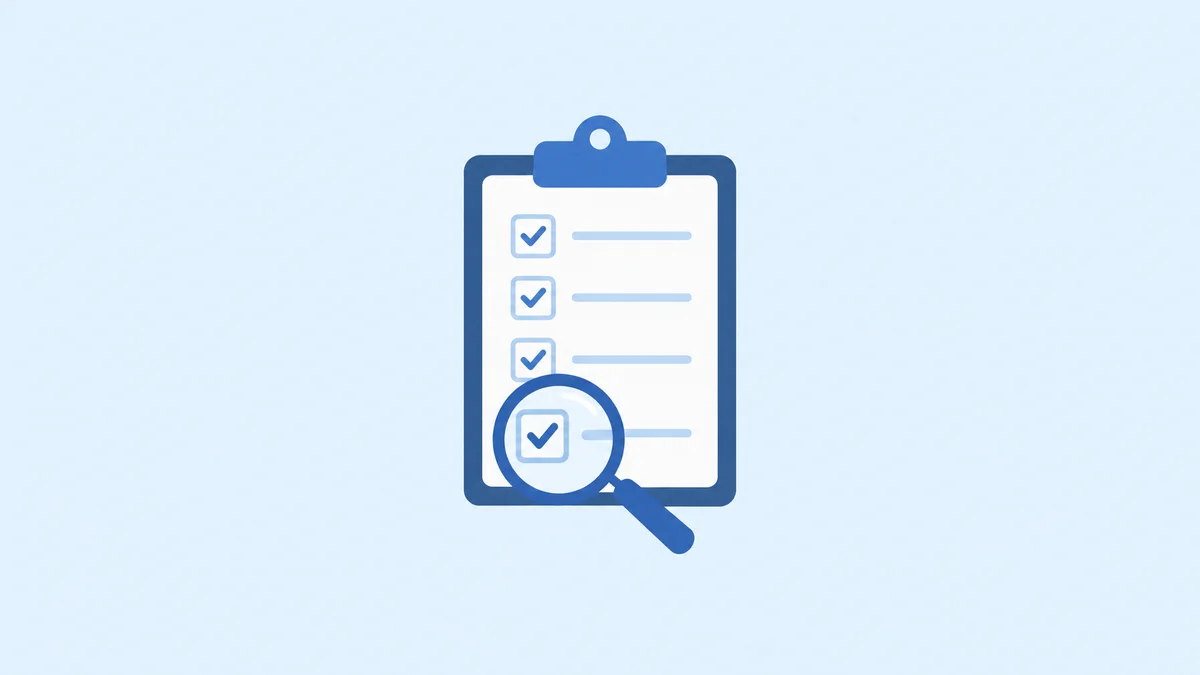
No single tool is best for AI answer visibility. The best one passes four tests: a transparent prompt library, a stated run count per prompt, separate citation and mention parsing, and exports finance can audit. Run counts matter because identical ChatGPT questions returned the same cited sources only 0.06% of the time in a 2026 EWR Digital study.
Flat illustration of a checklist panel with four ticks next to a magnifying glass
How do you choose a best AI answer visibility measurement tool?
A mention is your brand named in an answer, while a citation is a source link. Tools that merge the two inflate results. Parsing also decides the denominator: 57.8% of ChatGPT repetitions did not activate web search in one configuration (arXiv survey, 2026), so a tool that drops those runs overstates visibility.
Score every vendor the same way, including vendors with an affiliation to this site (aeogeo.com is a GrowthSpree property).
Criterion
Question to ask
Red flag
Prompt library
Can we see and edit every prompt?
Prompts hidden or changed without notice
Run count
How many runs per prompt, per engine?
A single run reported as a result
Parsing
Are citations, mentions and no-search responses separated?
The Failure-Point Test is not for teams that need guaranteed citations, a precise revenue figure within 30 days, or a site that is blocked, gated or nearly empty, because it diagnoses failures and ranks fixes but cannot promise outcomes. Run-to-run variance is also large: ChatGPT returned the identical cited-source set on a repeated question only 0.06% of the time (EWR Digital, 2026).
Flat illustration of a signpost with a calendar page and a caution triangle
Know these limits before you start:
Cost before a verdict. Six months at a $1,500 monthly retainer is $9,000. At $6,000 a month it is $36,000. This is illustrative arithmetic, not a quote.
Evidence quality. Several figures here come from vendor-published or agency studies, and one is a preprint. Treat them as directional. The EWR Digital result, for example, is single-source agency research.
Correlation, not proof. The YouTube and branded-mention figures from Ahrefs show association, not cause.
Small visible signal. AI referral traffic is small, so judge influence with self-reported attribution as well.
No fit for B2C. The approach assumes buyers research online before talking to sales and that you have an active own website.
How do I measure AI answer visibility in a way that finance will accept as a real number?
AI answer visibility is measured as citation frequency: the share of N repeated runs of a fixed prompt set in which your brand is cited, reported as a range with the method stated. Finance accepts a stated method and sample size. It rejects a single screenshot, because identical AI queries can produce different responses and cite different sources.
How do I get my brand cited in AI answers?
A brand gets cited in AI answers by fixing three layers in order: let AI crawlers fetch your pages, answer the exact buyer question in an extractable paragraph, and earn corroboration from independent third-party sources. Publishing volume fixes none of these. Verify progress by tracking how often the brand is cited across repeated runs of a fixed prompt set.
What is the best tool for AI answer visibility?
The best tool for AI answer visibility is whichever one passes four tests: a transparent prompt library, a stated number of runs per prompt, separate parsing of citations and mentions, and auditable exports. No tool is best in general. Score vendors on these criteria first, then compare price against your break-even deal count.
Does blocking GPTBot stop my site appearing in ChatGPT search?
Blocking GPTBot alone does not remove a site from ChatGPT search, because OpenAI treats search (OAI-SearchBot), training (GPTBot) and user-initiated fetches (ChatGPT-User) as separate settings. OpenAI's documentation states that sites opted out of OAI-SearchBot will not be shown in ChatGPT search answers, so that bot is the one to allow.
Do I need llms.txt or special schema markup to get cited in AI Overviews?
Google AI Overviews do not need special markup, according to Google's May 2026 guide, which says SEO fundamentals remain foundational and that llms.txt and special AI markup are not required. Google also lists seeking artificial brand mentions as something to avoid, so spend effort on access, clear answers and genuine corroboration.
Conclusion
Citation is a three-layer problem, and each layer has a test, a detection method and a first fix. The takeaways:
Check access first: a page an AI crawler cannot fetch cannot be cited.
Rewrite pages so each question has an answer-first paragraph and lists or tables for options.
Earn independent mentions, since paid content is only 0.3% of AI citations (Muck Rack, 2026).
Report citation frequency across N runs as a range, with every run in the denominator.
Score tools on prompts, run counts, parsing and exports before you compare prices.
Your next step: pick 10 queries where you rank in the top three, run each repeatedly, and record in how many runs you are cited. Then run the three tests on the pages that lose, and get the weekly brief to follow platform and crawler-policy changes as they happen.
Written by
Ishan Manchanda
Ishan Manchanda is co-founder of GrowthSpree, a B2B SaaS marketing consultancy founded in 2017 that has managed $60M+ in ad spend across 300+ B2B SaaS companies. He focuses on demand generation, go-to-market strategy and pipeline growth, and has been featured in Silicon Valley Times, SaaS Mag and the Unbounce podcast.
 Ishan ManchandaNov 4, 2026