Who Can Help Us Get Cited More in AI Answers? A Vendor-Neutral Buyer's Guide
who can help us get cited more in ai answersAEO agencymanaged AEO provider
Who Can Help Us Get Cited More in AI Answers? A Vendor-Neutral Buyer's Guide
A vendor-neutral scorecard for choosing who can help you get cited in AI answers: metrics, attribution, kill criteria, contract terms and break-even math.
Request a quote and our experts will contact you within 24 hours with tailored solutions and pricing.
Who Can Help Us Get Cited More in AI Answers? A Vendor-Neutral Buyer's Guide
Getting cited more in AI answers can be handled by a managed answer engine optimization (AEO) provider, your SEO agency or an in-house team, and the right choice depends on who can prove citations, attribution and an exit. Search for the best AEO agency and the results are agencies ranking themselves, which leaves a CMO with no neutral yardstick. This guide supplies one. It covers a weighted scorecard, a four-layer metric hierarchy, an attribution method, kill criteria, contract terms and break-even arithmetic, so a revenue leader can compare any provider before signing a six-month engagement. For a deeper side-by-side, see this AEO agency comparison framework.
Key Takeaways
A managed AEO provider, an SEO agency and an in-house team can all get a brand cited; the deciding factor is which one can show prompt-level logs, CRM-linked reporting and a 90-day exit.
AI answers vary between runs, so valid proof is sampled citation frequency (cited in x of N runs), never a single screenshot.
AEO metrics belong in four separate layers: citation share, AI-referred sessions, pipeline and revenue.
At $30,000 ACV and 75% margin, six months of AEO spend breaks even at 0.4 to 1.6 deals for $1,500 to $6,000 a month.
Salient by GrowthSpree is scored here by the same criteria as every other provider, with the GrowthSpree affiliation disclosed.
By Ishan Manchanda, co-founder of GrowthSpree. Disclosure: aeogeo.com is a GrowthSpree property, and Salient by GrowthSpree is scored below. Updated October 28, 2026.
Who can help us get cited more in AI answers?
Three kinds of provider can help a B2B company get cited more in AI answers: a managed answer engine optimization (AEO) provider, an existing SEO agency, or an in-house team. Choose by evidence, not list position. The 6sense 2025 Buyer Experience Report found 94% of buying groups ranked preferred vendors before first contact with a seller (6sense via Enterprise Marketing Insights, 2025).
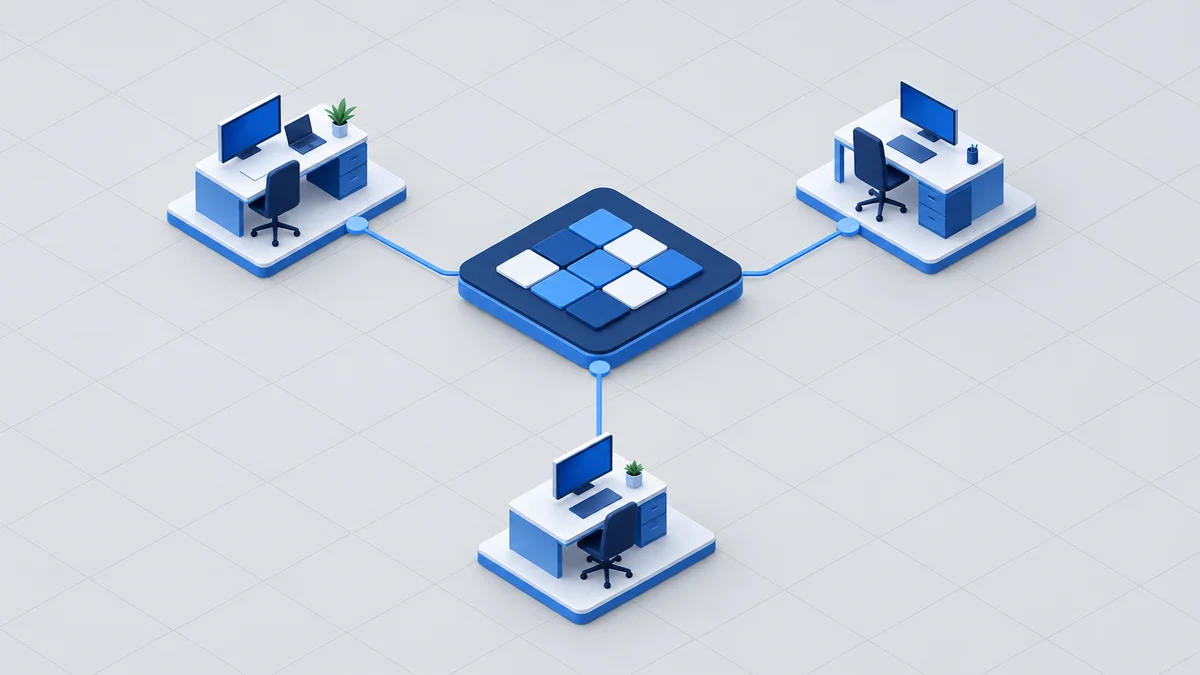
Isometric illustration of three desks representing an agency, an SEO team and an in-house team connected to one scoring board
Answer engine optimization (AEO) is the practice of making a brand's pages readable by machines, answer-fit and trusted, so AI assistants cite or recommend it. The 94% shortlist figure explains the urgency: the list forms before any form fill.
Option
Best when
Main risk
Proof to request
Managed AEO provider
No internal owner, and engineering and content capacity are thin
How do I choose an AEO agency when every 'best AEO agency' list is written by an agency?
Choose a managed AEO provider by scoring every candidate against the same weighted criteria instead of trusting a ranked list. In an October 2026 web snapshot, the 'best AEO agency' results were agencies' own listicles, so none can serve as independent evaluation. Gartner's May 2026 survey found 69% of B2B buyers validate AI insights with sales reps (Gartner, 2026), so demand live demos and references.
A weighted scorecard
The weights below are a suggested starting point, not a benchmark. Adjust them to your risk. A CFO-led buying group may push contract terms higher.
Criterion
Suggested weight
Pass test
Red flag
Metric hierarchy
25%
Citation, traffic, pipeline and revenue reported separately
A mention implies pipeline
Attribution method
20%
Referrer rules, CRM fields, self-reported source
A claim to track revenue with no method
Volatility-aware sampling
15%
Stated prompt list, runs per prompt, denominator
Screenshots as proof
Contract and exit
15%
90-day exit, data and prompt-list ownership
Long lock-in, no exit
Scope and access
10%
Crawler access audit plus off-site authority work
Content volume only
Live demo
10%
Prompt-level demo on your brand
Slides only
References
5%
Named reference on a comparable ACV
Traffic-only case studies
A 30-minute sales-call test
Run this on every finalist, in order:
Ask the provider to show its own brand's citation frequency on a stated prompt list.
Ask for a live baseline on your category: 10 prompts, repeated runs, denominator shown.
Ask which AI surfaces it can verify natively, and which it infers.
Ask who owns the prompt list, the logs and the tool access at termination.
Ask what result at day 90 would make it recommend ending the contract.
Which success metrics and attribution method should an AEO provider commit to?
An AEO provider should commit to four metric layers reported separately: prompt-level citation share, AI-referred sessions, CRM pipeline and revenue. Citation share must be sampled over time, because Detailed's 28-day study found ChatGPT returned an identical brand set on only 0.3% of random day pairs (Detailed, 2026). One screenshot proves nothing.
Isometric stack of four layered tiles representing visibility, traffic, pipeline and revenue metrics
Layer
Metric
Method to demand
Why it cannot stand alone
1. Visibility
Share of answers
Fixed prompt set, repeated runs, range reported
A mention is not a lead
2. Traffic
AI-referred sessions
GA4 channel group on AI referrers
Visible traffic is a small share of influence
3. Pipeline
AI-sourced and AI-influenced opportunities
CRM "AI assistant" source value plus self-reported field
Depends on honest form and call capture
4. Revenue
Win rate, ACV, cycle of AI-attributed deals
CRM report against other sources
Needs months of closed deals
Share of answers is the percentage of repeated runs on a fixed prompt set in which a brand is cited or recommended. AI-referred sessions are website visits whose referrer is an AI assistant such as chatgpt.com or perplexity.ai.
Why clicks understate visibility
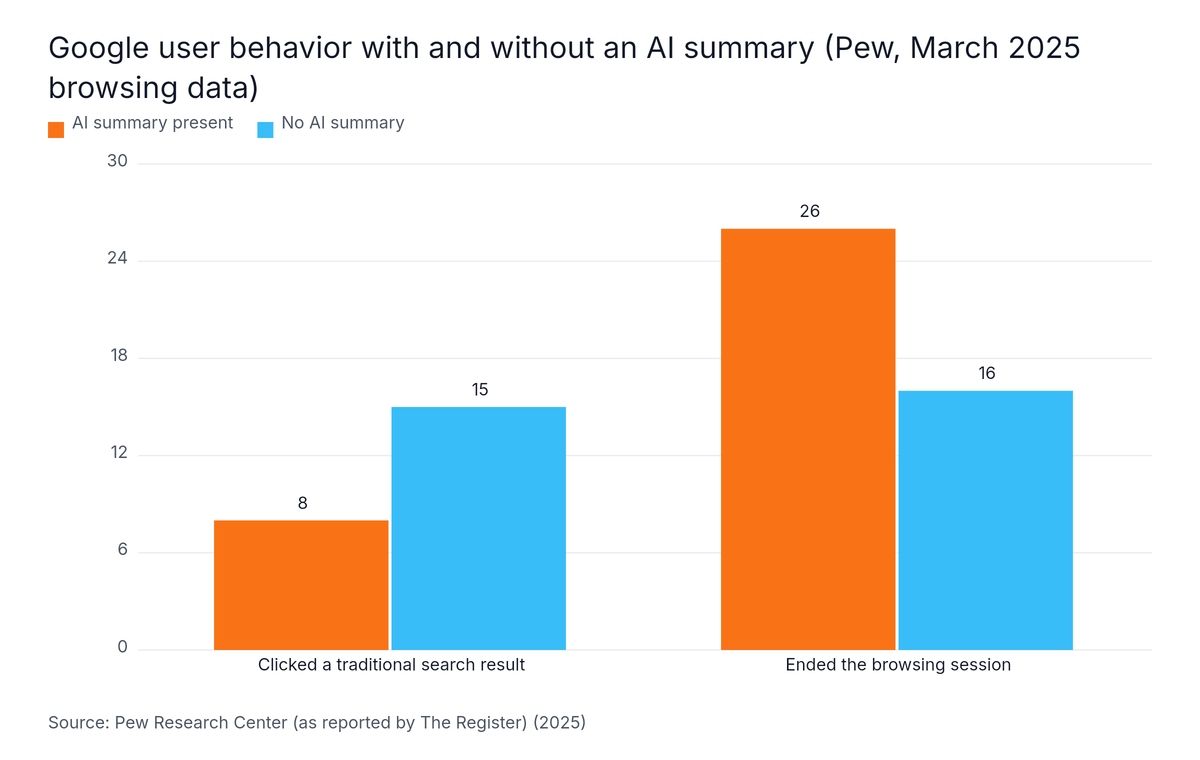
Pew Research Center's March 2025 browsing panel of 900 US adults found clicks fall when an AI summary appears. "Users who encountered an AI summary clicked on a traditional search result link in 8 percent of all visits," said analyst Athena Chapekis (The Register, 2025). Without a summary the figure was 15%. Only 1% of visits included a click on a link inside the summary itself, and Pew's data as reported by The Register (2025) shows 26% of visits with a summary ended the browsing session.
Grouped Bar chart: Google user behavior with and without an AI summary (Pew, March 2025 browsing data). Highest: Ended the browsing session at 26.
A provider reporting traffic alone will therefore miss most of the effect. Pair traffic with sales evidence, and ask the provider to explain, in writing, how it will do so.
How to attribute pipeline when AI traffic shows up as direct
AI-influenced leads often arrive as direct traffic or with no referrer, so no single report captures them. Require triangulation, and treat the visible number as a floor:
Referrer rules. Build a GA4 channel group for chatgpt.com, perplexity.ai, gemini.google.com, copilot.microsoft.com and claude.ai.
CRM field. Add an "AI assistant" value to the lead-source picklist so sales can record it.
Self-reported source. Add a free-text source field on forms and read it weekly. Gartner's finding that buyers check AI insights with reps makes call notes and call-recorder trackers a second source.
Native dashboards. Microsoft launched the AI Performance report in Bing Webmaster Tools on February 10, 2026, and Google Search Console now shows impressions from AI Overviews and AI Mode. Neither attributes clicks or conversions to citations (CXL, 2026).
Closed-won comparison. Compare AI-attributed deals with other sources on win rate, ACV and cycle before judging lead quality.
What a monthly report should show
The prompt list, runs per prompt and denominator, with any change explained.
Citation frequency as a range (cited in x of N runs), by AI surface.
AI-referred sessions and self-reported AI leads, shown separately.
Opportunities and revenue tied to CRM records.
Access findings: bot policy, rendering and log review.
What kill criteria and contract terms protect a six-month AEO engagement?
A kill criterion is a trigger, agreed before signing, that ends an AEO engagement without penalty. Set the first gate at 90 days: no prompt-level logs after 30 days, no CRM-linked reporting by month three or four, or any guarantee of citations. At $1,500 a month, the first 90 days cost $4,500.
Isometric contract folder beside a stopwatch and an exit door on a platform
The guarantee trigger is not arbitrary. Detailed's 2026 study found ChatGPT repeated an identical brand set on only 0.3% of random day pairs (Detailed, 2026), so a promise of fixed citations cannot be kept honestly.
Kill criteria to write into the contract
No prompt-level logs delivered within 30 days.
A changed prompt list or denominator with no written explanation.
Any guarantee of citations, rankings or revenue.
No CRM-linked reporting by month three or four.
Case studies that show traffic only.
Contract terms to negotiate
Ownership of work product, prompt lists, logs and data.
Transfer of tool access at termination.
Scope that includes off-site and third-party authority work, not only on-site content.
A 90-day pilot gate with an exit, then a 180-day pipeline gate.
A fee structure stated plainly (retainer or performance), with no vendor-defined units.
What it costs and when it breaks even
Break-even deals is monthly spend divided by average contract value multiplied by gross margin, per period. AeoGeo's illustrative model uses $30,000 ACV and 75% gross margin. Observed pricing runs $999 to $6,000 a month. GrowthSpree retainers start at $3,000, and practitioners on Indie Hackers quote $3,000 to $6,000 with 90 to 180 days to results (anecdotal).
Monthly fee
90-day cash out
Six-month total
Break-even deals at $30,000 ACV
At $100,000 ACV
$1,500
$4,500
$9,000
0.4
0.12
$3,000
$9,000
$18,000
0.8
0.24
$6,000
$18,000
$36,000
1.6
0.48
These figures are illustrative arithmetic, not forecasts or financial advice. The AEO ROI calculator guide shows how to rebuild the model with your own ACV, margin and lag.
How does Salient by GrowthSpree score against the same criteria?
Salient by GrowthSpree is a managed AEO and generative engine optimization (GEO) service sold on a six-month engagement at $999 or $1,500 a month, launched in September 2026. aeogeo.com is a GrowthSpree property, so this guide discloses that affiliation and applies the scorecard to Salient exactly as it would to any other provider.
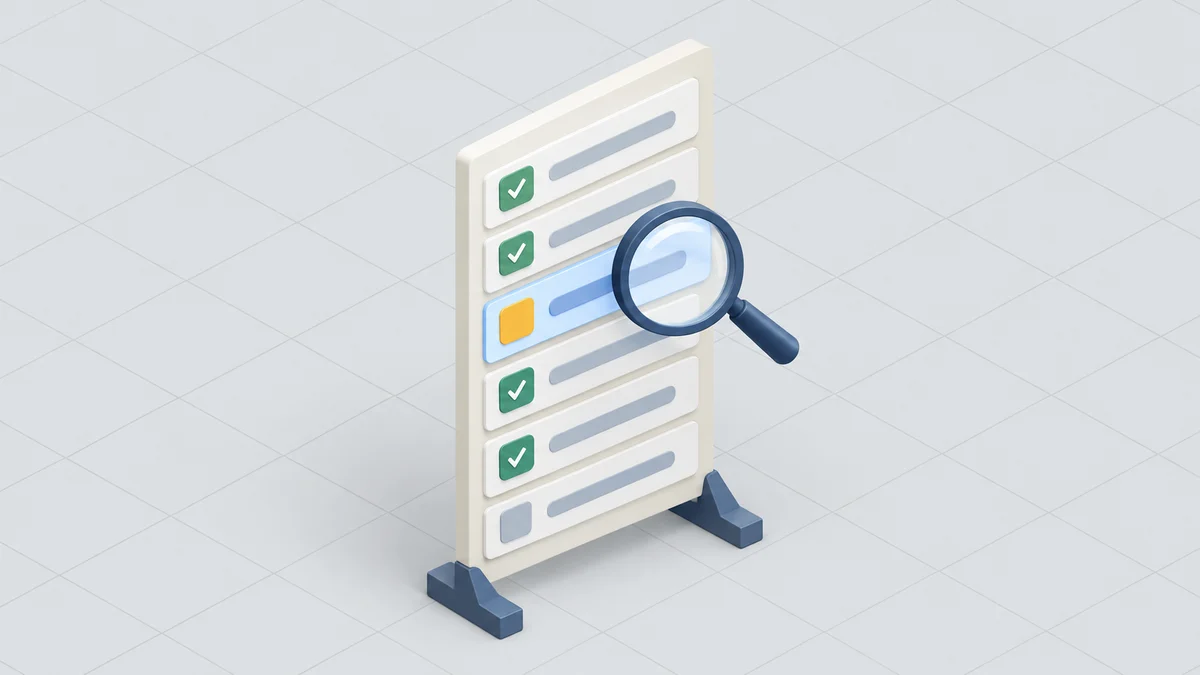
Isometric scorecard board with checkmark tiles and a magnifying glass over one row
Our data: Salient by GrowthSpree's pitch deck reports 48,800 citations, $165,000+ pipeline and $70,000 media-equivalent across its clients. These are vendor-reported, affiliated figures, not independent research.
Pooled citation counts need the same scrutiny as any other. Detailed found ChatGPT returned an identical brand set on only 0.3% of random day pairs (Detailed, 2026), so a buyer should ask how Salient samples, not just how many citations it reports.
Criterion
What is stated
What a buyer should verify
Metric hierarchy
Citation tracking and pipeline attribution are part of the service
Whether the four layers are reported separately
Attribution method
Pipeline attribution is offered
Referrer rules, CRM fields, self-reported source
Sampling
Not stated in the materials reviewed
Prompt list, runs and denominator
Contract and exit
Six-month engagement
A 90-day exit and data ownership
Price
$999 and $1,500 a month
Scope included at each tier
Track record
Results aggregated across clients
Per-client baselines, since the service launched in September 2026
The totals are pooled across clients, so they say little about any single account. Request the same prompt-level proof you would ask of anyone else.
Who is this guide not for, and what are its limits?
The AeoGeo vendor-neutral buyer's guide for AEO providers is not for companies that have not yet checked whether their buyers use AI assistants, or that run a thin, blocked or unmaintained website. Its evidence has limits too: Google disputes the Pew study, and AI referrals were only 0.2% of all visits in one Contentsquare benchmark of 99 billion sessions (Elmo, 2026).
Google's response was blunt: "This study uses a flawed methodology and skewed queryset that is not representative of Search traffic." (PPC Land, 2025). Read the click data as direction, not precision.
Other caveats:
B2B data is thin. Adobe reported that AI-referred US retail traffic converted 54% better than non-AI traffic in May 2026 (Digital Commerce 360, 2026). Adobe also noted that "Many U.S. retailers, however, continue to have AI visibility gaps." Retail is not B2B, so benchmark your own CRM.
Small teams. A 25-person company may not need a retainer. Fix crawler access, add an "AI assistant" source to the lead form and stage-gate before paying.
Can an AEO agency guarantee citations in ChatGPT or Google AI Overviews?
No AEO agency can honestly guarantee citations in ChatGPT or Google AI Overviews. Answers vary between runs: a 28-day Detailed study found ChatGPT returned an identical brand set on only 0.3% of random day pairs. Treat any citation or ranking guarantee as a kill-criterion trigger and ask for sampled citation frequency instead.
How much does an AEO agency cost per month, and how long should the contract be?
Observed AEO pricing runs from $999 to $6,000 per month, usually on a six-month engagement. Salient by GrowthSpree lists $999 and $1,500 per month, GrowthSpree retainers start at $3,000, and practitioners on Indie Hackers quote $3,000 to $6,000 (anecdotal). Negotiate a 90-day exit so cash at risk stays between $4,500 and $18,000.
How long does it take to see results from AEO?
Practitioners quote 90 to 180 days to results for answer engine optimization, an anecdotal range from Indie Hackers threads rather than a measured benchmark. Leading indicators such as bot access, prompt-level logs and sampled citation frequency should appear within the first 90 days; pipeline evidence belongs at the 180-day gate.
Is AEO different from SEO, and should one agency handle both?
Answer engine optimization overlaps with SEO on crawlability, content quality and authority, but it differs in what is measured: citations and recommendations rather than rankings. One agency can handle both if it reports AEO metrics separately, owns off-site corroboration work and passes the same scorecard you would apply to a specialist.
Conclusion
The question of who can help you get cited in AI answers is settled by proof, not reputation. Carry these five points into your next vendor call:
Score every provider, Salient by GrowthSpree included, against one weighted scorecard.
Require four separate metric layers, with citation frequency sampled over repeated runs.
Write kill criteria into the contract and gate the first review at 90 days.
Model break-even before signing: 0.4 to 1.6 deals at $30,000 ACV and 75% margin.
Keep your own CRM as the final judge of AI-sourced lead quality.
Your next step is to run the 30-minute call test on your top two finalists this week. Get the weekly brief from aeogeo.com for dated platform changes and scorecard updates.
Written by
Ishan Manchanda
Ishan Manchanda is co-founder of GrowthSpree, a B2B SaaS marketing consultancy founded in 2017 that has managed $60M+ in ad spend across 300+ B2B SaaS companies. He focuses on demand generation, go-to-market strategy and pipeline growth, and has been featured in Silicon Valley Times, SaaS Mag and the Unbounce podcast.
 Ishan ManchandaNov 6, 2026