Blog
AI Crawler Access Audit: How to Check Whether AI Assistants Can Read Your Site
Run an AI crawler access audit in five layers: robots.txt, CDN/WAF rules, rate limits, origin and rendering. Includes a per-bot policy table and owner model.
Improve visibility in AI search results in three steps: fix crawler access, answer the exact query, earn third-party corroboration. Evidence from 2025 to 2026.
 Ishan ManchandaOct 31, 2026

Run an AI crawler access audit in five layers: robots.txt, CDN/WAF rules, rate limits, origin and rendering. Includes a per-bot policy table and owner model.
A vendor-neutral scorecard for choosing who can help you get cited in AI answers: metrics, attribution, kill criteria, contract terms and break-even math.
AI search visibility platforms cost $99 to $20,000 a month. See dated price bands by source and the break-even math: 0.4 to 1.6 deals at $30K ACV.
Request a quote and our experts will contact you within 24 hours with tailored solutions and pricing.
aeogeo.app
Last updated: Oct 31, 2026
Improving visibility in AI search results means making your pages fetchable by AI crawlers, answering buyer questions in extractable form, and getting named on the third-party sources that AI engines trust, in that order. A team publishes steadily, asks ChatGPT its own category question, and sees three competitors named, none of them its own. That team does not need ten tactics. It needs a first step. This guide explains how to improve visibility in AI search results with a three-layer sequence, the evidence behind each layer and a way to measure progress. It builds on the evidence for GEO and AEO techniques.
Key Takeaways
- Improving visibility in AI search results works best in three ordered layers: crawler access, an answer to the exact query, then third-party corroboration.
- AI crawler access is a binary gate: a page that an AI crawler cannot fetch or parse cannot be cited, whatever its quality.
- More than 84% of AI citations come from earned and third-party sources, so off-site presence decides many outcomes (Muck Rack, 2026).
- LLM optimization is the content team's recurring backlog for those three layers, not a separate discipline.
- AI answers vary between runs, so AI visibility should be reported as a frequency range across repeated runs, never as one check.
By Ishan Manchanda, co-founder of GrowthSpree. Disclosure: AeoGeo is a GrowthSpree property, and GrowthSpree also runs a managed AI search service, Salient. This guide recommends no vendor.
Improving visibility in AI search results has become a starting-point question because buyers research inside chatbots and click less. G2's 2026 poll of 1,076 B2B software buyers found 51% start research with an AI chatbot (G2, 2026), while Ahrefs estimates position-one click-through is 58% lower when an AI Overview appears (Ahrefs, 2026).
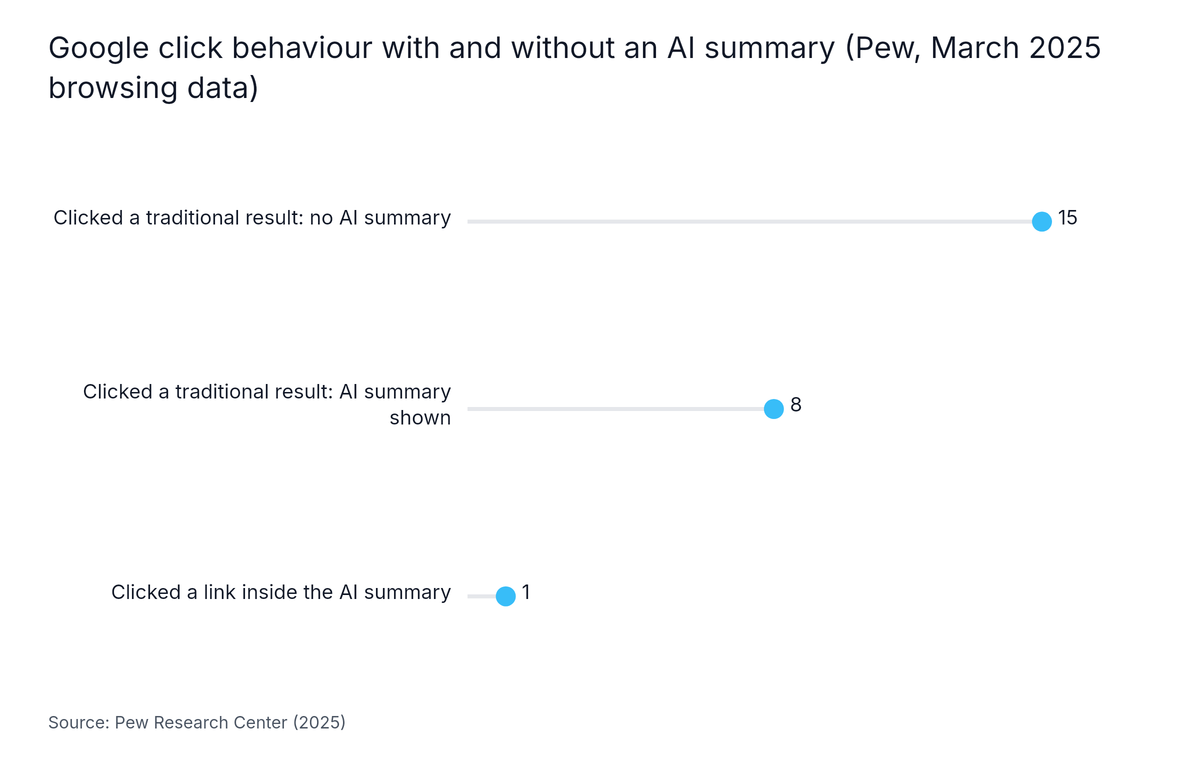
Source: Pew Research Center, 2025
Pew Research Center's browsing data shows the same pattern from the user side: 15% of visits included a click on a traditional result without an AI summary, 8% with one, and just 1% included a click on a link inside the summary (Pew Research Center, 2025).
Ahrefs' original study of 300,000 keywords found a 34.5% lower average click-through rate (CTR) for the top-ranking page when an AI Overview was present (Ahrefs, 2025). Re-run with December 2025 data, the estimate rose. Study author Ryan Law wrote: "we found that AI Overviews reduced clicks to top-ranking content by 34.5%, despite Google's statements to the contrary." (Ahrefs, 2026)
Pew analysed 68,879 unique Google queries from 900 U.S. adults in March 2025. Its analyst wrote: "Users who encountered an AI summary clicked on a traditional search result link in 8% of all visits." (Pew Research Center, 2025) Treat the Ahrefs numbers as correlation from desktop data, not proof of cause. Pew's independent panel points the same way.
G2's 2026 report also found that 71% of buyers rely on chatbots somewhere in the research process (G2, 2026). The sample covers software buyers, not all B2B. A team selling elsewhere should check its own call recordings and self-reported attribution before assuming the same share.
Our data: This is AeoGeo's illustrative Revenue-at-Risk Model, a calculation and not measured data. Assumptions: organic share of pipeline multiplied by the share of queries showing AI answers, then by click erosion. At 30% organic share and 60% of queries exposed, 6.2% of total pipeline is at risk at 34.5% click erosion and 10.4% at 58%. At 40% organic share and 80% exposure, the figures are 11.0% and 18.6%. The AEO ROI calculator guide shows how to build the same model for a specific business.
The three-layer sequence for improving brand visibility in AI search is: fix crawler access so machines can read the site, answer the exact buyer query on an extractable page, then earn third-party corroboration. The order matters because a page that cannot be fetched cannot be cited, and a page that does not answer the question gives third-party mentions nothing to point at.

AI visibility is how often and how accurately a brand is named, described and linked in answers from AI search engines. A citation is a source an AI answer names or links as the basis for a statement. Both are measured per prompt and per engine, which is why each layer has a different owner and a different test.
| Layer | Question it answers | First action | Evidence | Typical owner |
|---|---|---|---|---|
| 1. Crawler access | Can the machine fetch and parse the page? | Audit robots.txt, CDN and WAF rules, rendering | 347 of 710 sites blocking GPTBot still allow OAI-SearchBot (AICrawlerCheck, 2026) | Engineering and SEO |
| 2. Answer fit | Does the page answer the exact query? | One answer-first page per buyer question | Roughly 60% of AI Overview citations come from outside the top 20 (AirOps, 2025) | Content |
| 3. Corroboration | Do trusted third parties confirm it? | Earn accurate mentions on pages engines already cite | 85% of brand mentions originate from third-party pages (AirOps, 2025) | PR, product marketing, partnerships |
The Day-One Shortlist Test is AeoGeo's own framework, not an industry standard. It asks whether a company appears when a buyer types a first prompt, before any contact with sales. It is the simplest baseline for a brand with no citations: run 10 category prompts, record who is named and note which layer fails for your pages. For how this overlaps with classic search work, see answer engine optimization vs traditional SEO.
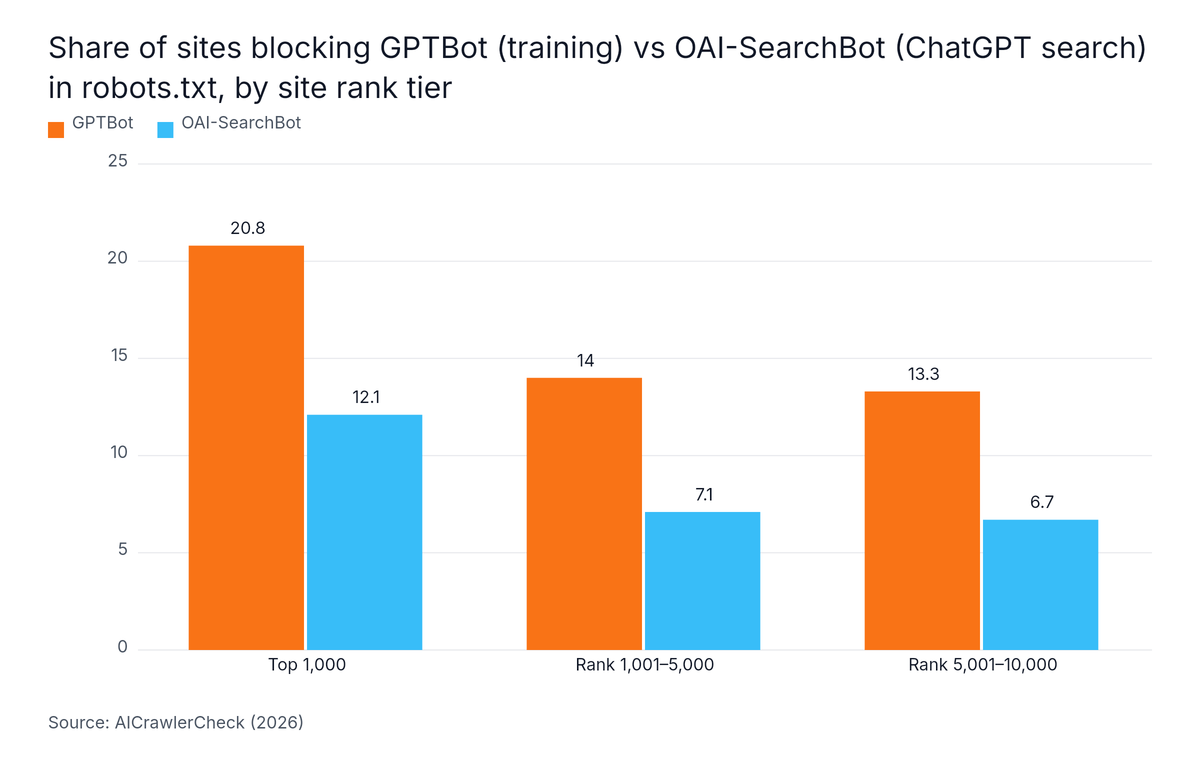
A company improves its visibility in AI search engines first by fixing crawler access: set a per-bot policy so AI search crawlers can fetch public pages while training crawlers are decided separately. In a 2026 AICrawlerCheck study of 4,962 robots.txt files, 710 sites blocked GPTBot and 347 of them still allowed OAI-SearchBot (AICrawlerCheck, 2026), so the two decisions are independent.
Source: AICrawlerCheck, 2026
AICrawlerCheck's rank-tier breakdown shows blocking is most common among the largest sites: 20.8% of the top 1,000 against 13.3% of sites ranked 5,001 to 10,000 (AICrawlerCheck, 2026). The study is a tool vendor's self-published research, so read it as a pattern, not a benchmark.
A per-bot policy is a written rule that sets, bot by bot and path by path, which crawlers may fetch which parts of a site. Bots serve different purposes, so one allow-or-block rule is usually wrong.
| Bot | Primary purpose | Typical starting decision |
|---|---|---|
| GPTBot | Model training | Decide separately, by your content and IP position |
| OAI-SearchBot | ChatGPT search retrieval | Allow on public marketing and docs paths |
| ClaudeBot | Model training | Decide separately, rate-limit and log |
| Claude-SearchBot | Claude search retrieval | Allow on public paths |
| PerplexityBot | Search and retrieval | Allow on public paths |
| Google-Extended | Training use of content by Google's AI models | Decide separately |
For tools that surface crawler diagnostics, the AEO and GEO tools comparison lists what each category can and cannot see.
Answering the exact query means publishing one answer-first page per buyer question, with the direct answer in the opening 40 to 80 words. Rank alone does not decide citation: roughly 60% of AI Overview citations come from URLs outside the top 20 organic results (AirOps, 2025), so a page can be cited without ranking well.
An answer-first page states the direct answer to one buyer question in its opening 40 to 80 words, then adds evidence and detail. Engines lift passages, not pages, so each section must make sense alone and name its subject in full.
AirOps reports that sequential headings and rich schema correlate with 2.8× higher citation rates, and pages not updated quarterly are 3× more likely to lose citations (AirOps, 2025). Both are correlations from vendor research, not causal proof. The eMarketer 2026 report adds that fewer than 10% of sources cited in ChatGPT, Gemini and Copilot rank in the top 10 Google results for the same query (eMarketer, 2026). The page does not state the underlying sample.
Brands get cited in AI search answers by being described accurately on pages they do not own, because AI engines draw mostly from them. Muck Rack's October 2026 Generative Pulse found more than 84% of AI citations come from earned and third-party sources, while paid and advertorial content is only 0.3% (Muck Rack, 2026).
AirOps reports a similar direction using brand mentions: 85% of brand mentions in AI search originate from third-party pages rather than owned domains (AirOps, 2025). Two different methods land close together, which strengthens the case. Both are vendor research. Muck Rack also notes that "earned" is a broad taxonomy, including encyclopedic, government and third-party corporate content.
Owned content still matters. In the same October 2026 edition, owned content's share rose from 13.7% to 15.2% while journalism's share fell to 22% (Muck Rack, 2026).
Muck Rack's May 2026 report shows citation habits differ by engine: ChatGPT cites sources in 96% of responses, Gemini in 82% and Claude in 55%, and journalism citations overlap little across models (Muck Rack, 2026). A single top-tier placement therefore does not transfer.
LLM optimization for a B2B content team means turning the three-layer sequence into a recurring backlog: crawler access checks, answer-first pages, quarterly refreshes and third-party placements. Pages not updated quarterly are 3× more likely to lose citations (AirOps, 2025), so refresh cadence is part of the job, not an extra.

LLM optimization is the operational translation of the three-layer sequence into a content team's recurring backlog. Answer engine optimization (AEO) and generative engine optimization (GEO) are the names agencies and tools use for the same work. Google's documentation, updated July 10, 2026, says: "From Google Search's perspective, optimizing for generative AI search is optimizing for the search experience, and thus still SEO." (Google Search Central, 2026)
Both statements hold. The shared foundation is indexable, snippet-eligible pages and content quality, as Google says. The different work is answer-level structure and off-site presence, because fewer than 10% of cited sources rank in the top 10 for the same query (eMarketer, 2026). A team that treats this as SEO renamed will cover Layer 1 and part of Layer 2 and miss Layer 3.
| Backlog task | Layer | Owner | Cadence |
|---|---|---|---|
| Review robots.txt, CDN and WAF rules, bot logs | 1 | Engineering and SEO | Monthly |
| Publish or rewrite one answer-first page per buyer question | 2 | Content | Continuous |
| Refresh dated pages | 2 | Content | Quarterly |
| Correct company facts across third-party profiles | 3 | Product marketing | Quarterly |
| Pursue placements on already-cited pages | 3 | PR and partnerships | Ongoing |
| Re-run the prompt set and report a frequency range | All | RevOps or SEO | Monthly |
The visibility tools for marketing teams guide covers what to evaluate if the team later wants software to run the last row.
A B2B brand grows visibility in AI search over time by measuring frequency across repeated runs and refreshing pages on a schedule, because single checks mislead. AirOps found only 30% of brands stay visible from one AI answer to the next, and 20% across five consecutive runs (AirOps, 2025).
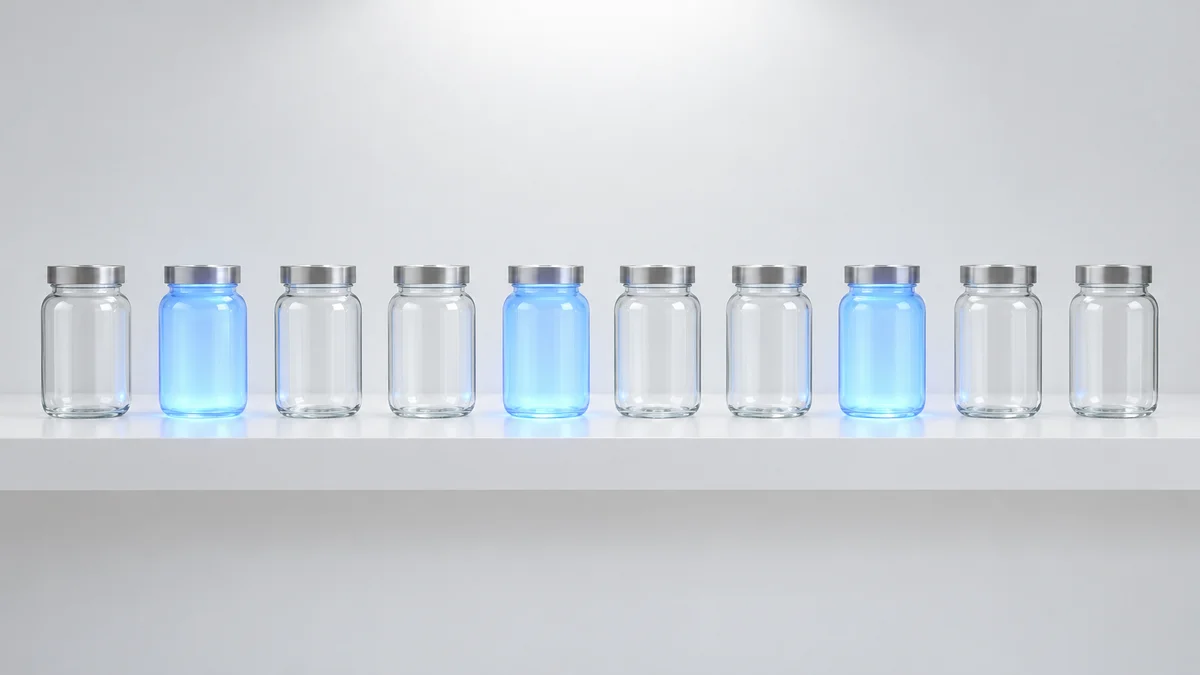
A frequency range is the number of runs in which a brand is cited out of the total runs of a fixed prompt set, such as 14 of 50. A page cited in 14 of 50 runs looks "not cited" in a single check, which is why one screenshot proves nothing. The AirOps figure measures volatility in its own query set, not a population law, but the practical lesson holds.
| Metric | Method | What it tells you |
|---|---|---|
| Bot access | Robots.txt, CDN rules and server logs | Whether Layer 1 is open |
| Citation frequency | Fixed prompt set, repeated runs, range reported | Whether Layers 2 and 3 are working |
| AI-referred sessions | GA4 channel group for chatgpt.com, perplexity.ai, gemini.google.com, copilot.microsoft.com, claude.ai | The visible click signal, which is small |
| AI-sourced leads | "AI assistant" as a self-reported attribution option in forms and CRM | Influence that never shows as a click |
| AI-influenced pipeline | CRM report by opportunity stage and win rate | Whether visibility reaches revenue |
The boardroom-ready visibility tool numbers guide goes deeper on measurement.
Break-even deals equal total spend divided by (ACV × gross margin). The table below is illustrative arithmetic, not a forecast or financial advice.
| Illustrative six-month spend | Break-even deals at $30,000 ACV, 75% margin | Break-even deals at $100,000 ACV, 75% margin |
|---|---|---|
| $9,000 ($1,500/month) | 0.4 | 0.12 |
| $18,000 ($3,000/month) | 0.8 | 0.24 |
| $36,000 ($6,000/month) | 1.6 | 0.48 |
A smaller team can start with the hours-only minimum: fix crawler access, add "AI assistant" to the lead form and publish a first set of answer pages before committing any retainer.
Our data: GrowthSpree, the parent company of AeoGeo, audited paid accounts and found 34.0% of Google Ads spend wasted across 104 accounts and $78.0M in total spend audited, and 32% of LinkedIn Ads spend wasted across 56 accounts and $9.4M audited. This is paid-media data, not AI search data. It shows where budget may be recoverable before any new money is needed.
The three-layer AI search visibility sequence is not for teams that need a guaranteed citation count or one precise AI revenue number, because neither exists. AI answers are volatile, much of the evidence in this field is vendor research, and the Ahrefs click studies are correlational desktop data covering 300,000 keywords (Ahrefs, 2026).
A B2B brand grows visibility in AI search over time by tracking citation frequency on a fixed prompt set, refreshing key pages quarterly, and adding accurate third-party mentions. Visibility is volatile: only 20% of brands remain present across five consecutive AI answers (AirOps, 2025), so progress shows up as a rising frequency range, not as one successful check.
Improving brand visibility in AI search starts with three steps in order: make public pages fetchable by AI crawlers, publish one answer-first page for each buyer question, then earn accurate mentions on third-party sources. Roughly 60% of AI Overview citations come from URLs outside the top 20 organic results (AirOps, 2025), so ranking alone does not decide the outcome.
A company improves its visibility in AI search engines by making public pages crawlable, setting separate policies for training and search bots, and publishing answer-first pages. Pew's 2025 browsing data shows users clicked a link inside an AI summary in only 1% of visits, so being named in the answer matters more than earning the link (Pew Research Center, 2025).
Brands get cited in AI search answers by being readable, being the clearest answer to the exact question, and being confirmed by sources the engine already trusts. AirOps reports that 85% of brand mentions in AI search originate from third-party pages rather than owned domains (AirOps, 2025), so off-site presence decides many competitive outcomes.
Optimizing for large language models involves a recurring backlog, not a new discipline: crawler access checks, answer-first pages for each buyer question, quarterly refreshes, third-party placements and repeated-run measurement. AirOps found sequential headings and rich schema correlate with 2.8× higher citation rates (AirOps, 2025), a correlation from vendor research, not proof of cause.
Improving visibility in AI search results is a sequencing problem before it is a content-volume problem. The evidence points to five takeaways:
The next step is to run the Day-One Shortlist Test on ten category prompts and note which layer fails first. For deeper reading, see the AEO versus SEO overlap and the visibility tools for B2B SaaS. To put the sequence into practice, Download the checklist, a one-page AI-search readiness checklist covering all three layers.
Written by
Ishan Manchanda
Ishan Manchanda is co-founder of GrowthSpree, a B2B SaaS marketing consultancy founded in 2017 that has managed $60M+ in ad spend across 300+ B2B SaaS companies. He focuses on demand generation, go-to-market strategy and pipeline growth, and has been featured in Silicon Valley Times, SaaS Mag and the Unbounce podcast.