Blog
AI Crawler Access Audit: How to Check Whether AI Assistants Can Read Your Site
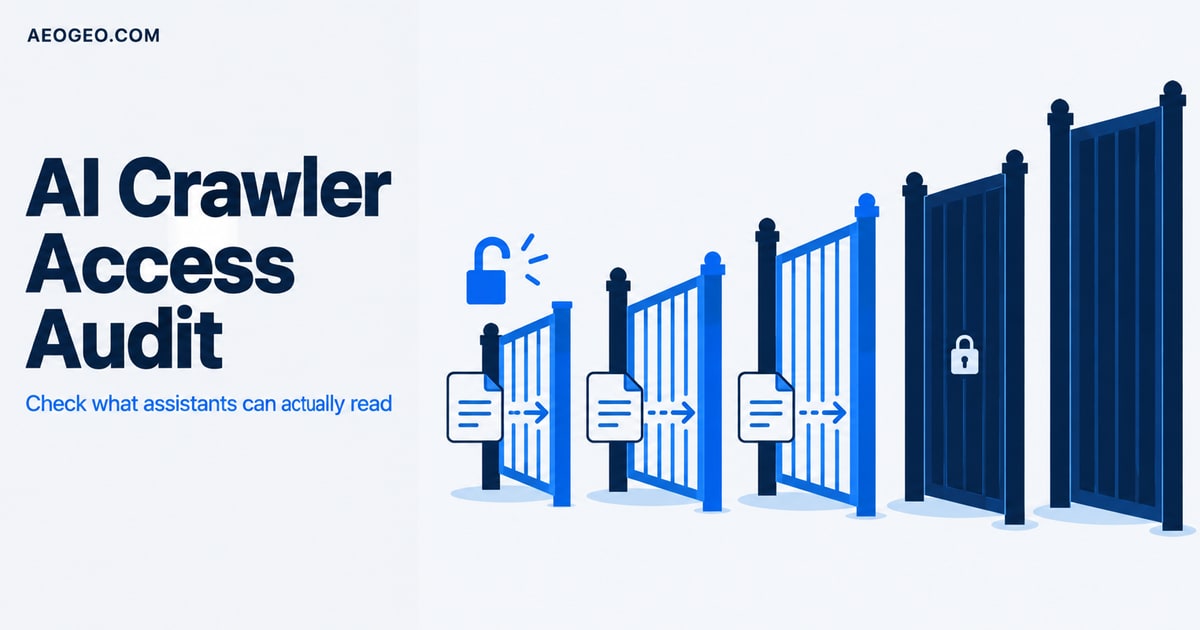
Run an AI crawler access audit in five layers: robots.txt, CDN/WAF rules, rate limits, origin and rendering. Includes a per-bot policy table and owner model.
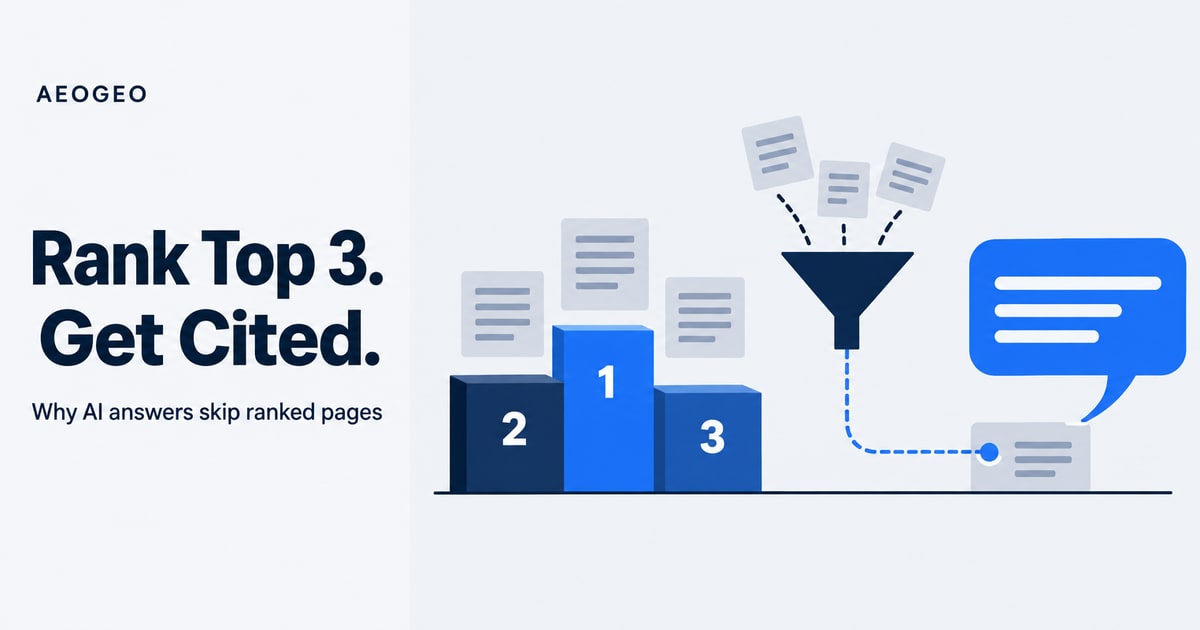
Rank top three but lose the AI citation? See how SEO for LLMs differs, why overlap studies disagree, and a step-by-step workflow to get cited in AI answers.
 Ishan ManchandaNov 11, 2026
Run an AI crawler access audit in five layers: robots.txt, CDN/WAF rules, rate limits, origin and rendering. Includes a per-bot policy table and owner model.
A vendor-neutral scorecard for choosing who can help you get cited in AI answers: metrics, attribution, kill criteria, contract terms and break-even math.
AI search visibility platforms cost $99 to $20,000 a month. See dated price bands by source and the break-even math: 0.4 to 1.6 deals at $30K ACV.
Request a quote and our experts will contact you within 24 hours with tailored solutions and pricing.
Last updated: Nov 11, 2026
SEO for LLMs is the practice of earning citations inside AI-generated answers, which adds a retrieval-and-selection step on top of ranking, so a page can sit in Google's top three and still lose the citation to a competitor. Ahrefs found that only 37.9% of URLs cited in Google AI Overviews also ranked in the first 10 results for the same query (Ahrefs, 2026). A Head of SEO who sees a top-three page ignored by ChatGPT is looking at that gap. This guide explains how to get cited in AI answers: the two-stage path from retrieval to citation, why overlap studies disagree, which fixes the evidence supports, and a diagnostic workflow. The difference from classic SEO is the measure: citations, not positions.
By Ishan Manchanda, co-founder of GrowthSpree. Disclosure: aeogeo.com is a GrowthSpree property, and GrowthSpree also runs Salient by GrowthSpree, a managed AEO/GEO service named once below. Last updated October 28, 2026.
Key Takeaways
- SEO for LLMs adds a citation step to ranking: only 37.9% of Google AI Overview citations came from the top 10 in Ahrefs' March 2026 update (Ahrefs, 2026).
- ChatGPT cites in two stages, retrieval and selection, and cites only about 15% of the pages it retrieves (AirOps, 2026).
- Page titles that overlap at least 50% with the retrieving query were cited 20.1% of the time, versus 9.3% for under 10% overlap (AirOps, 2026).
- Google's May 2026 guidance treats llms.txt, chunking, AI-only rewrites and special schema as unnecessary, while OAI-SearchBot access still matters for ChatGPT search.
- Citation tracking works as a frequency range (cited in x of N runs), and break-even in this guide's illustrative model is 0.4 deals at $1,500/month on a $30,000 ACV.
In this guide: how the disciplines differ, why top-three ranks lose citations, how ChatGPT selects sources, platform mechanics, on-page changes, a diagnostic workflow, the business case and the limits.
SEO for LLMs is the work of earning citations inside AI-generated answers, and it shares its foundations with classic SEO: crawlable pages, useful content and authority. The outcome differs. Classic SEO earns a ranked link, while SEO for LLMs earns a place inside a synthesized answer, and only 12% of URLs cited across four AI assistants rank in Google's top 10 (Ahrefs, 2025).
Google's own documentation says "our generative AI features on Google Search are rooted in our core Search ranking and quality systems" (Google Search Central, 2026). The AirOps research team reaches a similar conclusion from citation data: "Great SEO is your advantage in AI search." (AirOps, 2026). Crawlability, content quality and authority carry over. A strong organic program is the right starting point.
Three terms keep the rest of this guide precise:
| Dimension | Classic SEO | SEO for LLMs |
|---|---|---|
| Unit of success | Ranked position and click | Citation or recommendation inside an answer |
| What gets measured | Rankings, impressions, sessions | Citation frequency across repeated runs (cited in x of N) |
| Stability | Rankings move gradually | Citations churn from month to month |
| Who decides | Ranking systems score the page | Retrieval, then a model selects sources |
| Outside influence | Links and on-site quality | Third-party mentions the SEO team does not control |
ChatGPT can cite competitors despite your top-three ranking because citation is a separate selection step after retrieval. Only 37.9% of URLs cited in Google AI Overviews also appeared in the first 10 results (Ahrefs, 2026), and ChatGPT cites only about 15% of the pages it retrieves (AirOps, 2026). Ranking gets a page into the pool; wording and focus decide the pick.
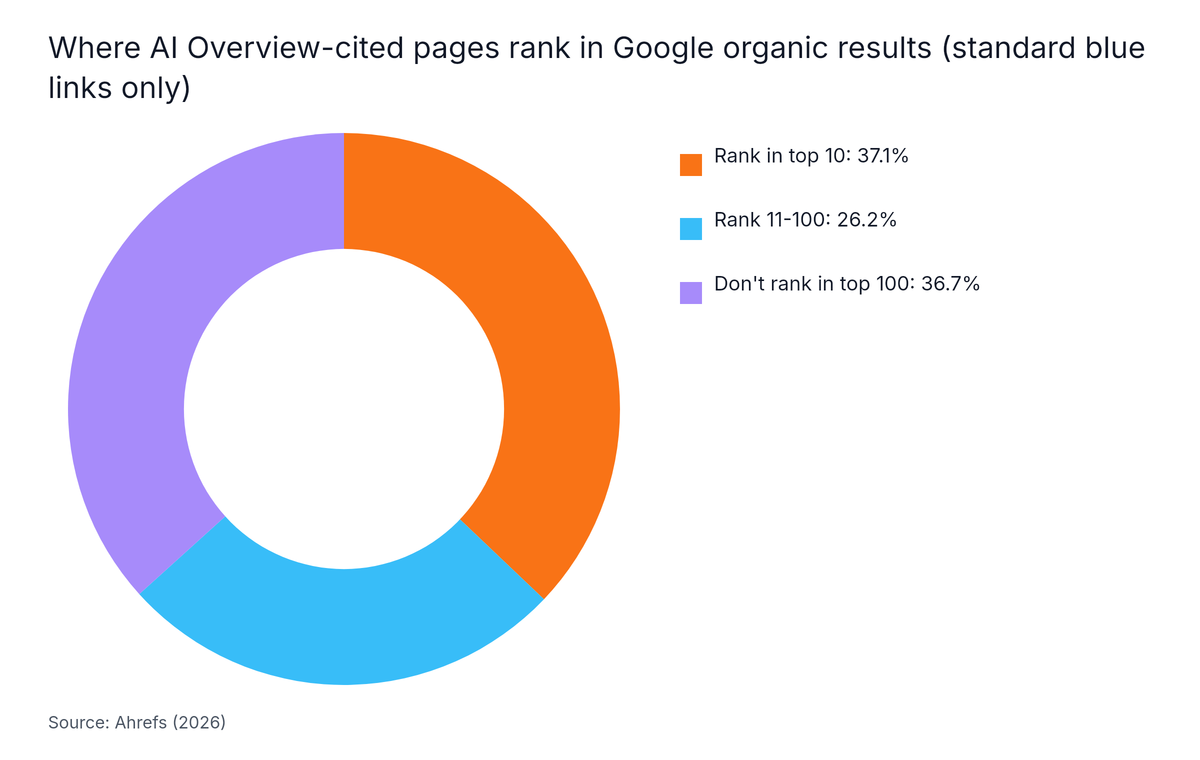
Source: Ahrefs, 2026
Ahrefs' chart data counts standard blue links only, so it differs slightly from the 37.9% headline figure. It shows 37.1% of AI Overview-cited pages ranking in the top 10, 26.2% at positions 11 to 100 and 36.7% outside the top 100 (Ahrefs, 2026). A top-three rank improves the odds of being retrieved. It does not decide the selection that follows.
Published overlap figures look contradictory because each study counts something different. Treat them as separate measurements, not a trend line.
| Study | Date | What was measured | Result |
|---|---|---|---|
| Ahrefs, AI Overview update | March 2026 | About 4 million AI Overview URLs across 863,000 keyword SERPs | 37.9% in the top 10 |
| Ahrefs, earlier AI Overview study | July 2025 | 1.9 million AI Overview citations, earlier parser and sample | 76.10% in the top 10 |
| seoClarity, AI Overview overlap | October 2025 | 362,000 keywords against top-20 organic results | 43% cited at position one, 7% at position 20; 44% of citations from beyond the top 20 |
| Ahrefs, four assistants | 2025 (month not shown) | ChatGPT, Gemini, Copilot and Perplexity vs Google rankings | 12% in Google's top 10 |
Ahrefs states that its parser and sample changed between its first two studies, so they are not like-for-like. The four-assistant figure covers other platforms and a different unit: the original prompt, not the sub-queries an assistant generates. The seoClarity result uses a top-20 window. Different parsers, samples and units explain the spread.
A page that ranks third for the head term is matched against the head term. ChatGPT also searches its own sub-queries, and Ahrefs reports that cited pages match those fan-out queries, through titles and URLs, more than the original prompt (Ahrefs, 2026). A fan-out query is a sub-query an AI assistant generates from the original prompt to retrieve pages. The top-three page may answer the broad question while a competitor's narrower page answers the sub-query.
ChatGPT decides which sources to cite in two stages: it retrieves candidate pages for the prompt and for its own fan-out sub-queries, then selects a few to cite. Retrieval rank is the strongest signal, with a 58% citation rate at position 1 against 14% at position 10 (AirOps, 2026), and ChatGPT cites only about 15% of the pages it retrieves (AirOps, 2026).
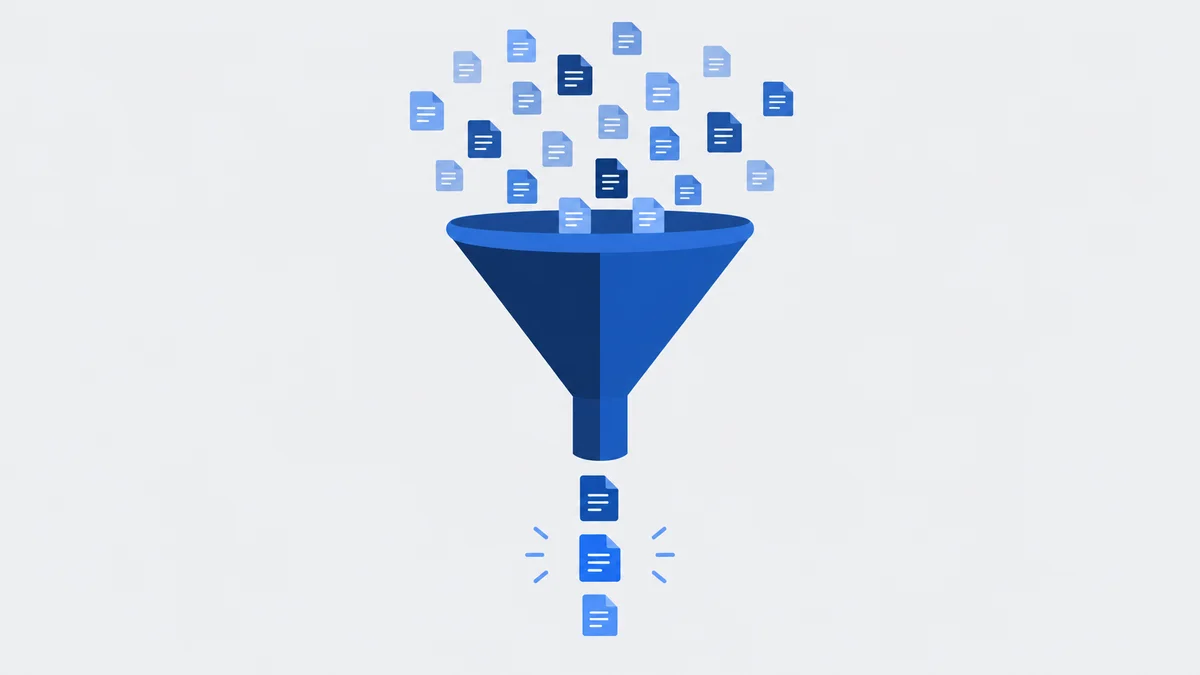
Retrieval is the step where an assistant fetches candidate pages from a search index for the prompt and its sub-queries. The AirOps study covered 16,851 queries across 10 verticals and 50,553 ChatGPT responses, and retrieval rank was the strongest predictor of citation. Being found is only the first stage, because most retrieved pages are never cited.
Selection is where wording matters. Pages whose title overlaps at least 50% with the retrieving query were cited 20.1% of the time, against 9.3% for pages with under 10% overlap, a 2.2x lift (AirOps, 2026). Citation rates also vary by query type, which is why a single average hides the pattern.
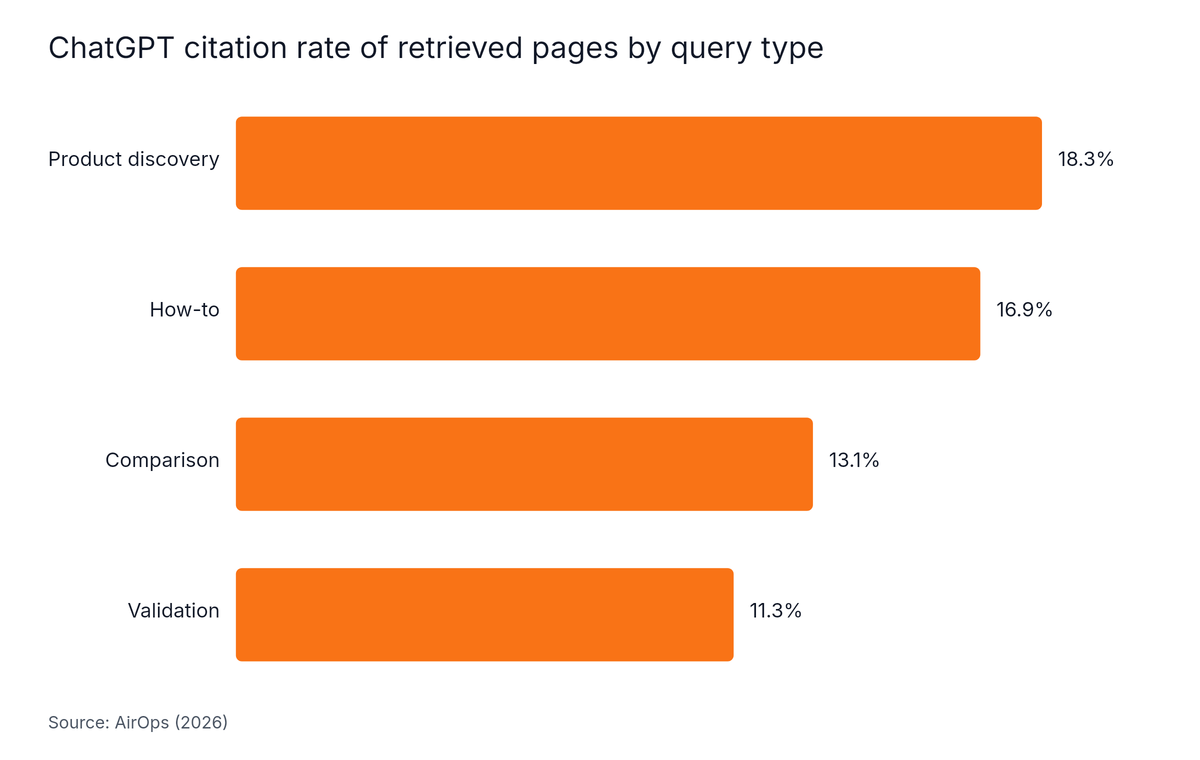
Source: AirOps, 2026
In the AirOps data, ChatGPT cited 18.3% of retrieved pages for product discovery queries, 16.9% for how-to, 13.1% for comparison and 11.3% for validation (AirOps, 2026).
Authority does not decide selection. AirOps found that very high-authority sites (DA 80 to 100) were retrieved most often yet cited at 15.0%, a lower rate than every other authority tier (AirOps, 2026). A narrowly focused page that matches a sub-query can beat a broad "ultimate guide". Third-party sources matter too: Ahrefs reports that 67.8% of ChatGPT-retrieved URLs that never get cited come from Reddit, so it appears to supply context, not attribution (Ahrefs, 2026).
Google AI Overviews and ChatGPT find pages through different systems, so one fix does not cover both. Google says its generative AI features sit on its core Search ranking systems and reports AI Overviews above 2.5 billion monthly users (Google, 2026). ChatGPT search depends on OpenAI's crawler, OAI-SearchBot, and its own retrieval, which is why top Google rankings carry over only partly.
| Platform | Where pages come from | Bot or control | Practical action |
|---|---|---|---|
| Google AI Overviews and AI Mode | Google Search index | Googlebot; a Search Console opt-out control is being tested | Keep pages indexable and strong in standard SEO |
| ChatGPT search | OpenAI's retrieval, with Bing referenced by practitioners | OAI-SearchBot (search), GPTBot (training) | Allow OAI-SearchBot on public paths |
| Perplexity | Its own retrieval | PerplexityBot | Allow on public marketing and docs paths |
| Claude | Anthropic's crawler | ClaudeBot | Decide by policy, rate-limit and log |
OAI-SearchBot is the OpenAI crawler that fetches pages for ChatGPT search results, separate from GPTBot, which collects training data. Blocking both with one rule is a common mistake. Cloudflare began blocking AI crawlers by default in July 2025, so a CDN or WAF setting can remove a site from retrieval without anyone in marketing noticing.
Google is also testing a Search Console control for opting out, and states: "Sites that opt out will not receive traffic or impressions from our generative AI features." (Google, 2026). Ownership of that decision should be explicit, not left to a default.
Getting a page cited in AI answers starts with matching the sub-queries a model actually searches. AirOps found that pages whose title overlaps at least 50% with the retrieving query were cited 20.1% of the time, against 9.3% for pages under 10% overlap, a 2.2x lift (AirOps, 2026). Narrow, query-matching pages beat broad guides, so edits focus on titles, headings and the first answer.
| Tactic | Evidence status | Guidance |
|---|---|---|
| Titles and headings that match sub-queries | 20.1% vs 9.3% citation rate (AirOps, 2026) | Do |
| Allow OAI-SearchBot on public paths | A page the crawler cannot fetch cannot be cited | Do |
| llms.txt | Google's May 2026 guidance lists it as unnecessary | Skip, or test and track as speculative |
| Content chunking and AI-only rewrites | Google's May 2026 guidance lists them as unnecessary | Skip |
| Special schema for AI features | Google's May 2026 guidance lists it as unnecessary | Skip as an AI tactic |
The table follows Google's May 2026 guidance for Google's features. Ranking in Google and being cited by ChatGPT remain separate outcomes, so claims about schema or file formats need their own tests.
A lost AI citation is diagnosed by running the Failure-Point Test on each page: can the machine read it, does it answer the exact question, and is the source trusted. Since ChatGPT cites only about 15% of retrieved pages (AirOps, 2026), the test uses a fixed prompt set and a frequency range, such as an illustrative 14 of 50 runs, rather than one check.
The Failure-Point Test is a three-part diagnostic that scores each page on machine readability, answer fit and source trust. A frequency range reports how often a source is cited across repeated runs of the same prompt set. The 14-of-50 figure is a hypothetical example, not a measured result.
Tooling helps with the repetition. A comparison of AI search visibility tools covers what trackers measure and where they fall short, and a GEO tools comparison covers crawler diagnostics and attribution.
SEO for LLMs is worth funding when the break-even arithmetic holds and AI surfaces are large enough to matter. Google reports AI Overviews above 2.5 billion monthly users (Google, 2026), and ChatGPT's share of worldwide website referrals rose from 0.23% to 0.32% between April and May 2026 (SE Ranking, 2026). Referral clicks are still small, so the case rests on influence as well.
The Revenue-at-Risk Model multiplies organic share of pipeline by the share of queries showing AI answers by click erosion. This guide's illustrative scenarios use erosion of 34.5% and 58%. At 30% organic share and 60% AI-exposed queries, 6.2% of total pipeline is at risk at 34.5% erosion and 10.4% at 58%. At 40% and 80%, the figures are 11.0% and 18.6%. These are illustrative, not forecasts.
Break-even deals equal spend divided by ACV times gross margin. The table uses a 75% margin and the monthly prices observed for these programs.
| Monthly spend | Six-month cost | Break-even deals at $30,000 ACV | Break-even deals at $100,000 ACV |
|---|---|---|---|
| $1,500 | $9,000 | 0.4 | 0.12 |
| $3,000 | $18,000 | 0.8 | 0.24 |
| $6,000 | $36,000 | 1.6 | 0.48 |
Our data: Salient by GrowthSpree, a managed service affiliated with aeogeo.com, reports 48,800 citations, $165,000+ pipeline and $70,000 media-equivalent across its clients (Salient pitch deck; launched September 2026). These are vendor-reported figures, not independent research.
The calculation is illustrative and not financial advice. Teams building the case can use the AEO ROI calculator guide.
AI visibility spans five functions: content, docs and pricing, crawl access, measurement and claims accuracy. Without one named owner, a mis-set crawler policy can leave visibility switched off for months. The citations that depend on third-party mentions sit partly outside the SEO team, which is why the owner is usually a VP Marketing, not a practitioner.
SEO for LLMs is not the right priority for teams that need guaranteed rankings, a fast payoff or proof from a single check. Citation studies are observational and citations churn: 107 of the 215 most-cited pages from October 2025 earned zero citations by September 2026 in one small agency study (Greenflag Digital, 2026), so treat it as directional. Teams with blocked crawlers or thin sites should fix those first.
ChatGPT cites competitors with weaker Google rankings because citation is a separate selection step after retrieval. Cited pages match ChatGPT's own fan-out sub-queries through their titles and URLs, and AirOps found very high-authority sites (DA 80 to 100) were cited at 15.0% in 2026 (AirOps, 2026), lower than every other authority tier. A page ranking for the head term can lose to a narrower page that matches a sub-query.
SEO for LLMs overlaps heavily with traditional SEO but adds a citation step. Google says its generative AI features are rooted in core Search ranking and quality systems, so crawlability, quality and authority still matter. The additions are matching fan-out sub-queries, allowing the right AI crawlers, earning third-party mentions and measuring citation frequency across repeated runs instead of rankings.
No, Google AI Overviews do not only cite top-10 pages. Ahrefs found only 37.9% of cited URLs appeared in the first 10 results in its March 2026 update, compared with 76.10% in its July 2025 study that used an earlier parser, so the figures are not like-for-like. A top-10 ranking helps but is not required.
Allowing OAI-SearchBot on public paths is the recommended policy for appearing in ChatGPT search, because a page the crawler cannot fetch cannot be cited. OAI-SearchBot is separate from GPTBot, OpenAI's training crawler, so a site can allow search retrieval while deciding on training separately. Cloudflare began blocking AI crawlers by default in July 2025, so CDN rules need checking too.
No, Google's May 2026 guidance lists llms.txt, content chunking, AI-only rewrites and special schema as unnecessary for its generative AI features. Llms.txt is treated here as speculative, with no study in this guide showing a citation lift. Evidence supports titles and headings that match sub-queries, a direct answer near the top and open crawler access instead.
Track citations by running a fixed prompt set repeatedly and reporting a frequency range, such as cited in 14 of 50 runs (an illustrative example). A single check misleads because citations churn: 107 of the 215 most-cited pages from October 2025 earned zero citations by September 2026 in one small agency study. Log sources and sub-queries, and tag chatgpt.com and perplexity.ai in GA4.
A top-three ranking gets a page into the retrieval pool. It does not win the citation. The evidence in this guide points to five takeaways:
For the next step, run the seven-step diagnosis on 10 queries where the site ranks in the top three, then compare options in the GEO tools comparison. Get the weekly brief for dated platform changes and what each means for a revenue team.
Written by
Ishan Manchanda
Ishan Manchanda is co-founder of GrowthSpree, a B2B SaaS marketing consultancy founded in 2017 that has managed $60M+ in ad spend across 300+ B2B SaaS companies. He focuses on demand generation, go-to-market strategy and pipeline growth, and has been featured in Silicon Valley Times, SaaS Mag and the Unbounce podcast.